
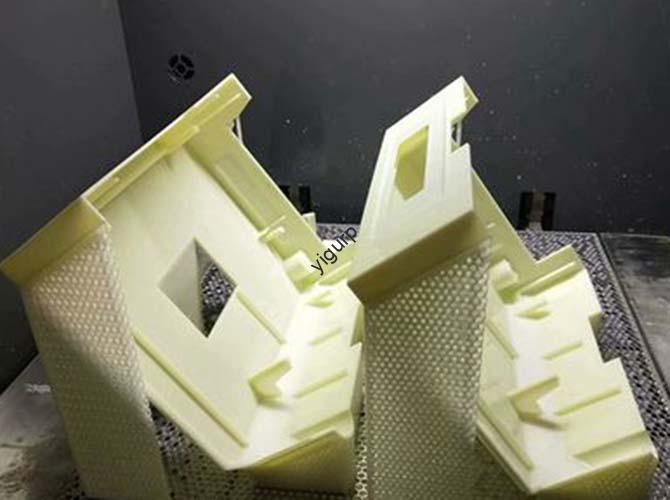
In the world of fabrication de précision, creating high-quality Teflon prototype parts demands a perfect match between material characteristics and advanced machining technology. Parmi les différentes méthodes disponibles, CNC Swiss machining stands out for its ability to deliver exceptional accuracy and consistency—even when working with challenging materials like Polytétrafluoroéthylène (PTFE). Cet article détaille l'ensemble du processus, from understanding Teflon’s unique properties to implementing strict quality control, helping you overcome common hurdles and produce top-tier Teflon prototypes.
1. Understanding Teflon (PTFE): Key Material Properties for Machining
Before diving into the machining process, it’s critical to grasp how Teflon’s properties influence every step. Contrairement aux métaux, PTFE has distinct traits that require specialized handling—ignore them, and you risk flawed prototypes, matériel gaspillé, or damaged equipment.
| Propriété matérielle | Description | Impact on Machining |
| Résistance chimique | Resistant to almost all acids, socles, et solvants | Eliminates corrosion risks but limits coolant options (must use compatible, non-reactive fluids) |
| Stabilité thermique | Maintains properties between -200°C and 260°C (-328°F to 500°F) | Reduces thermal deformation during machining but requires tools that avoid excessive friction (which can cause local overheating) |
| Usinabilité | Doux, ductile, and prone to “gumming” or melting under pressure | Demands sharp, low-friction cutting tools and optimized cutting parameters to prevent material buildup |
| Faible coefficient de friction | One of the lowest friction coefficients of any solid material | Increases risk of part slippage during clamping—requires specialized workholding solutions |
A common question here is: Why is Teflon harder to machine than metals? The answer lies in its softness and ductility. While metals chip cleanly during cutting, Teflon tends to stretch or melt, making it difficult to achieve tight tolerances without tailored strategies.
2. Swiss Machine Technology: Why It’s Ideal for Teflon Prototypes
Swiss machine (ou Swiss-type lathe) technology is designed for precision—making it the perfect choice for Teflon prototypes that require tight dimensional control. Let’s break down the core features that make it a game-changer:
- Automatic Bar Feeding: Feeds long lengths of Teflon bar stock continuously, reducing manual intervention and ensuring consistent part-to-part accuracy. This is critical for prototypes, where small variations can render parts unusable.
- Outillage en direct: Intègre des outils rotatifs (par ex., exercices, moulins) directly into the lathe, allowing for complex operations (par ex., trous, machines à sous) in a single setup. For Teflon prototypes with intricate designs, this eliminates the need for multiple machines—reducing error and saving time.
- Guide Bushing System: Supports the bar stock close to the cutting area, minimizing deflection. Since Teflon is soft, deflection is a major risk; the guide bushing keeps the material stable, ensuring precise cuts.
- High-Speed CNC Controls: Enables precise adjustment of cutting parameters (par ex., vitesse de broche, vitesse d'avance) in real time—essential for adapting to Teflon’s unique machinability.
En bref, Swiss-type lathe technology addresses Teflon’s biggest machining challenges: slippage, deflection, and inconsistent cuts. No other machining method combines stability and precision quite like it.
3. Step-by-Step Machining Process for Teflon Prototype Parts
Creating Teflon prototypes with a Swiss machine follows a linear, step-by-step process—each stage builds on the last to ensure quality. Vous trouverez ci-dessous une répartition détaillée, with a focus on solving common pain points:
Étape 1: Part Design & Préparation
Start with a clear part design (using CAD software like SolidWorks or AutoCAD) that accounts for Teflon’s properties. Key considerations:
- Avoid sharp internal corners (Teflon can crack under stress here).
- Specify realistic tolerances (aim for ±0.01mm for most prototypes—tighter tolerances may be possible but increase cost).
- Include details for workholding (par ex., extra material for clamping to prevent slippage).
Étape 2: Sélection d'outils
Choisir le bon outils de coupe is make-or-break for Teflon machining. Contrairement aux métaux, Teflon requires tools that minimize friction and prevent melting:
| Tool Type | Recommended Material | Avantage clé |
| Outils de tournage | Carbure (coated with diamond or TiAlN) | Faible frottement; résiste à l'usure |
| Outils de fraisage | Solid carbide (4-flute) | Prevents material “gumming” |
| Forets | Carbure (with polished flutes) | Reduces chip buildup |
Pro Tip: Avoid high-speed steel (HSS) tools—they generate too much friction, leading to Teflon melting and tool wear.
Étape 3: Setting Cutting Parameters
Optimizing cutting parameters (vitesse de broche, vitesse d'avance, depth of cut) is critical to achieving smooth état de surface et des tolérances serrées. Below are recommended starting points for Teflon (adjust based on part complexity):
| Paramètre | Recommendation | Rationale |
| Vitesse de broche | 3,000–6,000 RPM | High speed reduces time in cut (minimizing heat buildup) |
| Vitesse d'alimentation | 0.05–0.15 mm/rev | Slow feed prevents material stretching; fast enough to avoid gumming |
| Depth of Cut | 0.1–0,5mm | Shallow cuts reduce deflection; deeper cuts risk tool chatter |
Étape 4: Exécution de l'usinage
Load the Teflon bar stock into the Swiss machine’s automatic bar feeder, secure it with a specialized workholding (par ex., a soft-jaw chuck to avoid damaging the material), and start the CNC program. Monitor the first few parts closely to:
- Check for material buildup on tools (clean tools if needed).
- Verify dimensional accuracy (use calipers or micrometers).
- Ensure surface finish is smooth (no melting or burring).
4. Ensuring Quality: Contrôle & Inspection for Teflon Prototypes
Pour Teflon prototypes, quality control isn’t just a final step—it’s integrated throughout the process. The goal is to catch issues early and ensure parts meet précision dimensionnelle et contrôle de tolérance exigences.
Key Inspection Methods
- Contrôle dimensionnel: Use tools like:
- Pieds à coulisse numériques (for quick measurements of length/diameter).
- Machines à mesurer tridimensionnelles (MMT) (for complex geometries—ensures accuracy within ±0.005mm).
- Surface Roughness Testing: Use a profilometer to measure surface roughness (Râ). Teflon prototypes typically require Ra values between 0.8–3.2 μm (smoother for parts requiring low friction).
- Non-Destructive Testing (CND): For critical prototypes (par ex., those used in medical or aerospace), use ultrasonic testing to detect internal defects (par ex., fissures) without damaging the part.
Quality Control Checklist
- Part dimensions match CAD design (tolerance ±0.01mm).
- Surface finish is smooth (no melting, burring, or scratches).
- No internal defects (verified via NDT if required).
- Part functions as intended (par ex., s'adapte à d'autres composants).
5. Yigu Technology’s Perspective on Teflon Prototype Machining
Chez Yigu Technologie, we’ve refined CNC Swiss machining for Teflon prototypes by focusing on material-machine synergy. Teflon’s low rigidity demands not just sharp tools but adaptive CNC programs—our engineers tweak feed rates in real time to avoid gumming, using diamond-coated carbide tools for consistent finishes. Pour les prototypes, we prioritize rapid iteration: our Swiss machines with live tooling cut lead times by 30% contre. méthodes traditionnelles, while our CMM-driven inspection ensures each part meets tolerances. The biggest lesson? Success lies in respecting Teflon’s uniqueness—don’t treat it like metal, and you’ll unlock its full potential.
FAQ
1. Can Swiss machines produce Teflon prototypes with tolerances tighter than ±0.01mm?
Oui, but it depends on part complexity. For simple geometries (par ex., small shafts), tolerances as tight as ±0.005mm are possible with advanced Swiss machines and specialized tooling. Pour pièces complexes (par ex., with multiple holes), ±0.01mm is more realistic to avoid deflection.
2. What’s the biggest mistake to avoid when machining Teflon prototypes with a Swiss machine?
Using the wrong cutting tools. Many manufacturers use HSS tools (commun pour les métaux), but they generate too much friction—causing Teflon to melt and gum up the tool. Always use diamond or TiAlN-coated carbide tools.
3. How long does it take to produce a Teflon prototype with a Swiss machine?
Pour les pièces simples (par ex., a 20mm-long pin), lead time is 1–2 days (y compris la conception, installation, et usinage). Pour pièces complexes (par ex., with multiple slots and holes), lead time is 3–5 days—thanks to live tooling that eliminates multiple setups.