
Si vous vous êtes déjà demandé comment les pièces métalliques, composants en plastique, ou même des pièces aérospatiales complexes sont fabriquées, vous êtes probablement curieux de connaître l'usinage. L'usinage est l'épine dorsale de la fabrication, but with so many machining types disponible, c'est facile de se sentir dépassé. Que vous soyez un amateur souhaitant démarrer un petit atelier, un étudiant en fabrication étudiant pour des examens, or a professional needing to choose the right process for a project, this guide will break down every key machining category—with real-world examples, practical tips, and clear comparisons to help you make informed decisions.
1. Conventional Machining Processes: The Foundation of Manufacturing
Conventional machining is the oldest and most widely used set of techniques, relying on physical contact between a outil de coupe and the workpiece to remove material (appelé chip formation). These processes are ideal for simple to moderately complex parts and are often more cost-effective for low-to-medium volume production. Let’s break down the most common methods:
Key Conventional Machining Techniques
- Tournant: Done on a tour, turning spins the workpiece while a single-point cutting tool shapes it. It’s perfect for cylindrical parts like bolts, arbres, or pipes. Real-world example: A local automotive shop uses a lathe to repair worn-out crankshafts—by spinning the crankshaft and removing a thin layer of metal, they restore its original diameter and smoothness.
- Fraisage: Using a moulin, this process rotates a multi-point cutting tool (like an end mill) against a stationary workpiece. It’s used for flat surfaces, machines à sous, or 3D shapes. Industry fact: Sur 60% of small-scale machine shops rely on vertical mills for prototyping parts, according to the Manufacturing Technology Association (MTA).
- Forage: The simplest conventional process, drilling creates holes using a rotating drill bit. It’s used in everything from woodworking to metal fabrication. Pro tip: Pour trous profonds (more than 3x the hole diameter), use a “peck drilling” technique—pausing to retract the bit periodically—to clear chips and prevent overheating.
- Affûtage: Often used as a finishing step, grinding uses an abrasive wheel to smooth surfaces or achieve tight tolerances. It’s critical for parts like bearing races, where surface finish directly impacts performance.
- Other Techniques: Sawing (for cutting large pieces into smaller ones), façonner (for flat surfaces on small workpieces), planing (for large flat surfaces like machine beds), et aborder (for precision holes or slots with complex shapes, comme des clés).
When to Choose Conventional Machining
Conventional processes shine when:
- You’re working with common materials (aluminium, acier, laiton).
- Production volumes are low to medium (1–1 000 pièces).
- Cost is a primary concern (conventional machines are often cheaper to purchase and maintain than advanced alternatives).
2. Non-Traditional Machining (NTM): Beyond Cutting Tools
Non-Traditional Machining (NTM) processes don’t rely on physical cutting tools—instead, they use energy (electricity, lasers, eau, ou des produits chimiques) pour enlever du matériel. These methods are essential for hard-to-machine materials (like titanium or ceramics) or intricate parts where conventional tools would cause damage.
Common NTM Techniques & Leurs utilisations
| Machining Type | Comment ça marche | Applications idéales | Avantage clé |
| GED (Usinage par électroérosion) | Uses electrical sparks to melt/erode material | Intricate molds, meurt, or parts with tiny holes | No physical contact—avoids distorting fragile parts |
| ECM (Electrochemical Machining) | Uses chemical reactions to dissolve material | Grand, pièces complexes (par ex., pales de turbine) | No heat or tool wear—ideal for high-tolerance parts |
| Découpe Laser | Uses a high-powered laser to vaporize material | Thin metal sheets, signalisation, or precision components | Extremely fast for thin materials; un minimum de déchets |
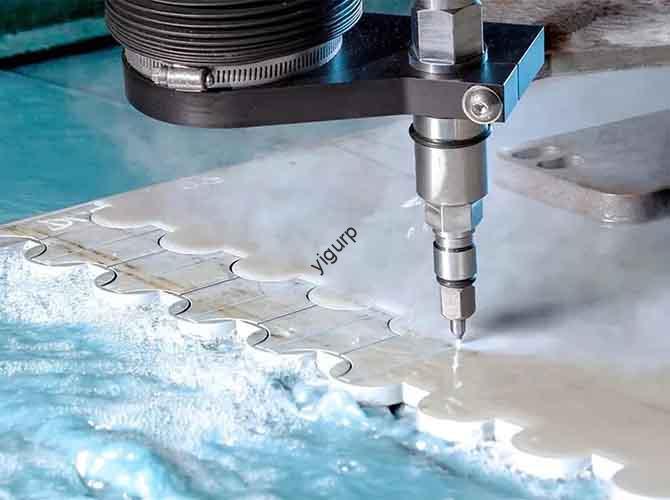
| Waterjet Cutting | Uses high-pressure water (plus abrasives) | Thick materials (bois, pierre, métal) or heat-sensitive parts (plastiques) | No heat-affected zone (ZAT) |
| Ultrasonic Machining | Uses high-frequency vibrations + abrasives | Matériaux durs (verre, céramique) or brittle parts | Gentle process—prevents cracking |
Real-world case study: A medical device manufacturer uses ECM to produce titanium hip implants. Titanium is strong but difficult to machine with conventional tools, and ECM creates smooth, precise surfaces that reduce friction in the body—critical for implant longevity.
Key Fact About NTM
According to the American Society of Mechanical Engineers (ASME), the global NTM market is expected to grow by 8.2% annually through 2030—driven by demand from aerospace, médical, and electronics industries for smaller, more complex parts.
3. Abrasive Machining Processes: Precision Finishing for Quality Surfaces
Abrasive machining focuses on improving état de surface et précision dimensionnelle—it’s often the final step in manufacturing to ensure parts meet strict standards. Contrairement à l'usinage conventionnel (which removes large amounts of material), abrasive processes remove tiny amounts (sometimes just microns) to refine surfaces.
Popular Abrasive Techniques
- Honing: Uses a rotating abrasive stone to smooth the inside of holes (par ex., cylindres de moteur). Industry example: Automotive manufacturers use honing to create crosshatched patterns in cylinder walls—these patterns hold oil, reducing friction between the piston and cylinder.
- Clapotis: A slow, precise process that uses a flat lap (a plate) and abrasive paste to create ultra-flat surfaces. It’s used for optical lenses, plaquettes semi-conductrices, or precision bearings. Fun fact: Lapping can achieve surface finishes as smooth as 0.025 microns—thinner than a human hair (which is ~50 microns).
- Polissage & Polissage: Polishing uses fine abrasives to remove scratches, while buffing uses soft cloth wheels to create a shiny finish. These are common in consumer goods (par ex., stainless steel appliances) ou pièces décoratives.
- Superfinishing: Even more precise than honing, superfinishing uses a small abrasive stone to remove microscopic irregularities. It’s critical for parts like gears or camshafts, where smoothness reduces wear and noise.
Why Abrasive Machining Matters
Poor surface finish can lead to premature part failure—for example, a rough bearing race will wear out 3x faster than a smooth one, according to the Society of Manufacturing Engineers (PME). Abrasive processes ensure parts not only look good but perform reliably.
4. CNC & Usinage automatisé: The Future of Precision
CNC (Commande numérique par ordinateur) machining uses computers to control machine tools, replacing manual operation. It’s revolutionized manufacturing by increasing speed, précision, and consistency—especially for high-volume or complex parts.
Key CNC & Automated Tools
- Fraisage CNC: A computer-controlled mill that can create 3D shapes, machines à sous, and holes. It’s used in industries from aerospace (par ex., supports d'avion) to electronics (par ex., coques de smartphone). Real-world example: A drone manufacturer uses a 5-axis CNC mill to produce lightweight aluminum frames—5-axis machines can move the workpiece in 5 directions, allowing for complex shapes that 3-axis mills can’t achieve.
- Tournage CNC: Similar to manual turning but computer-controlled, CNC turning is used for high-volume cylindrical parts (par ex., boulons, attaches). Efficiency stat: CNC turning centers can produce parts 2–3x faster than manual lathes, with error rates below 0.1%, according to CNC Machine World.
- Centres d'usinage: All-in-one machines that combine milling, forage, et en tapant. They often include pallet changers (to swap workpieces automatically) et robotic loading (to load/unload parts without human help).
- Swiss-Type Lathes: Designed for small, parties longues (par ex., aiguilles médicales, composants de montre). They hold the workpiece with a guide bushing, reducing vibration and enabling ultra-precise cuts.
- CAD/CAM Integration: GOUJAT (Conception Assistée par Ordinateur) software creates 3D models of parts, while CAM (Fabrication assistée par ordinateur) software converts these models into machine-readable code. This seamless workflow eliminates manual programming errors.
Benefits of CNC Machining
- Précision: CNC machines can achieve tolerances as tight as ±0.0001 inches—critical for aerospace or medical parts.
- Cohérence: Chaque pièce est identique, even in high-volume production (10,000+ parties).
- Flexibilité: Changing a part design only requires updating the CAD/CAM program—no need to retool the machine.
5. Cutting Tool-Based Processes: Mastering the Tools That Shape Materials
Cutting tool-based processes are a subset of machining that focuses on how tools interact with workpieces. The right tool and technique can mean the difference between a high-quality part and a wasted workpiece.
Key Cutting Tool Techniques
- Single-Point Cutting: Uses a tool with one cutting edge (par ex., outils de tournage). It’s simple but slower than multi-point cutting. Pro tip: For single-point tools, use a “positive rake angle” (the tool edge slopes upward) to reduce cutting force—ideal for soft materials like aluminum.
- Multi-Point Cutting: Uses tools with multiple cutting edges (par ex., fraises en bout, forets). It’s faster and more efficient for high-volume production.
- End Milling vs. Fraisage du visage: End milling cuts along the side of the tool (for slots or 3D shapes), while face milling cuts along the top (pour surfaces planes). Industry best practice: Use face milling for large flat surfaces—it covers more area per pass than end milling.
- Ennuyeux, Tapotement, & Threading: Boring enlarges existing holes (pour la précision), tapping creates internal threads (par ex., trous de boulons), and threading creates external threads (par ex., boulons). Critical note: For tapping, always use cutting fluid to cool the tool and prevent thread damage—this can extend tool life by up to 50%, per the Tooling & Manufacturing Association (TMA).
- Toolpath & Feeds/Speeds: UN toolpath is the path the cutting tool takes around the workpiece—optimizing it reduces cycle time. Feeds and speeds (how fast the tool moves and rotates) depend on the material: pour l'acier, use slower speeds than aluminum to avoid overheating.
Yigu Technology’s Perspective on Machining Types
Chez Yigu Technologie, we believe the right machining type depends on balancing three factors: part requirements, matériel, et volume de production. Conventional machining still adds value for low-volume, simple parts—no need to invest in CNC for 10 supports personnalisés. For complex, high-tolerance parts (like medical implants), NTM or CNC is non-negotiable. We also see a growing trend: combining processes (par ex., Fraisage CNC + abrasive superfinishing) to get the best of both speed and precision. Finalement, the goal isn’t to “choose the best” machining type—it’s to choose the one that meets your needs without unnecessary cost.
FAQ About Machining Types
1. What’s the difference between conventional and non-traditional machining?
Conventional machining uses physical cutting tools to remove material (par ex., tournant, fraisage), while non-traditional machining uses energy (par ex., lasers, electricity) with no tool-workpiece contact. Conventional is cheaper for simple parts; NTM is better for hard materials or intricate designs.
2. When should I use CNC machining instead of manual machining?
Use CNC if: you need high precision (tolérances < ±0,001 pouces), volume de production élevé (100+ parties), or complex shapes (3D designs). Use manual machining for small batches (1–10 pièces) or simple tasks (par ex., drilling a few holes).
3. Which abrasive process is best for improving surface finish?
It depends on the part: Honing for internal holes, lapping for ultra-flat surfaces, superfinishing for microscopic precision, and polishing/buffing for shine. Par exemple, use lapping for optical lenses and superfinishing for gears.
4. Is NTM more expensive than conventional machining?
Oui, upfront—NTM machines (par ex., laser cutters) cost more than manual lathes. But for hard materials (par ex., titane) ou pièces complexes, NTM saves money long-term by reducing tool wear and rework.
5. What’s the most common machining type for small-scale workshops?
Conventional machining (manual lathes, vertical mills) is most common—they’re affordable, easy to learn, and handle most hobbyist or small-batch projects (par ex., custom bolts, simple brackets).