
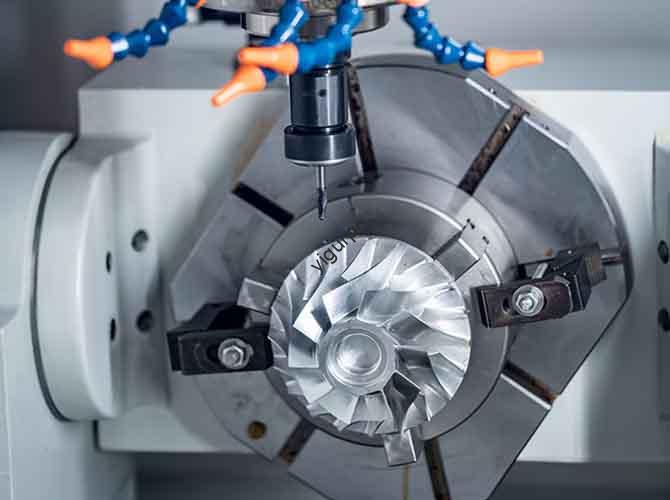
When choosing a manufacturing method for parts—whether for small-batch prototypes or large-scale production—understanding the gap between usinage traditionnel et Usinage CNC est critique. Cet article détaille leurs principales différences en matière de contrôle, précision, flexibilité, et applications, vous aider à choisir la bonne méthode pour votre projet.
1. Comparaison en un coup d'œil: Usinage vs. Usinage CNC
To quickly grasp the biggest contrasts, start with this side-by-side table. It highlights 5 key dimensions that directly impact production efficiency and part quality.
| Dimension de comparaison | Usinage traditionnel | Usinage CNC |
| Control Method | Fonctionnement manuel (relies on worker skills/experience) | Computer numerical control (program-driven automation) |
| Processing Precision | Faible à moyen (±0.1–0.5mm tolerance); incompatible | High to ultra-high (±0.001–0.05mm tolerance); highly consistent |
| Efficacité de production | Lent (single-part focus; prone to worker fatigue) | Rapide (24/7 opération; multi-axis simultaneous cutting) |
| Flexibilité | Faible (long setup time for tool/fixture changes) | Haut (quick switch via program updates; no major tooling changes) |
| Skill Requirements | Haut (needs master workers for complex parts) | Moyen (programmers/operators need CAD/CAM skills) |
2. Deep Dive Into Core Differences
Below is a detailed breakdown of each key difference, using a “definition + real-world example” structure to link technical traits to practical use cases.
2.1 Control Method: Manual Skill vs. Programmed Automation
The biggest divide between the two methods lies in how they control machine tools:
- Usinage traditionnel: Every step depends on human input. A worker uses handwheels, leviers, or pedals to adjust tools (par ex., fraises, lathe blades) and machine parameters (vitesse de coupe, vitesse d'avance) en temps réel. Par exemple, when drilling a hole in a metal block, the worker must visually align the drill bit with the marked position and manually adjust the drill’s depth—relying entirely on their experience to avoid errors.
- Usinage CNC: Control is fully automated via code. A programmer first uses Logiciel de CAO to design the part, then converts the design into machine-readable instructions with Logiciel de FAO (par ex., Code G). This program is uploaded to the CNC machine, which automatically adjusts tool paths, vitesses, and feeds. For the same metal block drilling task, the CNC machine follows the program to drill the hole to exact depth (par ex., 10mm) and position (par ex., 20mm from the edge)—no manual intervention needed.
Pourquoi c'est important: CNC’s automation eliminates human error (par ex., shaky hands, fatigue) that plagues traditional machining.
2.2 Précision & Cohérence: Inconsistent vs. Uniform Results
Precision directly affects whether parts fit or function—and here, CNC machining dominates:
- Usinage traditionnel: Tolérances (allowed size deviation) typically range from ±0.1mm to ±0.5mm. Par exemple, if you make 10 identical gear parts manually, each gear’s tooth spacing might vary slightly because the worker can’t replicate exact hand movements every time. This inconsistency is a dealbreaker for parts that need tight fits (par ex., composants du moteur).
- Usinage CNC: Tolerances drop to ±0.001mm (for high-end machines)—thin enough to match the width of a human hair. Once the program is set, every part (même 1,000+ unités) will have identical dimensions. Par exemple, CNC-machined smartphone screws all have the same thread pitch and length, ensuring they fit perfectly into every device.
Pourquoi c'est important: Industries like aerospace or medical devices (par ex., outils chirurgicaux) require ultra-consistent parts—CNC is the only reliable choice here.
2.3 Efficacité de production: Slow Batch Work vs. 24/7 Automation
Efficiency is make-or-break for large-scale projects:
- Usinage traditionnel: It’s slow for volume production. A worker can only focus on one part at a time, et la fatigue (par ex., après 8 hours of lathe work) slows down speed and raises error rates. Par exemple, fabrication 50 aluminum brackets manually might take 2 days—with some brackets needing rework due to mistakes.
- Usinage CNC: It’s built for speed. Les machines CNC fonctionnent 24/7 (avec un minimum de supervision) et utiliser liaison multi-axes (par ex., 5-machines à axes) to cut multiple part features at once. The same 50 aluminum brackets could be finished in 4 hours with CNC—no rework needed.
Pourquoi c'est important: Pour la production de masse (par ex., car parts, électronique grand public), CNC slashes lead times and labor costs.
2.4 Flexibilité: Rigid Setup vs. Quick Program Switches
How easily can you switch from making one part to another?
- Usinage traditionnel: Changing parts means reconfiguring everything. Par exemple, if you first make a metal plate and then switch to a plastic housing, you need to replace fixtures (pinces, jigs), adjust tool heights, and retrain workers—taking 4–8 hours of setup time.
- Usinage CNC: Switching parts takes minutes, not hours. To make the same metal plate-to-plastic housing change, you just upload a new CNC program (created in advance) to the machine. No fixture changes or worker retraining are needed—production restarts in 15–30 minutes.
Pourquoi c'est important: For product development (par ex., essai 3 different prototype designs), CNC cuts time-to-market drastically.
3. Application Fields: Which Method Fits Your Industry?
Each method shines in specific scenarios. Below is a breakdown of their most common uses:
| Méthode | Key Application Scenarios |
| Usinage traditionnel | – Production en petits lots (1–10 pièces, par ex., custom tooling for a workshop)- Pièces simples (par ex., handcrafted metal brackets)- Special processes (par ex., manual engraving, fitter work for repairs)- Cost-sensitive small factories (low equipment upfront cost) |
| Usinage CNC | – Industries de haute précision (aérospatial: pales de turbine; médical: pièces d'implants)- Production de masse (automobile: engine pistons; électronique: boîtiers de circuits imprimés)- Pièces complexes (par ex., 3D curved surfaces on smartphone frames)- 24/7 production lines (needs consistent output) |
4. Yigu Technology’s View on Machining vs. Usinage CNC
Chez Yigu Technologie, we don’t see traditional machining and CNC as rivals—they’re complementary. Pour les petits volumes, pièces simples (par ex., a one-off repair bracket), traditional machining saves cost; pour la haute précision, large-scale projects (par ex., composants de dispositifs médicaux), CNC is non-negotiable. We often advise clients to combine both: use CNC for core part production and traditional machining for final tweaks (par ex., manual polishing). As automation advances, we’re also integrating AI into CNC programming to further reduce setup time—making precision manufacturing even more accessible.
5. FAQ: Common Questions About Machining vs. Usinage CNC
T1: Is CNC machining always more expensive than traditional machining?
Pas nécessairement. Pour les petits lots (1–5 parts), traditional machining is cheaper (no programming or CNC setup costs). But for batches of 10+ parties, CNC becomes more cost-effective—its speed and low error rate offset upfront program costs.
T2: Can traditional machining make complex parts (par ex., 5-axis curved surfaces)?
Rarement. Complex parts require precise, simultaneous movement of multiple axes—something human hands can’t replicate consistently. Traditional machining might make a basic version, but it will have poor precision and take far longer than CNC.
T3: Do CNC machines need no human oversight at all?
Non. While CNC runs automatically, workers still need to: 1) Load/unload raw materials; 2) Monitor for tool wear (par ex., replacing a dull cutter); 3) Troubleshoot program errors. Full “lights-out” operation needs advanced robotics (par ex., automated part loaders), which adds cost.