
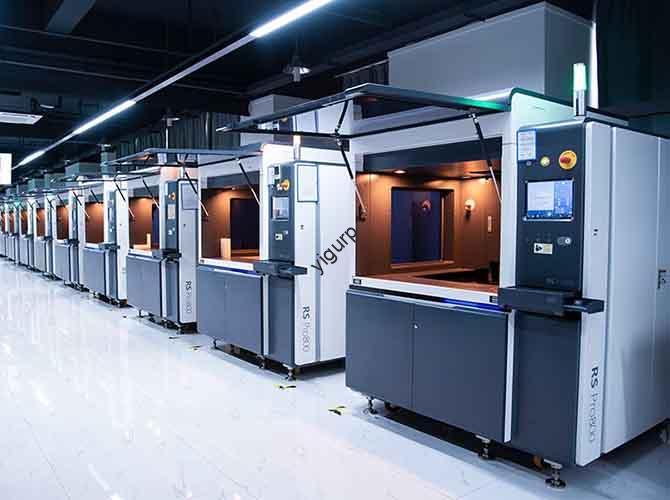
Si vous envisagez d'utiliser l'impression 3D en aluminium pour des pièces, que ce soit pour le prototypage, composants automobiles, ou des boîtiers électroniques : comprendre comment calculer le prix est crucial pour respecter le budget. Le coût de l’impression 3D sur aluminium n’est pas un chiffre unique; cela dépend de l'utilisation du matériau, type de technologie, complexité de la pièce, et plus. This guide breaks down the key cost drivers, step-by-step calculation methods, and practical tips to optimize expenses.
1. 7 Key Factors That Impact the Price of Aluminum 3D Printing
Before calculating the price, you first need to identify the factors that shape it. Each element directly adds to the total cost, and knowing them helps you avoid overestimates or hidden fees. Below is a detailed breakdown with real numbers:
(1) Aluminum Material Cost
Material cost is the foundation of the price and is calculated by weight or volume. Different grades of aluminum powder (the raw material for 3D printing) have varying prices, and material utilization (how much of the powder becomes the final part) also matters.
| Aluminum Grade | Powder Price (RMB/gramme) | Cas d'utilisation courants | Material Utilization Rate |
| AlSi10Mg | 0.5 ~ 2 | Pièces automobiles, lightweight enclosures | 70 ~ 90% |
| Al6061 | 1 ~ 3 | Composants structurels, electronic parts | 65 ~ 85% |
Note: Print failures or scrap material (from support structures or unused powder) reduce utilization, which means you’ll pay for more powder than ends up in the final part. Par exemple, if a part weighs 100 grams and utilization is 80%, you’ll need 125 grams of powder—adding 25% to the material cost.
(2) 3D Printing Technology Type
Different aluminum 3D printing technologies have varying equipment, travail, and maintenance costs. The most common options include SSM (Selective Sintering of Metals), SLS (Frittage sélectif au laser), et DMLS (Frittage laser direct des métaux).
| Type de technologie | Hourly Cost (RMB/hour) | Niveau de précision | Idéal pour |
| SSM | 80 ~ 150 | Moyen | Faible coût, pièces simples (par ex., spacers) |
| SLS | 120 ~ 200 | Haut | Pièces détaillées (par ex., small electronic components) |
| DMLS | 180 ~ 300 | Ultra-High | Pièces de haute précision (par ex., composants aérospatiaux) |
(3) Part Volume & Poids
Most service providers charge based on the part’s weight (par gramme) or volume (per cubic centimeter). This is a direct cost that’s easy to calculate once you know the part’s dimensions.
- Per-gram pricing: The average range is 0.5 ~ 5 RMB/gramme, depending on complexity and precision.
- Per-cubic-centimeter pricing: Some providers use this, with rates of 10 ~ 50 RMB/cm³.
Exemple: A 50-gram AlSi10Mg part (simple structure) would cost 25 ~ 100 RMB just for material (0.5 ~ 2 RMB/gram × 50 grams).
(4) Processing Time
Processing time includes the time the 3D printer spends building the part, and it’s tied to the technology type and part complexity. Complex parts with thin walls or internal hollows take longer to print, increasing the time-based cost.
| Part Complexity | Printing Time (for a 100-gram part) | Additional Time for Supports |
| Simple (block) | 2 ~ 4 heures | 0.5 ~ 1 heure |
| Moyen (surfaces courbes) | 4 ~ 8 heures | 1 ~ 2 heures |
| Complexe (parois minces <2mm) | 8 ~ 15 heures | 2 ~ 4 heures |
(5) Post-Processing Cost
Aluminum 3D printed parts rarely come “ready-to-use.” Post-processing steps like support removal, affûtage, polissage, traitement thermique, or anodizing add to the price—and some steps can increase costs by over 50%.
| Post-Processing Step | Coût (RMB/part) | But |
| Suppression du support | 20 ~ 100 | Remove excess material used to hold the part during printing |
| Grinding/Polishing | 50 ~ 200 | Improve surface smoothness (reduce roughness) |
| Anodisation | 80 ~ 300 | Add corrosion resistance and color |
| Traitement thermique | 100 ~ 400 | Strengthen the part (par ex., for structural use) |
(6) Part Complexity & Précision
Géométries complexes (like internal channels or thin walls) et des tolérances serrées (par ex., ±0,1mm) require slower printing speeds, more support structures, and stricter quality checks—all of which raise the price.
- Low precision (±0,5 mm): Adds 0 ~ 10% to the base cost.
- Medium precision (±0.1 ~ 0.3mm): Adds 10 ~ 30% to the base cost.
- Haute précision (±0.01 ~ 0.05mm): Adds 30 ~ 60% to the base cost.
Exemple: A 100-gram AlSi10Mg part with high precision costs 30 ~ 60% more than the same part with low precision—raising the price from 50 ~ 100 RMB to 65 ~ 160 RMB.
(7) Order Volume
Bulk printing unlocks volume discounts, as fixed costs (like equipment setup or programming) are spread across more parts. The more parts you order, the lower the per-unit price.
| Order Volume | Per-Unit Price Discount (contre. 1–10 Parts) | Exemple: 100-gram Simple Part (Original Price: 100 RMB) |
| 1–10 pieces | 0% | 100 RMB/piece |
| 11–50 pieces | 10 ~ 20% | 80 ~ 90 RMB/piece |
| 51–100 pieces | 20 ~ 30% | 70 ~ 80 RMB/piece |
| 100+ pièces | 30 ~ 40% | 60 ~ 70 RMB/piece |
2. 4 Step-by-Step Methods to Calculate the Price of Aluminum 3D Printing
Once you know the key factors, you can use these common methods to calculate the total price. Each works best for different scenarios (par ex., simple vs. pièces complexes).
Method 1: Material Weight-Based Calculation (Le plus courant)
This method uses the part’s weight and material price, plus adjustments for utilization.
Formula: Total Price = (Part Weight ÷ Material Utilization Rate) × Material Unit Price
Exemple:
- Part weight: 80 grams
- Material grade: AlSi10Mg (1 RMB/gramme)
- Material utilization rate: 80%
Total Price (Material Only) = (80 ÷ 0.8) × 1 = 100 × 1 = 100 RMB
Add post-processing: If you need anodizing (100 RMB), total price becomes 100 + 100 = 200 RMB.
Method 2: Processing Time-Based Calculation
This method focuses on the time the printer spends building the part, plus material cost.
Formula: Total Price = (Printing Time × Technology Hourly Cost) + Coût du matériel
Exemple:
- Printing time: 5 heures
- Technologie: SLS (150 RMB/hour)
- Material cost: 80 RMB (from Method 1)
Total Price = (5 × 150) + 80 = 750 + 80 = 830 RMB
Method 3: Mixed Calculation (Matériel + Temps + Post-traitement)
This is the most accurate method, as it includes all key costs.
Formula: Total Price = Material Cost + (Printing Time × Hourly Cost) + Post-Processing Cost
Exemple:
- Material cost: 100 RMB (80-gram part, AlSi10Mg, 80% utilization)
- Printing time: 4 heures (SLS, 150 RMB/hour) → Time cost: 4 × 150 = 600 RMB
- Post-traitement: Affûtage (80 RMB) + Traitement thermique (120 RMB) → 200 RMB
Total Price = 100 + 600 + 200 = 900 RMB
Method 4: Fixed Quote (For Simple Parts)
For standardized or simple parts (par ex., small spacers, basic enclosures), service providers often offer a fixed price that includes all costs.
Exemples:
- A 10-gram simple AlSi10Mg part: 10 ~ 15 RMB/piece
- A 50-gram medium-complexity Al6061 part: 50 ~ 100 RMB/piece
3. 5 Practical Tips to Reduce the Price of Aluminum 3D Printing
You don’t have to compromise on quality to lower costs. Try these strategies to optimize your budget:
- Optimize part design: Reduce material use with lightweight features (par ex., structures creuses) to cut material cost by 15 ~ 30%. Simplify geometry (par ex., fewer thin walls) to shorten printing time by 10 ~ 25%.
- Choose the right aluminum grade: Use AlSi10Mg (moins cher, 0.5 ~ 2 RMB/gramme) instead of Al6061 (1 ~ 3 RMB/gramme) if the part doesn’t need high structural strength.
- Order in bulk: Even small volume increases (par ex., depuis 10 à 50 parties) can unlock 10 ~ 20% discounts, lowering per-unit costs significantly.
- Minimize post-processing: Skip unnecessary steps—for example, if the part’s surface won’t be visible, avoid polishing to save 50 ~ 200 RMB/part.
- Improve material utilization: Design parts with fewer support structures (par ex., self-supporting angles) to boost utilization from 70% à 90%, reducing powder waste.
Yigu Technology’s Perspective on Aluminum 3D Printing Pricing
Chez Yigu Technologie, we believe transparency and design optimization are key to fair aluminum 3D printing pricing. Many clients overspend because they don’t realize how design choices (like excess thin walls) or material overspecification (using Al6061 when AlSi10Mg works) drive up costs. Our team works with clients to simplify designs—for example, replacing complex internal channels with simpler shapes—to cut printing time by 15 ~ 20%. We also help clients choose the right aluminum grade and aggregate small orders into bulk batches (even across multiple clients) to unlock 20 ~ 30% discounts. En plus, we provide itemized quotes, so clients see exactly how material, temps, and post-processing contribute to the price. Our goal is to make aluminum 3D printing cost-effective without sacrificing performance.
FAQ
- Why does material utilization affect the price of aluminum 3D printing?
Material utilization (how much powder becomes the final part) matters because you pay for all the powder you use—even if some is wasted on supports or unused. Par exemple, if utilization is 70%, a 100-gram part requires ~143 grams of powder, so you’ll pay for 43 grams of waste. Higher utilization (80 ~ 90%) reduces this waste and lowers the material cost.
- How much does post-processing add to the total price of aluminum 3D printing?
Post-processing typically adds 20 ~ 50% to the total price. Simple steps like support removal cost 20 ~ 100 RMB/part, while more complex ones like anodizing + heat treatment can add 180 ~ 700 RMB/part. For a 500 RMB base price (matériel + temps), post-processing could raise the total to 600 ~ 750 RMB.
- Can I negotiate the price of aluminum 3D printing with a service provider?
Yes—especially for bulk orders or simple parts. If you can show that a part’s design can be optimized (par ex., fewer supports to reduce time), providers may lower the quote by 10 ~ 20%. Pour les commandes de 100+ parties, you can often negotiate 30 ~ 40% discounts by committing to a larger volume.