
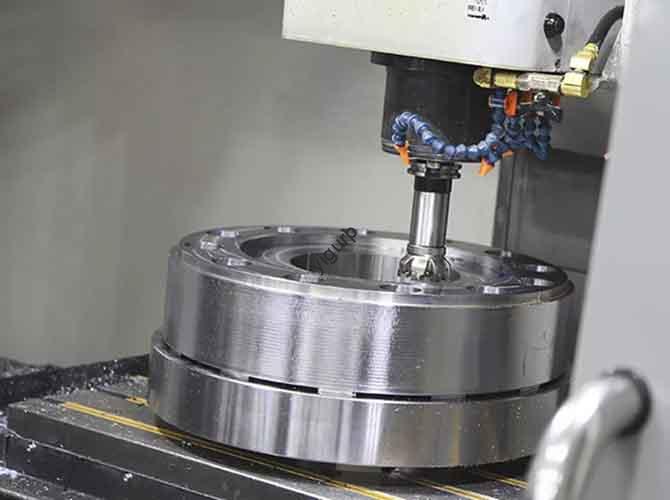
Dans un monde manufacturier en évolution rapide, comment garantir une qualité constante et une efficacité élevée lors de la production d'électrodes? The answer lies in CNC de traitement des électrodes—a computer-controlled technology that has become a game-changer for industries like mold making, électronique, et aérospatiale. Cet article décompose sa valeur fondamentale, processus, et des applications pour vous aider à résoudre les défis de production courants.
1. What Is Electrode Processing CNC?
À la base, CNC de traitement des électrodes uses computer numerical control (CNC) systems to automate the machining of electrode materials (par ex., cuivre, graphite). Contrairement aux méthodes manuelles traditionnelles, it relies on pre-programmed code to control tool movement, ensuring every electrode meets exact design specs.
Key Advantages vs. Traditional Machining
| Feature | CNC de traitement des électrodes | Traditional Manual Machining |
|---|---|---|
| Précision | ±0.001mm accuracy | ±0,01mm (depends on operator) |
| Efficacité | 3x faster (24/7 opération) | Lent (requires breaks) |
| Cohérence | 99% uniform output | 70-80% (operator-dependent) |
| Gestion de la complexité | Handles 3D/intricate designs | Limited to simple shapes |
2. Step-by-Step Electrode Processing CNC Workflow
Wondering how to implement this technology in your workshop? Follow this linear, actionable process:
- Conception & Programmation: Use CAD software (par ex., AutoCAD, SolidWorks) to create the electrode’s 3D model. Convert the model into G-code (CNC machine language) using CAM software.
- Configuration du matériau: Secure the electrode material (par ex., graphite block) onto the CNC machine’s worktable. Calibrate tools (par ex., fraises en bout) for cutting/engraving.
- Usinage automatisé: Load the G-code into the CNC system. The machine will automatically control tool speed (5,000-20,000 RPM) and trajectory to shape the electrode.
- Post-traitement: Clean the electrode with ultrasonic cleaners to remove debris. Deburr edges using precision files or laser tools to ensure smoothness.
- Contrôle de qualité: Use a coordinate measuring machine (MMT) to verify dimensions—critical for mold manufacturing, where even tiny errors ruin batches.
3. Top Applications: Where Electrode Processing CNC Shines
Why is this technology indispensable? Let’s look at real-world use cases:
- Fabrication de moules: Molds for plastic parts (par ex., coques de téléphone) require electrodes to create detailed cavities. CNC-machined electrodes ensure 100% mold consistency, reducing defect rates by 40%.
- Industrie électronique: Electrodes for semiconductor chips need micro-level precision. CNC systems handle 0.1mm-wide grooves—impossible with manual tools.
- Aérospatial: Titanium alloy electrodes for engine parts demand high strength and accuracy. CNC machining maintains tight tolerances, even for large components.
4. Latest Innovations in Electrode Processing CNC
As technology advances, how is CNC evolving to solve new challenges? Here are two key upgrades:
- Smart CNC Systems: New models (par ex., Fanuc 30i-B) have AI-powered error detection. They can adjust tool paths in real time if material density varies—cutting waste by 25%.
- 5-Usinage des axes: Traditional 3-axis CNC limits movement; 5-axis systems rotate the tool and worktable, enabling complex shapes (par ex., curved electrodes for medical devices) dans une seule configuration.
5. Yigu Technology’s Perspective
Chez Yigu Technologie, we believeCNC de traitement des électrodes is not just a tool—it’s a catalyst for manufacturing innovation. Our clients in mold and electronics industries have seen 35% faster production cycles and 50% fewer reworks after adopting our CNC-integrated solutions. We prioritize user-friendly programming and after-sales support, ensuring even small workshops can leverage high-precision machining.
FAQ
- Q: What materials work best with Electrode Processing CNC?UN: Cuivre (haute conductivité) and graphite (fast machining) are most common. CNC systems also handle aluminum and titanium for specialized aerospace/medical parts.
- Q: How much does an Electrode Processing CNC machine cost?UN: Entry-level 3-axis machines start at $50,000; high-end 5-axis models for complex work cost $200,000+. Yigu offers flexible leasing options for small businesses.
- Q: Do I need skilled operators to run CNC electrode machining?UN: Basic training (2-4 semaines) is enough for programming and operation. Yigu provides free on-site training with machine purchases to reduce setup time.