
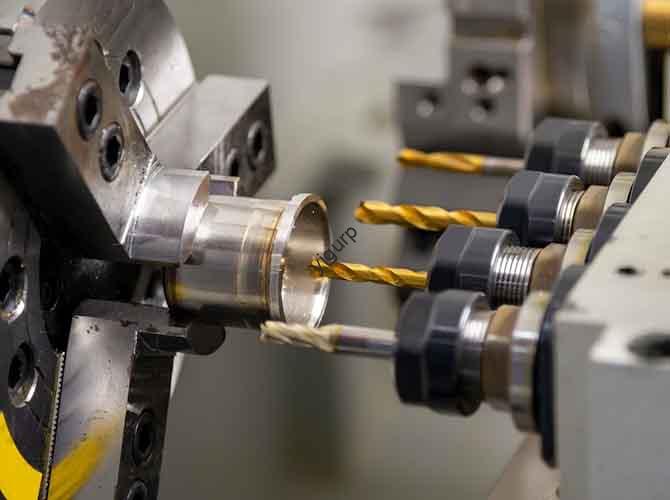
CNC spherical machining uses computer numerical control (CNC) pour fabriquer des pièces sphériques ou courbes complexes de haute précision, essentielles pour des industries comme l'aérospatiale, automobile, et médical (pensez aux roulements, vannes, ou des composants de moule). Contrairement à l'usinage traditionnel, il garantit que les trajectoires des outils s'alignent parfaitement avec les contours sphériques, mais des problèmes comme une mauvaise rondeur, rugosité de la surface, ou des erreurs de programmation font souvent dérailler les résultats. Cet article se décompose 5 core stages of CNC spherical machining, solving common pain points to help you achieve consistent, tight-tolerance outputs.
1. Choose the Right Machine Tool: Lay the Foundation for Precision
The first step to successful CNC spherical machining is picking a machine that matches your part’s needs. Two main options—CNC lathes and CNC milling machines—each have strengths, but the wrong choice leads to inaccuracies.
CNC Lathe vs. CNC Milling Machine for Spherical Machining
| Type de machine | Idéal pour | Avantage clé | Limitation |
| Tour CNC | Symmetrical spherical parts (par ex., ball bearings, simple valve heads) | Creates concentric spherical contours easily; faster for rotational parts. | Struggles with irregular curved surfaces (par ex., asymmetric molds). |
| CNC Milling Machine | Complex curved parts (par ex., mold cavities with mixed curves) | Handles non-symmetrical designs; more flexible for custom contours. | Slower than lathes for fully spherical, symmetrical parts. |
Key Question: When do I need a specialized CNC spherical grinding machine?
If your part requires ultra-tight tolerances (par ex., rugosité de la surface Ra < 0.8μm or diameter tolerance ±0.001mm), a specialized grinding machine is a must. It uses high-strength, rigid structures to refine spherical surfaces after initial machining—critical for medical or aerospace components.
2. Master Programming: Avoid Errors That Ruin Roundness
Programming is make-or-break for CNC spherical machining. Even small mistakes (like ignoring tool radius) can make a spherical part lopsided or uneven. The focus here is on tool reference accuracy et trajectory control.
2 Critical Programming Methods & Meilleures pratiques
- Manual Programming: Best for simple spherical parts (par ex., a 20mm-diameter ball bearing). You must:
- Use the tool head center as the programming reference (not the tool tip).
- Calculate the tool head radius (par ex., if the tool has a 5mm radius, adjust the trajectory to account for this).
- Double-check that every point on the tool’s path maintains equal distance from the spherical center (this ensures roundness).
- Software Programming: Ideal for complex parts (par ex., multi-curved molds). Tools like AutoCAD or Mastercam automate trajectory calculations, but you still need to:
- Input the exact tool head radius (software can’t guess this).
- Simulate the program before machining (catch collisions or trajectory errors early).
Exemple: A manufacturer once used the tool tip (not the center) as a reference for a 30mm spherical valve. The tool cut 2mm too deep on one side, making the part oval instead of round—wasting 20 hours of work. Using the tool head center would have prevented this.
3. Prepare for Finishing: Ensure Tight Tolerances with Grinding
Most high-precision spherical parts need a finishing step—grinding—to meet surface roughness and roundness requirements. Skipping this leads to parts that fail in real-world use (par ex., a rough bearing that wears out fast).
3-Step Grinding Process for Spherical Parts
- Pre-Grind Check: Inspect the initial machined part with a micrometer and surface roughness tester. If the diameter is off by more than 0.01mm or roughness is Ra > 3.2μm, rework the machining step first—grinding can’t fix large errors.
- Set Up the CNC Spherical Grinding Machine: Use its high-rigidity structure to your advantage. Calibrate the grinding wheel speed (typically 1,500–2,000 RPM for stainless steel parts) et vitesse d'avance (5–10mm/min) to avoid overheating.
- Post-Grind Inspection: Measure the part again. Pour les pièces critiques (par ex., aerospace bearings), use a coordinate measuring machine (MMT) to verify that the spherical surface is within tolerance.
Cause & Effect: If you skip grinding for a medical valve:
- The rough surface traps bacteria (violating safety standards).
- The uneven spherical shape causes leaks (the valve won’t seal properly).
- The part fails faster (rough edges wear down mating components).
4. Optimize Machining Parameters: Augmenter l'efficacité & Qualité
Even with the right machine and program, wrong parameters (like speed or feed rate) lead to poor results. The goal is to match settings to your material and part requirements.
Recommended Parameters for Common Materials
| Matériel | Vitesse de broche (RPM) | Vitesse d'alimentation (mm/min) | Grinding Wheel Type |
| Aluminium (6061) | 2,000–3,000 | 10–15 | Silicon carbide wheel (prevents clogging) |
| Acier inoxydable (304) | 1,200–1,800 | 5–8 | Aluminum oxide wheel (handles hard material) |
| Alliage de titane | 800–1,200 | 3–5 | Diamond wheel (for ultra-hard, high-tolerance parts) |
Pro Tip: For parts with both spherical and flat surfaces (par ex., a valve with a spherical head and flat base), machine the spherical surface first. This avoids damaging the delicate spherical contour when cutting flat areas later.
5. Contrôle de qualité: Ensure Consistency Batch After Batch
Without systematic checks, a single bad part can ruin a whole batch. The focus here is on surveillance en temps réel et documentation détecter les problèmes le plus tôt possible.
4-Step Quality Control Process
- In-Process Check: After every 5 parties, measure the spherical diameter with a micrometer and check roundness with a roundness tester. If a part is off by 0.005mm, adjust the machine’s spindle alignment.
- Surface Roughness Test: Use a portable roughness tester to spot-check parts—aim for Ra < 1.6μm for most industrial parts (Râ < 0.8μm for critical components).
- Inspection visuelle: Look for scratches or burrs (common after grinding). Use a magnifying glass (10x) to catch tiny flaws.
- Record Keeping: Log each batch’s parameters (machine type, programme, matériel) and quality results. If you see repeated roundness issues later, you can trace it back to a parameter change (par ex., a new tool with a different radius).
Yigu Technology’s Perspective
Chez Yigu Technologie, we’ve helped clients tackle CNC spherical machining challenges for years. The biggest mistake we see is skipping tool radius compensation in programming—it’s the top cause of uneven spherical parts. Our CNC machines come with built-in “spherical machining modes” that auto-adjust trajectories for tool radius, and we recommend pairing them with our specialized grinding attachments for tight tolerances. Remember: CNC spherical machining isn’t just about speed—it’s about matching machine, programme, and finishing steps to your part’s exact needs.
FAQ
- Q: My spherical part has uneven roundness—what’s the first thing I should check?
UN: Check if the tool head center was used as the programming reference. If you used the tool tip instead, the trajectory will be off, causing lopsidedness. Adjust the program to reference the tool head center and re-test.
- Q: Can I machine a spherical part with a diameter of 5mm (petit) using a standard CNC lathe?
UN: Oui, but use a small-diameter tool (par ex., 2mm radius) and slow the spindle speed to 1,800–2,200 RPM. Small parts are prone to vibration, so also use a steady rest to stabilize the workpiece.
- Q: How long does it take to machine and grind a 50mm-diameter stainless steel spherical part?
UN: Initial machining on a CNC lathe takes 15–20 minutes. Affûtage (for Ra < 0.8μm tolerance) adds 10–15 minutes. Total time: 25–35 minutes per part—faster than traditional machining (which can take 45+ minutes).