
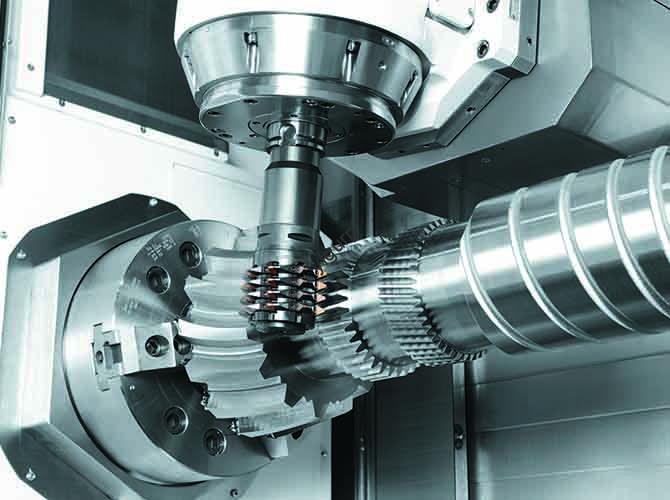
Dans mechanical manufacturing, why do engineers prefer CNC machine tool processing inner hole keyway over traditional methods like ordinary lathes? La réponse réside dans la capacité de la CNC à résoudre les problèmes critiques, tels que la faible précision due aux opérations manuelles., efficacité lente, et une faible adaptabilité aux pièces complexes, qui freinent l'usinage traditionnel des rainures de clavette des trous intérieurs.. This article breaks down what CNC inner hole keyway processing is, its core advantages, common processing methods, flux de travail étape par étape, et applications du monde réel, helping you achieve high-quality, efficient keyway production.
What Is CNC Machine Tool Processing Inner Hole Keyway?
CNC machine tool processing inner hole keyway refers to the use of Computer Numerical Control (CNC) systems to machine keyways—grooves inside cylindrical holes—for mechanical parts (par ex., arbres, engrenages). These keyways play a vital role in power transmission: they connect two components (like a shaft and a pulley) to ensure they rotate synchronously without slipping.
Unlike ordinary lathes, where tool feed and retraction depend on manual operation (prone to error), CNC machines use pre-programmed code to control every movement. This means each keyway is consistent in size, profondeur, and position—critical for parts that need tight fits (tolerance often ±0.01mm).
CNC vs. Traditional Inner Hole Keyway Processing: A Critical Comparison
Choosing between CNC and traditional methods can impact your production quality and efficiency. The table below contrasts their key differences to help you decide:
| Aspect | Rainure de clavette de trou intérieur de traitement de machine-outil CNC | Traditional Processing (Ordinary Lathe/Manual) |
|---|---|---|
| Précision | Haut (tolerance ±0.01–±0.03mm); keyway depth/width consistency >99%. | Faible (tolerance ±0.1–±0.2mm); manual operation causes size variations. |
| Efficacité | Fast—completes 20–30 keyways per hour (using compound fixed cycles like G71). | Slow—completes 5–8 keyways per hour; manual tool adjustment wastes time. |
| Tool Wear | Low—CNC controls feed rate evenly, reducing tool wear by 40% contre. traditionnel. | High—uneven manual feed causes rapid tool dulling; frequent tool changes. |
| Adaptability | Handles complex workpieces (large size, special shapes) via program adjustments. | Struggles with large/special-shaped parts; requires custom fixtures for each. |
| Labor Intensity | Low—automated processing needs 1 operator for 2–3 machines. | High—needs 1 skilled operator per machine; constant monitoring required. |
Core Advantages of CNC Machine Tool Processing Inner Hole Keyway
CNC’s superiority isn’t just about automation—it solves real manufacturing problems. Voici 3 key advantages with concrete examples:
1. Unmatched Precision
- Problème: A gear manufacturer needs inner hole keyways with a depth of 5mm (tolérance ±0,02 mm) for high-speed gears. Traditional lathes produce keyways with depth variations up to 0.1mm, causing gears to slip during operation.
- Solution: CNC machines use precise feed control (0.001mm per step) to ensure every keyway hits the 5mm depth target. The manufacturer reduced gear failure rates from 8% à 0.5%.
2. Boosted Efficiency
- Problème: A shaft factory spends 8 hours making 40 inner hole keyways with traditional lathes—too slow to meet a 100-keyway daily order.
- Solution: CNC’s compound fixed cycle G71 lets the machine auto-complete reciprocating tool insertion/retraction. The factory now makes 120 keyways in 8 heures, cutting delivery time by 30%.
3. Strong Adaptability
- Problème: A heavy machinery maker needs to process inner hole keyways for 1-meter-tall cylindrical workpieces. Traditional lathes can’t handle the size, and custom fixtures would cost $10,000.
- Solution: CNC machines adjust programs to fit the large workpiece and use universal fixtures (coût $500). The keyways are machined accurately, and the fixture can be reused for other sizes.
Common Processing Methods for CNC Inner Hole Keyway
CNC machines use 3 main methods to process inner hole keyways—each fits different needs. Voici une ventilation:
| Method | Comment ça marche | Idéal pour |
|---|---|---|
| Fraisage | Uses a milling cutter to remove material along the keyway path; haute précision. | Small-to-medium workpieces; keyways with complex shapes (par ex., rectangular, semicircular). |
| Broaching | Uses a broach (toothed tool) to push/pull through the inner hole, cutting the keyway in one pass. | Production en grand volume (1000+ parties); simple keyway shapes (rectangular). |
| Insertion | Uses a single-point tool to insert into the inner hole and cut the keyway via reciprocating movements; controlled by CNC cycles like G71. | Production en volume moyen; workpieces with hard materials (par ex., acier, titane). |
Step-by-Step Workflow for CNC Inner Hole Keyway Processing
Follow this linear process to ensure consistent results—each step builds on the last to avoid mistakes:
- Pre-Processing Preparation:
- Inspect the workpiece: Check inner hole diameter (ensure it’s within ±0.05mm of the design size) and surface smoothness (Râ < 1.6 µm).
- Choose the right tool: Utiliser de l'acier rapide (HSS) tools for soft materials (aluminium) or carbide tools for hard materials (acier).
- Programmation:
- Write the CNC program using G-codes (par ex., G71 for compound fixed cycles) and M-codes (for tool changes).
- Input key parameters: Keyway depth/width, vitesse d'avance (50–100 mm/min for steel), et vitesse de broche (1000–1500 rpm).
- Configuration de la machine:
- Install the workpiece in the CNC fixture; use a dial indicator to align it (runout < 0.01mm).
- Mount the tool and calibrate its position (use a tool setter to ensure accuracy within ±0.005mm).
- Test Processing:
- Run a test on a scrap workpiece. Check keyway size with a caliper and depth with a depth gauge.
- Adjust the program if needed (par ex., increase feed rate by 10% if the keyway surface is too rough).
- Full Production & Inspection:
- Start automated processing. Monitor the first 5 workpieces to confirm no issues.
- Inspect 10% of finished parts: Check tolerance, qualité de surface, and keyway alignment.
Yigu Technology’s Perspective
Chez Yigu Technologie, we seeCNC machine tool processing inner hole keyway as a cornerstone of precision manufacturing. Our CNC systems are optimized for keyway processing: they have built-in G71 cycle presets (cut programming time by 25%) and real-time tool wear monitoring (reduces scrap by 30%). We’ve helped clients—from auto parts makers to gear factories—cut production costs by 35% and improve keyway accuracy to ±0.008mm. As demand for high-precision mechanical parts grows, we’ll keep upgrading our software to support more complex keyway shapes and faster processing speeds.
FAQ
- Q: What’s the maximum inner hole diameter CNC can handle for keyway processing?UN: Our standard CNC machines handle inner holes up to 500mm in diameter. For larger holes (up to 1.5m), we offer custom machines with extended worktables and high-torque spindles.
- Q: Can CNC process inner hole keyways in non-metallic materials (par ex., plastique, céramique)?UN: Oui! Pour les plastiques, use HSS tools and lower feed rates (30–50 mm/min) pour éviter de fondre. Pour la céramique, use diamond-coated tools and slow spindle speeds (500–800 rpm) pour éviter les fissures.
- Q: How long does it take to train an operator for CNC inner hole keyway processing?UN: Basic operation (program loading, installation, production) takes 2 semaines. Advanced skills (program writing, dépannage) take 1 month—our user-friendly interface and preset cycles speed up training.