
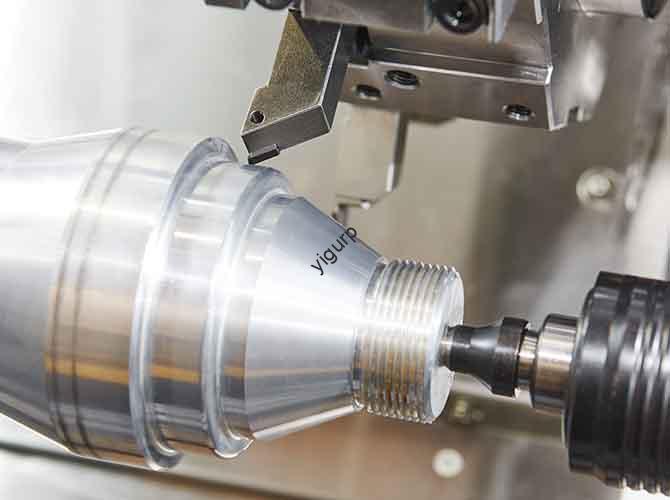
Dans la fabrication de précision, comment les ingénieurs produisent-ils systématiquement des pièces sphériques avec des tolérances serrées (souvent à moins de 0,005 mm)? The solution lies in CNC lathe ball head processing—a computer-controlled technique that turns raw materials into high-accuracy spherical components. Cet article vous guide à travers ses principes fondamentaux, flux de travail étape par étape, conseils critiques, applications du monde réel, et les tendances futures, helping you avoid common pitfalls and boost production efficiency.
What Is CNC Lathe Ball Head Processing?
CNC lathe ball head processing refers to the use of Computer Numerical Control (CNC) lathes to machine workpieces into spherical (ball head) formes. Unlike manual lathe operations—where precision depends entirely on the operator’s skill—this method uses pre-programmed code to control tool movement, ensuring uniform accuracy across every part.
À la base, the principle is straightforward: Un système CNC interprète une conception numérique (par ex., Fichier CAO) and directs the lathe’s tool to cut the workpiece along a preset spherical trajectory. This eliminates human error and enables repeatable production of complex spherical parts.
Step-by-Step Workflow of CNC Lathe Ball Head Processing
Follow this linear, actionable process to achieve consistent results. Each step builds on the previous one—skipping any can lead to defective parts or machine damage:
- Programmation: Use professional CNC software (par ex., Mastercam, UG) to write the machining program. Input key parameters:
- Spherical dimensions (diamètre, radius, tolérance).
- Tool type (par ex., carbide turning tools for hard metals).
- Cutting path (to avoid tool collisions).
Why it matters: A flawed program will result in parts that don’t meet design specs—even with a top-tier lathe.
- Workpiece Clamping: Secure the raw material (par ex., aluminium, acier) to the lathe’s chuck or fixture.
- Ensure positioning accuracy (use a dial indicator to check for runout < 0.01mm).
- Apply proper clamping force: Too loose causes displacement; too tight leads to workpiece deformation.
- Tool Setting: Calibrate the tool’s position relative to the workpiece (via trial cutting or a tool setter).
- Record tool offsets in the CNC system to ensure cuts align with the programmed trajectory.
Pro tip: Use a tool presetter to reduce setup time by 30% compared to manual trial cutting.
- Usinage: Start the lathe and let it run the program automatically.
- Monitor in real time: Check for abnormal noises (sign of tool wear) or coolant leaks.
- Adjust cutting parameters mid-process if needed (par ex., slow feed rate for hard materials like titanium).
- Inspection: Use precision tools to verify part quality:
- Micrometers for diameter measurements.
- Roundness testers to check spherical symmetry.
- If parts fail (par ex., out-of-tolerance radius), troubleshoot the program or tool setting before reprocessing.
Critical Factors for Successful CNC Lathe Ball Head Processing
The table below breaks down 4 key factors, their impact, and how to optimize them—solving common pain points like poor surface finish or tool breakage:
| Critical Factor | Impact on Processing | Optimization Tips |
| Sélection d'outils | Wrong tools cause poor surface finish, fast wear, or part damage. | – Use HSS tools for soft metals (aluminium); carbide tools for steel/titanium. – Choose tools with sharp cutting edges for spherical contours. |
| Paramètres de coupe | Improper settings reduce efficiency or damage tools. | – Cutting speed: 80–120 m/min for steel; 150–200 m/min for aluminum. – Vitesse d'alimentation: 0.1–0.2 mm/rev (slower for finer surface finish). – Depth of cut: 0.5–1 mm (avoid deep cuts in one pass for hard materials). |
| Refroidissement & Lubrication | Overheating damages tools and degrades part surface quality. | – Use water-soluble coolant for steel; mineral oil for aluminum. – Ensure coolant flow rate > 5 L/min to cover the cutting area. |
| Clamping Stability | Unstable clamping leads to runout, resulting in non-spherical parts. | – Use a 3-jaw chuck for round workpieces; a 4-jaw chuck for irregular shapes. – Clean the chuck jaws before clamping to remove debris. |
Where Is CNC Lathe Ball Head Processing Used?
Its high precision makes it indispensable in industries where spherical parts are critical. Voici 3 real-world examples with specific use cases:
- Aérospatial: Manufactures spherical components for aircraft engines (par ex., valve balls). These parts must withstand high temperatures (up to 800°C) and pressure—CNC lathe processing ensures tolerance within 0.003mm, preventing engine leaks.
- Automobile: Produces ball heads for steering systems and suspension knuckles. A leading carmaker uses this method to make 5,000 steering ball heads daily—with a defect rate of < 0.1%.
- Fabrication mécanique: Creates spherical joints for industrial robots. These joints need smooth rotation; CNC processing achieves a surface roughness (Râ) de 0.8 µm, reducing friction and extending joint life.
Yigu Technology’s Perspective
Chez Yigu Technologie, we see CNC lathe ball head processing as the backbone of precision manufacturing. Our clients—from aerospace startups to automotive suppliers—rely on our CNC solutions to cut production time by 25% while improving part accuracy. We integrate smart sensors into our lathes to monitor tool wear in real time, solving the common problem of unexpected tool failures. As industries demand tighter tolerances (par ex., 0.002mm for medical parts), we’ll continue to upgrade our software and hardware to keep pace with evolving needs.
FAQ
- Q: What’s the typical tolerance achievable with CNC lathe ball head processing?
UN: For standard setups, tolerances range from ±0.005mm to ±0.01mm. With high-precision lathes (par ex., Yigu Technology’s YG-2000 series) and advanced tooling, tolerances can reach ±0.002mm for critical parts.
- Q: How long does it take to machine one ball head part?
UN: It depends on size and material. A small aluminum ball head (10mm diamètre) takes 2–3 minutes; a large steel ball head (50mm diamètre) takes 8–10 minutes—including setup and inspection.
- Q: Can CNC lathe ball head processing handle non-metallic materials?
UN: Oui. It works for materials like engineering plastics (par ex., COUP D'OEIL) et céramique. Pour les plastiques, use lower cutting speeds (50–80 m/min) and dry cutting (pas de liquide de refroidissement) to avoid material melting.