
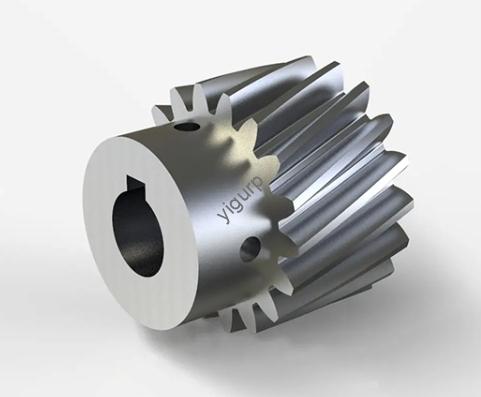
Si vous êtes un ingénieur produit ou un professionnel des achats travaillant sur des systèmes mécaniques, comme les transmissions automobiles, robots industriels, or medical equipment—CNC gear prototype machining process is your key to creating high-quality, pièces d'engrenage testables. Les engrenages sont essentiels à la transmission du mouvement et de la puissance, leur précision a donc un impact direct sur les performances du système. Contrairement à l'usinage traditionnel, CNC gear prototyping uses computer control to achieve ultra-high accuracy and repeatability, making it ideal for testing designs before mass production. Ce guide détaille chaque étape du processus, with real cases and data to help you avoid mistakes and get reliable prototypes.
1. What Is CNC Gear Prototype Machining?
D'abord, clarifions les bases: CNC gear prototype machining is a precision manufacturing method that uses computer numerical control (CNC) machine tools to shape raw materials into gear prototypes. These prototypes are used to test:
- How well the gear transmits torque and handles rotational speed (mechanical performance).
- If the gear fits with other components in the system (dimensional compatibility).
- How durable the gear is under real-world use (résistance à l'usure).
This process stands out because it can create gears with complex contours—like helical or bevel gears—that are hard to make with manual machining. It’s widely used in aerospace, automobile, and medical fields, where even tiny errors (as small as 0.01mm) can cause system failures.
Pourquoi c'est important: An automotive parts supplier once used manual machining to make a transmission gear prototype. The prototype had a dimensional error of 0.15mm, leading to noisy operation and premature wear during testing. Switching to CNC gear prototyping, they reduced the error to 0.02mm, and the next test run was smooth with no wear issues.
2. Step-by-Step CNC Gear Prototype Machining Process
The process has 6 core stages—each critical for ensuring the prototype meets design standards. Use the tables below to match the right equipment, matériels, and parameters to your project.
2.1 Conception & Programmation: Lay the Foundation for Precision
This stage is all about turning your gear design into machine-readable instructions. Follow these steps:
- Create a 3D Gear Model: Use software like SolidWorks, AutoCAD, or Siemens NX. Include key details like:
- Nombre de dents (par ex., 20-40 teeth for most industrial gears).
- Module (size of the gear teeth—common values: 0.5-5mm).
- Pressure angle (usually 20° for standard gears).
- Optimize for Machining: Consider the gear’s application—for example:
- If it needs to handle high torque, thicken the gear hub to 1.5x the module.
- If noise is a concern, add a slight curve to the tooth profile (couronnement des dents) pour réduire les frottements.
- Generate CNC Code: Use CAM software (par ex., Mastercam, Fusion 360) to convert the 3D model into G-code. This code tells the CNC machine the cutting path, vitesse, et vitesse d'avance.
Étude de cas: A robotics company designed a helical gear prototype but forgot to adjust the cutting path for the helix angle (15°). Their first CNC run produced a gear with distorted teeth. After re-programming the CAM software to account for the helix angle, the next prototype had perfect tooth geometry.
2.2 Equipment Selection: Choose Machines for Gear Machining
Not all CNC machines work for gears—you need ones with high rigidity and precise control. Here’s a breakdown of the best options:
| Equipment Type | Principales fonctionnalités | Idéal pour |
| CNC Gear Hobbing Machine | Specialized for cylindrical gears; cuts teeth in a continuous spiral. | Engrenages droits, engrenages hélicoïdaux (most common gear types). |
| CNC Gear Shaping Machine | Uses a reciprocating cutter to shape teeth; works for internal gears. | Internal gears, gears with narrow faces. |
| High-Rigidity Vertical Machining Center (VMC) | Equipped with gear-cutting tools; versatile for complex gear shapes. | Bevel gears, engrenages à vis sans fin (non-standard gear types). |
2.3 Préparation du matériel & Fixation
Choose a material that matches the gear’s intended use, then secure it to the machine to prevent shifting.
2.3.1 Sélection des matériaux
| Matériel | Propriétés mécaniques | Idéal pour |
| Alliage d'aluminium (6061-T6) | Léger (2.7 g/cm³), bonne usinabilité. | Low-torque applications (par ex., small robotics). |
| Acier inoxydable (304) | Résistant à la corrosion, haute résistance (515 Résistance à la traction MPa). | Food processing, équipement médical. |
| Acier allié (4140) | Haute dureté (28-32 HRC after heat treatment), résistant à l'usure. | High-torque applications (par ex., transmissions automobiles). |
2.3.2 Material Fixation
- Utilisez un 3-jaw chuck for cylindrical gear blanks (ensures concentricity—critical for smooth rotation).
- For large gears (diameter >200mm), use a face plate with T-slots to secure the blank.
- Check for runout (vibration) with a dial indicator—keep runout below 0.01mm to avoid machining errors.
2.4 Roughing: Remove Excess Material Fast
Roughing is about quickly shaping the gear blank into a near-finished form. Key parameters:
- Cutting Tool: Acier rapide (HSS) or carbide hob (for hobbing machines).
- Cutting Speed: 80-150 m/mon (faster for aluminum, slower for steel).
- Vitesse d'alimentation: 50-100 mm/min (balances speed and tool life).
- But: Leave 0.1-0.3mm of material for finishing (called “machining allowance”).
2.5 Finition: Achieve Final Precision
Finishing refines the gear to meet exact design specs. This stage is critical for tooth accuracy and surface quality:
- Cutting Tool: Polished carbide hob or gear shaper cutter (for smooth tooth surfaces).
- Cutting Speed: 60-120 m/mon (slower than roughing to reduce tool wear).
- Vitesse d'alimentation: 20-50 mm/min (slower for better precision).
- But: Achieve dimensional accuracy of ±0.01-0.03mm and surface roughness of Ra 0.8-1.6 µm.
2.6 Post-Treatment & Contrôle qualité
Après usinage, prepare the prototype for testing and verify its quality:
- Cleaning: Use a degreaser (par ex., alcool isopropylique) to remove cutting fluid and metal chips from the gear teeth.
- Traitement de surface (si nécessaire):
- Traitement thermique (par ex., carburizing for alloy steel) to increase hardness to 58-62 CRH.
- Sandblasting for a matte finish (reduces glare in food processing equipment).
- Placage (par ex., zinc plating for stainless steel) to improve corrosion resistance.
- Contrôle qualité:
- Utilisez un gear measuring center to check tooth profile, pas, and runout.
- Test torque capacity with a dynamometer—for a 4140 steel gear with 20 teeth (module 2mm), aim for a torque capacity of 50-100 N·m.
- Check for noise by running the gear with a mating gear at 1,000 RPM—noise levels should be below 70 dB.
3. Technical Advantages & Challenges of CNC Gear Prototype Machining
Understanding the pros and cons helps you plan your project effectively.
3.1 Avantages clés
- Haute précision: Achieves dimensional errors as small as ±0.005mm—critical for gears in aerospace or medical devices.
- Répétabilité: CNC machines produce identical prototypes every time—great for testing multiple design iterations.
- Complexité: Can machine non-standard gears (par ex., engrenages à vis sans fin, engrenages coniques) that traditional methods can’t make.
3.2 Défis communs
- High Equipment Cost: A CNC gear hobbing machine costs \(50,000-\)200,000—out of reach for small startups.
- Programming Complexity: G-code for helical or bevel gears requires advanced CAM skills—mistakes lead to ruined prototypes.
- Tool Wear: Gear-cutting tools wear out fast (par ex., a carbide hob lasts 50-100 prototypes for steel)—increases material costs.
4. Industry Application Cases
CNC gear prototype machining is used in three key fields:
- Automobile: A car manufacturer used CNC prototyping to test an engine timing gear. The prototype had a precision of ±0.02mm, and testing showed it reduced engine noise by 15% compared to the old design. They now use this design in their latest sedan model.
- Industrial Robotics: A robot maker needed a high-precision articulated gear for their arm. CNC prototyping let them test 3 itérations dans 2 semaines (contre. 6 semaines avec des méthodes traditionnelles). The final prototype had a runout of 0.01mm, ensuring smooth robot movement.
- Équipement médical: A medical device firm used CNC prototyping to make a gear for a surgical drill. The stainless steel prototype was corrosion-resistant and had a torque capacity of 80 N·m—perfect for the drill’s high-speed operation.
Yigu Technology’s View on CNC Gear Prototype Machining Process
Chez Yigu Technologie, we’ve supported 300+ clients in optimizing the CNC gear prototype machining process. We believe the biggest pain point is balancing precision and cost—many teams overspend on high-end machines for simple gears. Our solution: Custom equipment-material packages—for example, pairing a budget-friendly VMC with 6061 aluminum for low-torque gears, or a gear hobbing machine with 4140 steel for high-torque parts. This cuts costs by 25% while keeping precision at ±0.03mm. We also offer CAM programming support to avoid code errors.
FAQ
- How long does it take to make a CNC gear prototype?
It depends on the gear type and size: A small spur gear (50mm diamètre) takes 1-2 jours. A large helical gear (200mm diamètre) takes 3-5 jours (including design and inspection).
- Can CNC gear prototypes be used in final products?
Usually no—prototypes are for testing. But for low-volume products (par ex., custom medical tools), CNC prototypes can work if they pass heat treatment and durability tests (we’ve had clients use them for 10,000+ cycles).
- What’s the cost of a CNC gear prototype?
Costs vary by material and size: An aluminum spur gear (50mm diamètre) frais \(80-\)150. A stainless steel helical gear (100mm diamètre) frais \(200-\)400 (higher due to material and programming complexity).