
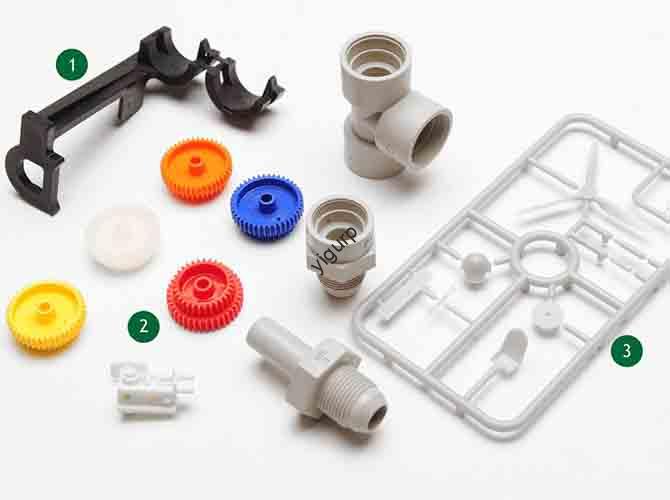
PTFE (polytétrafluoroéthylène)—connu pour sa résistance chimique exceptionnelle, faible friction, et la tolérance aux températures élevées – constituent depuis longtemps un défi pour la fabrication traditionnelle. But with advances in 3Technologie d'impression D, ce matériau haute performance est désormais imprimable, avec les processus et les équipements appropriés. This article answers the critical question “Can PTFE material be 3D printed?» en décomposant ses enjeux uniques, viable technologies, solutions to common issues, et applications du monde réel.
1. Why PTFE Is Hard to 3D Print: Key Material Challenges
PTFE’s desirable properties also make it difficult to process with standard 3D printing methods like FDM (Modélisation des dépôts fondus). Below is a breakdown of its critical characteristics and how they hinder printing.
| PTFE Characteristic | Impact sur l'impression 3D | Why It Causes Problems |
| High Melting Point (~342°C) + Low Decomposition Temp (~260°C) | Traditional FDM fails: Heating PTFE to its melting point causes it to decompose before it can be extruded. | FDM relies on fully melting thermoplastics (par ex., PLA, ABS) to build layers. PTFE breaks down into toxic fumes at temperatures below its melting point, making FDM unsafe and ineffective. |
| Poor Thermal Stability | Uneven heating/cooling leads to warping, fissuration, or shrinkage. | PTFE deforms easily when heated and crystallizes rapidly when cooled, creating internal stress that distorts printed parts. |
| Faible conductivité thermique | Heat distribution is uneven across the print bed, leading to inconsistent layer bonding. | Slow heat transfer means some areas of PTFE powder melt incompletely, while others overheat and decompose. |
| Low Surface Energy | Weak adhesion between layers; printed parts are prone to delamination. | PTFE’s non-stick surface (the same property that makes it ideal for cookware) prevents layers from bonding strongly, reducing part strength. |
2. Can PTFE Be 3D Printed? Viable Technologies
While FDM is off the table, two powder-based 3D printing technologies have proven effective for PTFE. These methods avoid full melting of the material, minimizing decomposition risks.
| 3Technologie d'impression D | Working Principle for PTFE | Key Advantages for PTFE | Limites |
| SLS (Frittage sélectif au laser) | A low-power laser (100–300 W) sinters PTFE powder—heating it just below its melting point (240–250°C) to bond particles without full melting. Layers are built sequentially in a controlled, low-oxygen chamber. | – Avoids thermal decomposition (stays below 260°C)- Reduces thermal stress (no rapid melting/cooling)- Suitable for complex geometries (par ex., canaux internes, parois minces) | – Requires fine PTFE powder (20–50 μm particle size) for uniform sintering- Part density is lower than molded PTFE (~90–95% vs. 98%+ for compression molding) |
| GDT (Fusion laser sélective) | A high-precision laser (500–800 W) locally melts PTFE powder in small, targeted areas—keeping the overall temperature below decomposition levels. The molten PTFE cools and solidifies quickly to form dense layers. | – Higher part density than SLS (~95–98%)- Better mechanical strength (conserve 85% of molded PTFE’s tensile strength) | – More complex parameter tuning (puissance laser, speed must be precise to avoid decomposition)- Higher equipment cost than SLS (\(500k+ vs. \)200k–$300k for SLS) |
3. Solving PTFE 3D Printing Issues: Solutions pratiques
Even with SLS/SLM, PTFE printing faces hurdles like shrinkage and weak layer bonding. Below are proven solutions to these challenges, organized by issue.
3.1 Issue 1: Thermal Shrinkage & Gauchissement
PTFE shrinks by 1–3% during cooling, which can distort parts.
Solutions:
- Optimize cooling rate: Use a heated build chamber (maintained at 120–150°C) to slow cooling, reducing crystallization and shrinkage.
- Adjust layer thickness: Thinner layers (20–30 μm) distribute heat more evenly, minimizing temperature gradients that cause warping.
3.2 Issue 2: Poor Powder Fluidity
PTFE’s low friction makes powder hard to spread uniformly on the print bed, leading to uneven layers.
Solutions:
- Add flow aids: Mix 1–2% of fumed silica (a fine, inert powder) into PTFE powder to improve flowability.
- Use a vibrating powder bed: Gentle vibration ensures consistent powder distribution across each layer.
3.3 Issue 3: Weak Interlayer Bonding
PTFE’s low surface energy reduces adhesion between layers, making parts brittle.
Solutions:
- Add high-temperature adhesives: Mix small amounts of metal oxides (par ex., alumine) or fluoropolymer binders into PTFE powder to enhance layer bonding.
- Post-print hot pressing: Heat printed parts to 280–300°C (below decomposition) and apply pressure (10–20 MPa) to densify the structure and strengthen bonds.
4. Applications of 3D Printed PTFE Parts
3D printed PTFE excels in industries where its unique properties are critical. Below are key application areas and example components.
| Industrie | Exemples d'application | Why 3D Printed PTFE Is Ideal |
| Fabrication industrielle | Corrosion-resistant pipes, valve linings, mechanical seals | PTFE resists most acids, alcalis, and solvents—perfect for chemical processing equipment. 3D printing enables custom shapes for non-standard valves/pipes. |
| Médical | Biocompatible catheters, artificial vascular coatings, composants d'outils chirurgicaux | PTFE is non-toxic and inert (FDA-approved for medical use). 3D printing creates patient-specific catheter designs for better comfort and functionality. |
| Aérospatial | High-temperature engine gaskets, composants du système de carburant, isolateurs électriques | PTFE withstands extreme temperatures (-200°C à 260°C) and resists aviation fuels. 3D printing reduces weight by creating lightweight lattice structures. |
| Scientific Research | Chemical reactor liners, inert sample containers, lab equipment parts | PTFE’s chemical inertness prevents contamination of sensitive experiments. 3D printing allows rapid prototyping of custom lab tools. |
5. Alternatives to 3D Printing PTFE
If 3D printing PTFE isn’t feasible (par ex., due to cost or equipment limitations), three traditional methods work well for PTFE parts.
| Alternative Method | Comment ça marche | Avantages clés | Idéal pour |
| Moulage par compression | PTFE powder is pressed into a mold and heated to 360–380°C (above melting point) sous haute pression, puis refroidi lentement. | High part density (98%+), excellentes propriétés mécaniques, low cost for large batches. | High-volume production of simple shapes (par ex., joints, feuilles). |
| Usinage | PTFE rods or sheets are cut, percé, or milled into the desired shape using CNC tools. | No heat-related issues, haute précision pour les petites pièces. | Low-volume production of complex, pièces de haute précision (par ex., lab fittings). |
| Composite Printing | PTFE is mixed with other printable materials (par ex., nylon, poudres métalliques) to improve processability. | Combines PTFE’s properties with the printability of other materials. | Parts that need partial PTFE benefits (par ex., low-friction nylon-PTFE gears). |
6. Yigu Technology’s Perspective on 3D Printing PTFE
Chez Yigu Technologie, we see 3D printed PTFE as a “niche but powerful” solution—ideal for custom, low-volume parts where PTFE’s unique properties are non-negotiable. Many clients mistakenly assume 3D printing PTFE is too expensive, but it’s often cheaper than machining for complex designs (par ex., a custom PTFE reactor liner with internal channels). Nos conseils: Start with SLS for most projects (équilibre le coût et la qualité) and reserve SLM for high-strength needs (par ex., composants aérospatiaux). We also optimize powder blends—adding 1.5% fumed silica to PTFE powder has reduced our clients’ warping issues by 70%. For clients with budget constraints, we recommend composite printing (nylon-PTFE) as a cost-effective middle ground. Finalement, 3D printing PTFE isn’t for every project—but when it’s right, it unlocks designs impossible with traditional methods.
FAQ: Common Questions About 3D Printing PTFE Material
- Q: Is 3D printed PTFE as strong as traditionally molded PTFE?
UN: Close, but not identical. SLS-printed PTFE has ~90–95% of molded PTFE’s strength, while SLM-printed PTFE reaches 85–90%. Post-traitement (par ex., hot pressing) can boost strength to ~95% of molded PTFE—sufficient for most industrial applications.
- Q: Is 3D printing PTFE safe?
UN: Oui, with proper equipment. SLS/SLM systems use sealed chambers with filtration to capture any toxic fumes from PTFE decomposition. Never attempt to print PTFE with FDM—it releases harmful perfluoroisobutylene (PFIB) fumes at high temperatures.
- Q: How much does 3D printed PTFE cost compared to machining?
UN: Pour les pièces simples, machining is cheaper (30–50% de coût inférieur). Pour pièces complexes (par ex., with internal channels), 3D printing is 20–40% cheaper—machining such designs requires multiple setups and generates 50–70% material waste, while 3D printing uses only the powder needed.