
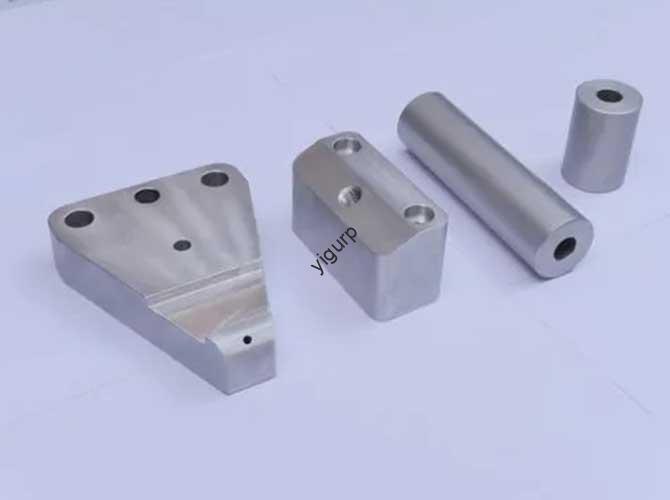
L'aluminium, apprécié pour sa légèreté, rapport résistance/poids élevé, and corrosion resistance—has become a critical material in 3Impression D, spécialement pour l'aérospatiale, automobile, et applications industrielles. Pour les ingénieurs, fabricants, et créateurs, comprendre si l'aluminium peut être imprimé en 3D, quels types fonctionnent le mieux, et comment surmonter les défis communs est essentiel. This article answers the question “Can aluminum be 3D printed?” by breaking down key materials, technologies, avantages, défis, and practical tips for successful printing.
1. Which Aluminum Materials Can Be 3D Printed? Key Types & Propriétés
Not all aluminum grades are equally suited for 3D printing. Pure aluminum and specific aluminum alloys dominate due to their processability and performance. Below is a detailed breakdown to help you select the right material for your project.
| Aluminum Type | Notes communes | Core Properties | 3D Printing Compatibility | Ideal Application Scenarios |
| Aluminium pur | 1060 | – Excellente résistance à la corrosion- Good electrical and thermal conductivity- Low strength (résistance à la traction: ~95 MPa)- Haute ductilité | Moyen (requires parameter optimization to avoid oxidation) | Pièces non structurelles (par ex., electrical conductors, heat sinks for low-stress devices), decorative components |
| Alliages d'aluminium | AlSi10Mg | – Haute résistance (résistance à la traction: ~330 MPa after heat treatment)- Good casting performance and corrosion resistance- Faible densité (2.68 g/cm³) | Haut (most widely used aluminum alloy in 3D printing) | Composants aérospatiaux (par ex., supports légers), pièces automobiles (par ex., composants du moteur), prototypes fonctionnels |
| AlSi7Mg | – Similar to AlSi10Mg but with lower silicon content- Moderate strength (résistance à la traction: ~300 MPa)- Improved surface finish | Haut | Complex structural parts (par ex., cadres de drones, bras robotiques), parts requiring fine surface details | |
| AlSi12 | – High silicon content (12% Et)- Good fluidity during melting- Low dimensional accuracy compared to AlSi10Mg/AlSi7Mg | Moyen | Parts with low precision requirements (par ex., non-critical brackets, decorative industrial components) |
2. How Is Aluminum 3D Printed? Core Technologies
Aluminum’s high melting point (~660°C for pure aluminum) and strong oxidation tendency require specialized 3D printing technologies. Three methods dominate, each with unique trade-offs in cost, précision, and part performance.
| 3Technologie d'impression D | Working Principle | Key Advantages for Aluminum | Key Limitations | Ideal Use Cases |
| GDT (Fusion laser sélective) | Uses a high-energy fiber laser (wavelength: 1064 nm, power: 500–1000 W) to scan and fully melt aluminum powder layer by layer. The molten aluminum cools and solidifies on a heated substrate (typically 150–200°C) to form dense parts. | – High part density (>99% for AlSi10Mg)- Excellente précision (épaisseur de couche: 20–100 μm)- Ability to create complex geometries (par ex., structures en treillis, canaux internes) | – High equipment cost (\(200k–\)1M+)- Strict powder quality requirements (taille des particules: 15–45 μm, low oxygen content) | High-precision aerospace parts (par ex., pales de turbine), composants de moteurs automobiles, medical device parts |
| EBM (Fusion par faisceau d'électrons) | Employs a focused electron beam (power: 1–3 kW) to melt aluminum powder in a vacuum environment. The vacuum prevents oxidation, and the high beam energy enables fast melting of aluminum. | – Vacuum environment reduces oxidation risk- Higher energy efficiency than SLM- Suitable for large, pièces à parois épaisses | – Lower precision than SLM (épaisseur de couche: 50–200 μm)- High equipment maintenance cost | Grandes pièces industrielles (par ex., heavy-duty automotive brackets), aerospace structural components |
| BJ (Jet de liant) | Mixes aluminum powder with a liquid binder, then sprays the mixture layer by layer into a molding cylinder. Après l'impression, la « partie verte » (unprocessed part) undergoes degreasing (to remove the binder) and sintering (to fuse powder particles) at high temperatures (1100–1200°C). | – Low equipment cost compared to SLM/EBM- Fast printing speed for large batches- Aucune structure de support nécessaire | – Low part density (90–95% vs. >99% for SLM)- Weaker mechanical properties (tensile strength ~20% lower than SLM parts) | Pièces à faible contrainte (par ex., non-critical brackets, decorative components), small-batch prototypes |
3. Advantages of 3D Printing Aluminum
3D printing unlocks unique benefits for aluminum that traditional manufacturing (par ex., extrusion, fonderie) cannot match—especially for complex or low-volume projects.
3.1 Design Freedom for Complex Geometries
Traditional methods struggle with internal cavities, structures en treillis, or intricate shapes. 3D printing aluminum builds parts layer by layer, enabling designs like:
- Structures en treillis léger (reduce weight by 40–60% vs. pièces solides) pour composants aérospatiaux.
- Internal cooling channels (improve heat dissipation) for automotive engine parts.
- Customized medical implants (match patient anatomy) with complex surface textures.
3.2 Faster R&D Cycles
3D printing aluminum eliminates the need for expensive molds (costing \(10k–\)50k for traditional casting) and long machining setups. Par exemple:
- A prototype aluminum bracket that takes 2–3 weeks to make via casting can be 3D printed in 2–3 days.
- Design iterations can be tested in days, pas des semaines, speeding up product development and time-to-market.
3.3 High Material Utilization
Traditional subtractive manufacturing (par ex., Fraisage CNC) wastes 50–70% of aluminum as scrap. 3D printing is additive—only the powder needed for the part is used, et la poudre inutilisée est recyclable (up to 5–10 reuses). This reduces material costs by 30–50% for small-batch production.
3.4 Léger & Haute résistance
3D printed aluminum parts retain the material’s natural lightweight property (densité: 2.6–2.7 g/cm³) while achieving high strength through heat treatment. Par exemple, SLM-printed AlSi10Mg has a tensile strength of 330 MPa—comparable to cast aluminum but with 30% less weight.
4. Key Challenges of 3D Printing Aluminum & Solutions
Malgré ses avantages, 3D printing aluminum faces three major hurdles. Below are proven solutions to mitigate risks and ensure high-quality parts.
4.1 Oxidation Risk at High Temperatures
Aluminum reacts with oxygen at high temperatures to form a dense oxide layer (Al₂O₃), which weakens part bonds and causes defects.
Solutions:
- Use SLM or EBM with protective environments: SLM uses argon gas (oxygen content <0.1%); EBM uses a high vacuum (10⁻⁵ mbar) to isolate aluminum from air.
- Pre-treat aluminum powder: Use powder with low oxygen content (<0.15%) and store it in airtight containers with desiccants to prevent pre-print oxidation.
4.2 Process Control for Defect Prevention
Aluminum’s high thermal conductivity causes rapid cooling, leading to defects like porosity, fissures, or incomplete fusion.
Solutions:
- Optimize printing parameters:
| Paramètre | GDT (AlSi10Mg) Recommendation | Raisonnement |
| Laser Power | 300–400 W | Ensures full melting without overheating. |
| Scanning Speed | 800–1200 mm/s | Balances melting efficiency and cooling rate. |
| Épaisseur de couche | 30–50 μm | Reduces thermal stress between layers. |
| Substrate Temperature | 180–200°C | Slows cooling to prevent cracking. |
- Post-heat treatment: Anneal parts at 200–300°C for 1–2 hours to relieve internal stress and reduce porosity.
4.3 Coût élevé & Post-Processing Requirements
3D printing aluminum is more expensive than traditional methods, and parts need extensive post-processing.
Solutions:
- Choose the right technology: Use BJ for low-cost prototypes; reserve SLM/EBM for high-performance, pièces de haute précision.
- Streamline post-processing:
- Remove supports with wire EDM (for precision parts) or mechanical cutting (pour les pièces non critiques).
- Use sandblasting (60–120 grit) to improve surface roughness (Ra 1,6–3,2 μm) before final finishing.
- Apply anodizing (pour la résistance à la corrosion) ou peinture (pour l'esthétique) only when necessary.
5. Yigu Technology’s Perspective on 3D Printing Aluminum
Chez Yigu Technologie, we see 3D printed aluminum as a “game-changer” for weight-sensitive and high-performance industries—but it’s not a one-size-fits-all solution. Many clients overspend on SLM for low-stress parts when BJ works, or choose the wrong alloy (par ex., pure aluminum for structural parts). Nos conseils: Start with AlSi10Mg for most functional projects (balances strength, coût, et la transformabilité) and use SLM for critical parts (par ex., composants aérospatiaux). For clients with budget constraints, we recommend hybrid approaches—3D print complex features (par ex., canaux internes) and CNC machine critical surfaces for precision. We also optimize parameters in-house: For a recent automotive client, adjusting SLM laser speed to 1000 mm/s reduced porosity by 70% and improved part strength. Finalement, 3D printing aluminum works best when aligned with your part’s performance needs and budget—not just the latest technology.
FAQ: Common Questions About 3D Printing Aluminum
- Q: Can 3D printed aluminum match the strength of traditionally cast aluminum?
UN: Yes—with SLM and heat treatment. SLM-printed AlSi10Mg has a tensile strength of 330 MPa, comparable to cast AlSi10Mg (300–320 MPa). EBM parts are slightly weaker (280–300 MPa), while BJ parts are 20–30% weaker (better for non-structural use).
- Q: Is 3D printing aluminum cost-effective for large-batch production (>1000 parts)?
UN: No—traditional casting is cheaper for large batches. 3D printing shines for small batches (1–500 pièces) ou des conceptions complexes; pour 1000+ parties, casting’s lower per-unit cost (50–70% less than SLM) makes it better.
- Q: What’s the maximum size of a 3D printed aluminum part?
UN: It depends on the technology. SLM systems typically handle parts up to 300×300×300 mm (par ex., small aerospace brackets). EBM can print larger parts (up to 500×500×500 mm) for industrial applications. For bigger components, parts are 3D printed separately and welded together.