
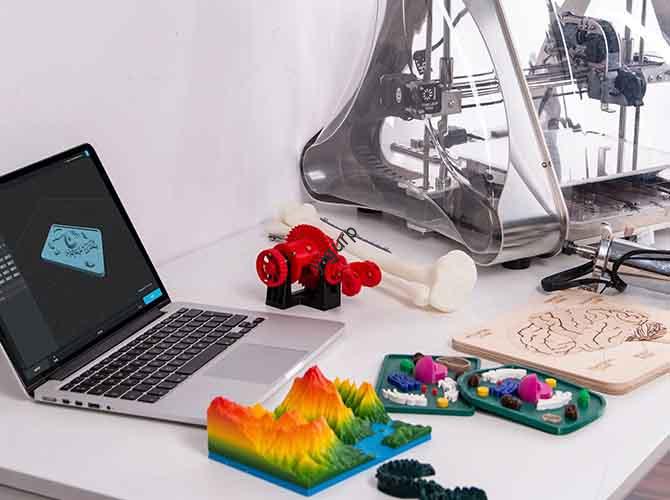
UV printing and 3Impression D are both advanced manufacturing technologies, mais ils servent des objectifs complètement différents. En qualifier un comme « meilleur » sans contexte est trompeur : leur valeur dépend de vos besoins spécifiques, par exemple si vous créez des conceptions de surface 2D ou des objets physiques 3D. Cet article détaille leurs principales différences, avantages, cas d'utilisation, and limitations to help you make the right choice.
1. Principes fondamentaux & Processus (Side-by-Side Comparison)
The fundamental distinction between UV printing and 3D printing lies in their working principles and output formats. Vous trouverez ci-dessous une répartition claire:
| Aspect | UV Printing | 3D Impression |
| Type de technologie | Flat printing (2D surface decoration) | Fabrication additive (3D object creation) |
| Principe fondamental | Sprays UV-curing ink onto material surfaces; ink cures instantly under ultraviolet (UV) lumière to form patterns/text. | Stacks materials (par ex., résine, poudre de métal) couche par couche to build 3D objects from digital models. |
| Key Process Step | 1. Prepare digital design → 2. Load flat material → 3. Print ink → 4. UV cure → 5. Finition (si nécessaire). | 1. Design 3D model (GOUJAT) → 2. Slice model into layers → 3. Load printing material → 4. Layer-by-layer stacking → 5. Post-process (supprimer les supports, sable). |
| Output Format | 2D patterns/text on flat/regular surfaces | Solid 3D objects (with complex geometries if needed) |
2. Critical Performance Metrics (Tableau de comparaison)
To evaluate which technology fits your project, compare their key performance indicators:
| Métrique | UV Printing | 3D Impression |
| Précision | Haut (jusqu'à 1080dpi or more) – ideal for fine details like photos or logos. | Inférieur (usually around 0.1mm) – surface smoothness depends on process (par ex., FDM has visible layer lines). |
| Printing Speed | Fast – suitable for production par lots (par ex., 100 phone cases printed in hours). | Slow – complex models take hours to days (par ex., a small mechanical part may take 4–8 hours). |
| Color Performance | Excellent – supports multi-color, gradient, and photo-quality printing (no extra steps for color variation). | Limited – mostly monochrome; multi-color requires advanced technologies (par ex., multi-material printers) and increases cost. |
| Épaisseur du matériau | Restricted by substrate thickness (utilise sheets or coils; no 3D depth). | Unrestricted – can create thick-walled, hollow, or layered structures (depth depends on printer size). |
| Coût | Low – affordable for small batches/personalization (no mold fees; ink costs are minimal). | High – especially industrial-grade or metal 3D printing (coûts matériels + long print times drive expenses). |
3. Scénarios d'application idéaux
Each technology excels in specific use cases. Use this guide to match your project goals:
3.1 When to Choose UV Printing
- 2D Surface Decoration: Projects requiring patterns on flat/regular materials, tel que:
- Billboards, posters, or signage (high color vibrancy).
- Coques de téléphone personnalisées, glass decorations, or metal signs (haute précision).
- Leather products, acrylic plates, or packaging boxes (multi-material compatibility).
- Small-Batch Personalization: Needs for low-cost, fast customization (par ex., personalized photos on mugs, art paintings on canvas).
- No Plate-Making Required: Quick turnaround for designs (no upfront tooling – ideal for frequent design changes).
3.2 When to Choose 3D Printing
- 3D Object Manufacturing: Creating physical, three-dimensional parts, tel que:
- Composants mécaniques (par ex., engrenages, parenthèses) or molds (prototypage rapide).
- Implants médicaux (par ex., custom bone replacements) or architectural models (formes complexes).
- Géométries complexes: Shapes impossible with traditional processes, tel que:
- Internal hollow structures (par ex., lightweight honeycomb parts for aerospace).
- Structures de soutien (easily removable after printing).
- Prototypage rapide: Testing designs without mold costs (par ex., a startup testing a new product prototype in 1–2 days).
4. Limites à considérer
Understanding their drawbacks helps avoid project delays or cost overruns:
4.1 UV Printing Limitations
- No 3D Capability: Cannot create physical 3D objects – only decorates existing surfaces.
- Material Surface Dependence: Ink adhesion relies on material pre-treatment (par ex., coating or sanding for smooth plastics/metals) to prevent peeling.
- No Deep Reliefs: Cannot print patterns with large height differences (limité aux surfaces planes).
4.2 3D Printing Limitations
- Low Accuracy/Surface Quality: Parts often need post-processing (ponçage, polissage) pour supprimer les lignes de calque (especially FDM technology).
- Slow Speed: Not suitable for mass production – even small parts take hours.
- Coûts élevés: Industrial-grade printers or specialty materials (par ex., poudre de métal, photosensitive resin) are expensive.
5. Le point de vue de Yigu Technology
Chez Yigu Technologie, we believe the “better” technology depends entirely on your project’s goals—there’s no one-size-fits-all answer. We often guide clients to pair the two for optimal results: Par exemple, 3D printing a custom mechanical part, then using UV printing to add logos or color-coded labels to its surface. For clients focused on 2D customization (par ex., brand signage), UV printing is the cost-effective, fast choice. For those developing new 3D products (par ex., dispositifs médicaux), 3D printing delivers unmatched flexibility in shape and prototyping speed. Nos conseils: Start by defining your core need—“Do I need a 2D design or a 3D object?”—then evaluate cost, vitesse, and accuracy from there.
6. FAQ (Foire aux questions)
- Q: Can UV printing be used on 3D-printed objects?
UN: Oui! A common composite process is 3D printing the object first, then using UV printing to add colors, logos, or patterns to its surface. This combines 3D structure with high-quality 2D decoration.
- Q: Is 3D printing suitable for mass production?
UN: Non. 3D printing is slow and costly for large batches. It’s best for prototyping or low-volume, pièces personnalisées; mass production is still more efficient with traditional methods (par ex., moulage par injection).
- Q: What materials work best for UV printing?
UN: UV printing works on most flat/regular materials, including plastic, métal, verre, bois, cuir, and stone. For smooth or non-porous materials (par ex., verre, polished metal), pre-treatment (revêtement) may be needed to improve ink adhesion.