
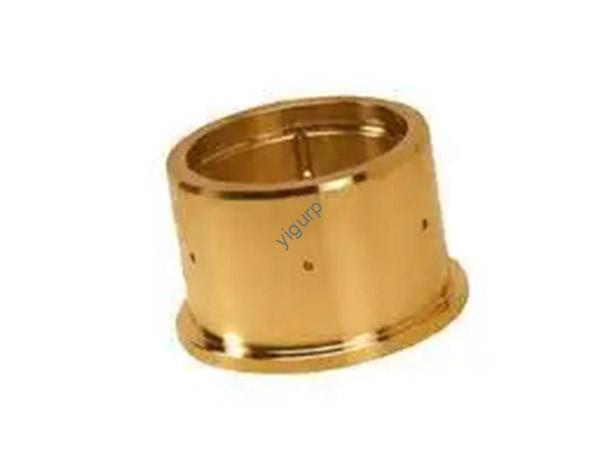
If you’re designing parts that need to handle heavy loadset extreme impact—like industrial crane shafts, composants de trains d'atterrissage aérospatiaux, ou des engrenages d'équipement de construction : vous avez besoin d'un matériau qui équilibre la résistance, dureté, and fatigue resistance.AISI 8740 acier allié is the premium solution: comme nickel-chrome-molybdène (Ni-Cr-Mo) alliage, it delivers higher core toughness andlimite de fatigue than lower-nickel grades like AISI 8630, while maintaining a hard, surface résistante à l'usure. Ce guide détaille ses propriétés, applications du monde réel, processus de fabrication, and material comparisons to help you solve “high-load + high-impact” design challenges.
1. Propriétés matérielles de l'AISI 8740 Acier allié
AISI 8740’s performance stems from its optimized Ni-Cr-Mo composition: higher nickel (0.40–0,70%) boosts low-temperature toughness, chromium enhances surface hardenability andrésistance à la corrosion, molybdenum improves high-temperature strength and fatigue resistance, and controlled carbon (0.38–0.43%) équilibre la résistance et la ductilité. Explorons ses propriétés clés en détail.
1.1 Composition chimique
AISI 8740 adheres to ASTM A29/A29M standards, with elements tailored for high toughness and strength. Below is its typical composition:
| Élément | Symbole | Gamme de contenu (%) | Rôle clé |
|---|---|---|---|
| Carbone (C) | C | 0.38 – 0.43 | Delivers baserésistance à la traction; enables heat treatment for hardness |
| Nickel (Dans) | Dans | 0.40 – 0.70 | Core toughness booster; maintainsrésistance aux chocs à -40 °C (critique pour les climats froids) |
| Chrome (Cr) | Cr | 0.40 – 0.60 | Enhances surface hardenability; améliorerésistance à la corrosion to mild chemicals |
| Molybdène (Mo) | Mo | 0.20 – 0.30 | Raiseslimite de fatigue for cyclic loads; prevents creep at high temperatures (jusqu'à 450 °C) |
| Manganèse (Mn) | Mn | 0.70 – 0.90 | Affine la structure des grains; amélioreductilité without reducing strength |
| Silicium (Et) | Et | 0.15 – 0.35 | Aids deoxidation; supports stability during heat treatment |
| Phosphore (P.) | P. | ≤ 0.035 | Minimized to avoid brittle fracture in low-temperature or high-stress conditions |
| Soufre (S) | S | ≤ 0.040 | Controlled to balanceusinabilité et la ténacité (lower S = better impact resistance) |
| Vanadium (V) | V | ≤ 0.03 | Oligoélément; refines grains for uniform strength across thick sections |
| Cuivre (Cu) | Cu | ≤ 0.30 | Oligoélément; adds mild atmospheric corrosion resistance for outdoor parts |
1.2 Propriétés physiques
These traits make AISI 8740 suitable for extreme environments—from sub-zero construction sites to high-heat industrial machinery:
- Densité: 7.85 g/cm³ (same as standard steels)—simplifies weight calculations for large parts like crane shafts
- Point de fusion: 1,420 – 1,450 °C (2,588 – 2,642 °F)—compatible with forging and heat treatment for complex shapes
- Conductivité thermique: 41.0 Avec(m·K) à 20 °C; 37.0 Avec(m·K) à 300 °C—ensures even heat distribution during quenching (reduces distortion)
- Coefficient de dilatation thermique: 11.5 × 10⁻⁶/°C (20 – 100 °C)—minimizes stress from temperature swings (par ex., -40 °C to 300 °C)
- Propriétés magnétiques: Ferromagnetic—enables non-destructive testing (CND) like ultrasonic phased array to detect internal defects in thick parts.
1.3 Propriétés mécaniques
AISI 8740’s mechanical performance excels in quenched & tempered condition, with a focus on toughness and strength. Vous trouverez ci-dessous les valeurs typiques:
| Propriété | Méthode de mesure | Recuit (Soft Condition) | Trempé & Tempéré (300 °C) | Trempé & Tempéré (600 °C) |
|---|---|---|---|---|
| Dureté (Rockwell) | CRH | 22 – 25 CRH | 50 – 53 CRH | 30 – 33 CRH |
| Dureté (Vickers) | HT | 210 – 240 HT | 480 – 510 HT | 290 – 320 HT |
| Résistance à la traction | MPa (ksi) | 750 MPa (109 ksi) | 1,750 MPa (254 ksi) | 1,050 MPa (152 ksi) |
| Limite d'élasticité | MPa (ksi) | 450 MPa (65 ksi) | 1,550 MPa (225 ksi) | 900 MPa (130 ksi) |
| Élongation | % (dans 50 mm) | 22 – 26% | 8 – 10% | 16 – 18% |
| Résistance aux chocs | J. (à -40 °C) | ≥ 75 J. | ≥ 35 J. | ≥ 60 J. |
| Limite de fatigue | MPa (faisceau rotatif) | 380 MPa | 800 MPa | 500 MPa |
1.4 Autres propriétés
AISI 8740’s traits solve high-load, high-impact challenges:
- Soudabilité: Moderate—requires preheating to 250–300 °C and post-weld heat treatment (Pwht) pour éviter de craquer; best for non-welded parts when possible.
- Formabilité: Fair—best forged (not bent) in the annealed condition; formes complexes (par ex., ébauches d'engrenages) are created via hot forging to maintain grain alignment.
- Usinabilité: Good in the annealed condition (22–25 HRC); heat-treated parts (50–53 HRC) require carbide tools (par ex., Revêtement TiAlN) pour la précision.
- Résistance à la corrosion: Moderate—resists mild rust, huile, and grease; for wet or chemical environments, add chrome plating or epoxy coating.
- Dureté: Exceptional—nickel content keeps it tough at -40 °C (even at high strength), making it ideal for cold-climate heavy equipment.
2. Applications de l’AISI 8740 Acier allié
AISI 8740’s high toughness-strength balance makes it ideal for parts that can’t fail under impact or heavy loads. Voici ses principales utilisations:
- Machines industrielles: Crane shafts, hydraulic press rams, and steel mill rolls—handle loads up to 100+ tons and absorb impact from material handling.
- Matériel de construction: Bras d'excavatrice, bulldozer axle shafts, and pile driver rods—tolerate cold temperatures (-40 °C) and shock from digging.
- Automobile (Heavy-Duty): Truck transmission gears, differential housings, and large diesel engine crankshafts—withstand high torque and road impact.
- Composants aérospatiaux: Landing gear linkages, engine accessory shafts, and cargo door mechanisms—balance strength and toughness for flight safety.
- Défense: Military vehicle axles, artillery recoil components, and armored vehicle track pins—tough enough for combat conditions.
- Composants mécaniques: High-load bearings, rotors de pompe (for thick fluids), and turbine shafts—resist cyclic wear and fatigue.
3. Techniques de fabrication pour l’AISI 8740 Acier allié
Production AISI 8740 requires precision in heat treatment to maximize toughness without sacrificing strength. Voici le processus étape par étape:
- Sidérurgie:
- AISI 8740 est réalisé à l'aide d'un Four à arc électrique (AEP) (recycles scrap steel) ou Four à oxygène de base (BOF). Nickel (0.40–0,70%), chrome (0.40–0,60%), et molybdène (0.20–0,30%) are added during melting to ensure uniform alloy distribution.
- Forgeage & Roulement:
- Most AISI 8740 parts start as Hot Forged blanks (1,150 – 1,250 °C)—forging aligns grain structure, augmenter la ténacité. Après avoir forgé, blanks are Laminé à chaud to rough shapes (thick bars, assiettes) or left as-forged for near-net-shape parts (par ex., vilebrequins).
- Recuit:
- Heated to 815–845 °C, held 3–4 hours, slow-cooled to 650 °C. Adoucit l'acier (22–25 HRC) for machining and removes forging stress.
- Usinage:
- Annealed AISI 8740 is machined into near-final shapes using turning, fraisage, ou perçage. Carbide tools are recommended for thick sections to avoid tool wear; HSS tools work for thin parts.
- Traitement thermique (Critical for Toughness):
- Trempe: Heated to 830–860 °C (austénitisant), held 1–2 hours (plus long pour les pièces épaisses), cooled in oil (not water—reduces cracking risk). Hardens to 55–58 HRC.
- Trempe: Reheated to 200–650 °C (based on needs):
- 300 °C: Max strength (1,750 traction MPa) pour pièces soumises à de fortes charges (par ex., arbres de grue).
- 600 °C: Balanced toughness-strength (1,050 traction MPa) for impact-prone parts (par ex., matériel de chantier).
- Traitement de surface:
- Placage: Chromage (résistance à l'usure) pour arbres; nickelage (résistance à la corrosion) pour pièces aérospatiales.
- Revêtement: Revêtement époxy (résistance chimique) pour machines industrielles; heat-resistant paint (jusqu'à 450 °C) pour pièces de moteur.
- Nitruration: Optional—heats to 500–550 °C in ammonia gas to harden the surface (60–65 HRC) without distortion, idéal pour les engrenages et les roulements.
- Contrôle de qualité:
- Analyse chimique: Mass spectrometry verifies nickel, chrome, and molybdenum levels (per ASTM A29/A29M).
- Tests mécaniques: Traction, impact (-40 °C), and hardness tests confirm performance; fatigue tests measure resistance to cyclic loads.
- CND: Ultrasonic testing checks for internal defects; magnetic particle inspection finds surface cracks.
- Microstructural Analysis: Optical microscopy ensures fine-grain structure (no large grains that reduce toughness).
4. Études de cas: AISI 8740 en action
Real high-impact projects highlight AISI 8740’s performance.
Étude de cas 1: Arctic Construction Crane Shafts (Canada)
A construction company needed crane shafts that could handle 80-ton loads and -40 Températures en °C. They replaced AISI 8630 shafts with AISI 8740 (tempéré à 600 °C for toughness). Les nouveaux arbres ont duré 5 years—no bending or cracking—because the nickel content maintainedrésistance aux chocs (-40 °C: 60 J vs. 45 J for 8630), and the molybdenum boosted fatigue resistance. This saved the company $150,000 in winter replacement costs.
Étude de cas 2: Aerospace Landing Gear Linkages (ROYAUME-UNI.)
An aircraft manufacturer needed landing gear linkages that could absorb takeoff/landing impact (120 kN) and resist fatigue. They chose AISI 8740 (tempéré à 300 °C for strength). Après 10,000 flight cycles, the linkages showed no fatigue cracks—outperforming AISI 4340 (which failed at 7,000 cycles). This extended the landing gear’s lifespan by 43%, économie $300,000 per aircraft.
5. AISI 8740 contre. Autres matériaux
Comment l’AISI 8740 compare to similar high-toughness and high-strength steels?
| Matériel | Similitudes avec l’AISI 8740 | Différences clés | Idéal pour |
|---|---|---|---|
| AISI 8630 | Ni-Cr-Mo alloy steel | Moins de carbone (0.28–0.33%); résistance inférieure (1,250 MPa max tensile); 15% moins cher | Medium-load, medium-impact parts |
| AISI 4340 | Ni-Cr-Mo alloy steel | Higher nickel (1.65–2,00%); meilleure ténacité; coût plus élevé (30% pricier) | Ultra-high-impact parts (par ex., militaire) |
| AISI 4140 | Cr-Mo alloy steel | Pas de nickel; ténacité inférieure (-40 °C impact: ≥20 J vs. 35 J.); 25% moins cher | Medium-load, pièces à faible impact |
| AISI 4150 | Cr-Mo alloy steel | Plus de carbone (0.48–0.53%); dureté plus élevée; ténacité inférieure; 20% moins cher | High-wear, pièces à faible impact |
| Alliage de titane (Ti-6Al-4V) | Haute résistance/poids | Plus léger (4.5 g/cm³); similar strength; 8× pricier | Aerospace parts where weight is critical |
Le point de vue de Yigu Technology sur l’AISI 8740 Acier allié
Chez Yigu Technologie, AISI 8740 is our top pick for high-load, high-impact components. Its Ni-Cr-Mo composition solves the biggest pain point for clients: getting strength without sacrificing toughness—critical for cold climates, aérospatial, and heavy industry. We supply AISI 8740 in forged blanks, thick bars, or machined components, with custom heat treatment (300–600 °C) and surface options. For clients upgrading from AISI 8630 ou 4140, AISI 8740 delivers 50–100% longer lifespan for high-impact loads at a small premium, cutting maintenance and replacement costs.
FAQ sur l’AISI 8740 Acier allié
- L'AISI peut-elle 8740 be used for high-temperature applications (au-dessus de 450 °C)?
Yes—but its strength drops above 450 °C. For temperatures up to 550 °C (par ex., fours industriels), add an aluminum diffusion coating to enhance heat resistance. For temperatures above 550 °C, choose AISI 316 stainless steel or nickel-based alloys. - Is AISI 8740 suitable for welding load-bearing parts?
Yes—but it requires strict preheating (250–300 °C) et revenu après soudure (600–650 °C) to reduce residual stress. Utilisez des électrodes à faible teneur en hydrogène (par ex., E9018-B3) and test welds with ultrasonic inspection to ensure toughness. - What’s the maximum part thickness for AISI 8740?
AISI 8740 works well for parts up to 200 mm thick—its high hardenability ensures uniform heat treatment. Pour les pièces plus épaisses (>200 mm), extend quenching hold time (2–3 heures) and use oil cooling to avoid core softening.