
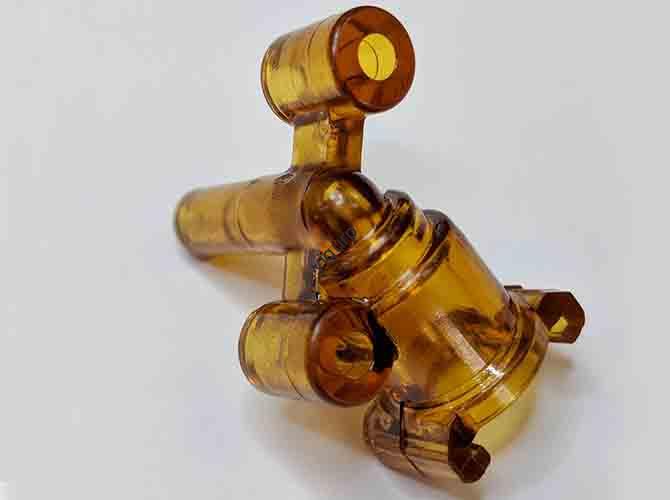
Industrial designers often face bottlenecks: le prototypage traditionnel prend des semaines et coûte des milliers de dollars, les structures creuses complexes sont presque impossibles à réaliser, et les lots personnalisés sont trop chers à produire. Mais 3D printing for industrial design solves these problems—turning concepts into tangible prototypes in hours, débloquer des idées structurelles audacieuses, et rendre la personnalisation en petits lots abordable. This guide breaks down how to leverage 3D printing to overcome design challenges and drive product success.
1. Core Advantages of 3D Printing for Industrial Design
Par rapport à la fabrication traditionnelle (like injection molding or CNC machining), 3D printing reshapes the design workflow with four unbeatable strengths. Le tableau ci-dessous met en évidence les principales différences:
| Advantage Category | 3D Printing Performance | Traditional Manufacturing Performance | Key Value for Designers |
|---|---|---|---|
| Prototypage rapide | Completes complex prototypes in4–24 hours (par ex., a plastic housing for a smartwatch) | Takes2–4 semaines pour moules + production | Validate design ideas 5–10x faster; cut iteration costs by 40–60% |
| Complex Structure Realization | Easily prints internal lattices, hollow channels, or organic shapes (par ex., lightweight chair frames with 30% less material) | Struggles with structures requiring undercuts or internal features; often needs assembly of 5+ parties | Encourages bold, functional designs (par ex., efficient cooling systems for electronics) |
| Personalized Customization | Adjusts designs in software (no mold changes); produces 1–100 custom parts at the same cost | Requires new molds ($5,000–$50,000+) for each custom version | Meets niche market needs (par ex., custom-fit medical braces or personalized fashion accessories) |
| Polyvalence des matériaux | Supports plastics (PLA, ABS), métaux (titane, aluminium), céramique, and even biomaterials | Limited to materials compatible with molds/machinery (par ex., rigid plastics or metals) | Enables multi-functional designs (par ex., flexible silicone grips for tools or heat-resistant parts for appliances) |
Exemple: A consumer electronics designer once spent 3 weeks and $3,000 on a single injection-molded prototype for a wireless earbud case. Avec l'impression 3D, they made 5 itérations dans 3 days for $200 total—fixing a button ergonomic issue that traditional prototyping would have missed.
2. Key Application Scenarios: Where 3D Printing Drives Design Success
3D printing isn’t just for prototyping—it adds value across industries, from automotive to consumer goods. Below are real-world use cases with tangible results:
2.1 Automotive Design: Speed Up Iteration & Pièces légères
- Prototypage: Tesla uses FDM 3D printing to produce dashboard prototypes in 6 heures (contre. 2 semaines avec des méthodes traditionnelles). This lets designers test 10+ button layouts in a month, reducing final product errors by 35%.
- Pièces fonctionnelles: BMW’s Designworks studio 3D prints custom air vents for concept cars. The vents have internal lattice structures that reduce weight by 25% while improving airflow—something impossible with injection molding.
2.2 Aerospace Design: Push Boundaries of Complexity
- NASA’s Jet Propulsion Laboratory (JPL) used SLS (Frittage sélectif au laser) 3D printing to create a Mars rover’s camera mount. The mount has 12 integrated parts (au lieu de 30+ assembled parts) and withstands extreme temperature swings (-120°C to 70°C). This cut production time by 60% and weight by 40%.
2.3 Biens de consommation: Turn Creativity Into Personalized Products
| Product Type | 3D Printing Impact | Example Result |
|---|---|---|
| Fashion Accessories | Customizable sunglasses frames (forme, couleur, ajuster) | Italian brand Superflex sells 3D-printed frames tailored to customers’ face scans—return rates dropped by 50% |
| Décoration d'intérieur | Organic-shaped vases or lamps with unique textures | IKEA’s 3D-printed “Sinnerlig” lamp uses wood-based PLA, allowing 20+ texture designs (contre. 2 with traditional manufacturing) |
| Dispositifs médicaux | Custom-fit orthotics (shoe inserts, braces) | Orthopedic company Össur 3D prints ankle braces in 2 jours (contre. 2 semaines) using patient foot scans—comfort ratings improved by 70% |
3. How to Choose the Right 3D Printing Technology for Your Design
Not all 3D printing methods work for every project. Use this checklist to pick the best option:
Étape 1: Define Your Design Goals
Ask yourself:
- Is this a prototype (pour tester) or a final part (for use)?
- Does the part need strength (par ex., a tool handle) ou flexibilité (par ex., une coque de téléphone)?
- What’s your budget (prototyping vs. production en petites séries)?
Étape 2: Match Technology to Goals
| 3Technologie d'impression D | Idéal pour | Options matérielles | Fourchette de coût (Par pièce) | Key Design Use Cases |
|---|---|---|---|---|
| FDM (Modélisation des dépôts fondus) | Prototypes à faible coût, durable plastic parts | PLA, ABS, PETG (rigide); TPU (flexible) | $5–50$ | Coques de téléphone, toy prototypes, poignées d'outils |
| ANS (Stéréolithographie) | Prototypes de haute précision (fine details) | Résines photopolymères (rigide, flexible, transparent) | $20–$100 | Jewelry designs, electronic component casings, modèles dentaires |
| SLS (Frittage sélectif au laser) | Fort, functional final parts | Nylon, polypropylène, poudres métalliques | $50–$500 | Composants aérospatiaux, supports automobiles, implants médicaux |
Pro Tip: For early-stage prototyping (testing shape/ergonomics), use FDM (faible coût). For late-stage prototypes (testing fit with other parts), use SLA (haute précision).
4. Common Design Challenges & 3D Printing Solutions
Even with 3D printing, designers face hurdles—but most have simple fixes:
| Défi | Cause | Solution |
|---|---|---|
| Prototype is too weak for testing | Using low-strength materials (par ex., basic PLA) pour les pièces fonctionnelles | Switch to ABS or PETG (pour les plastiques) ou du nylon (pour SLS); add internal lattice structures to boost strength without extra weight |
| Custom parts are too expensive | Overusing high-cost materials (par ex., métal) for non-critical features | Use hybrid designs: 3D print the custom part in plastic, then attach metal components (par ex., a custom handle with a metal screw insert) |
| Design details (par ex., petits trous) fail to print | Details are smaller than the printer’s minimum resolution (par ex., <0.1mm for FDM) | Adjust the design: increase hole size to 0.2mm+; use SLA (higher resolution than FDM) for fine features |
5. Future Trends: 3D Impression + Dessin industriel
The next 5 years will bring even more innovation, driven by two key trends:
5.1 Optimisation de la conception basée sur l'IA
AI tools (par ex., Generative Design) will work with 3D printing to create “optimal” designs. Par exemple:
- Input a design goal (par ex., “a chair that holds 100kg and uses 30% less material”).
- AI generates 10+ structures en treillis.
- 3D prints the best option—cutting design time by 70%.
5.2 Multi-Material & Multi-Process Printing
Future 3D printers will print parts with multiple materials in one go. Imagine a single print for a smartwatch band:
- Flexible TPU for the strap.
- Rigid ABS for the buckle.
- Conductive material for the sensor—no assembly needed.
6. Yigu Technology’s Perspective
Chez Yigu Technologie, we see 3D printing as a “design enabler,” not just a manufacturing tool. Many clients struggle to balance speed, coût, and complexity—we solve this by pairing 3D printing with tailored design support: from recommending the right technology (par ex., SLA for fine electronics) to optimizing designs for print success. We’re also integrating AI tools to help designers iterate faster. As 3D printing becomes more accessible, it will turn “impossible” designs into reality—and we’re excited to help clients lead this shift.
7. FAQ: Answers to Designers’ Top Questions
Q1: Can 3D printing be used for mass production of my design (par ex., 10,000+ parties)?
A1: It depends on the part. Pour les petits, pièces complexes (par ex., custom medical implants), 3D printing is cost-effective for mass production. Pour les grands, pièces simples (par ex., plastic cups), traditional injection molding is cheaper. A good rule: Use 3D printing if the part has >3 unique features (par ex., canaux internes) that molds can’t make.
Q2: How do I choose between plastic and metal 3D printing for my design?
A2: Prioritize plastic (FDM/SLA) if the part needs low weight, faible coût, ou flexibilité (par ex., une coque de téléphone). Choose metal (SLS) if the part needs strength or heat resistance (par ex., an automotive engine bracket). Test with a plastic prototype first—this saves money before investing in metal prints.
Q3: How can I ensure my 3D-printed prototype matches my digital design exactly?
A3: Follow two steps: 1) Use a printer with high accuracy (par ex., ±0.05mm for SLA). 2) Calibrate the printer monthly: Check nozzle height (pour FDM) or resin layer thickness (pour SLA) to avoid deviations. Most printers have free calibration tools—spend 15 minutes on this to reduce design errors by 80%.