
Si vous travaillez dans le secteur manufacturier, plomberie, or hardware design, vous en avez probablement entendu parler360 laiton—one of the most versatile and widely usedcommon brass grades in the industry. Aussi connu sous le nomalliage 360 laiton, laiton de décolletage, or by its UNS designationC36000, ce matériau se distingue par son usinabilité exceptionnelle et ses performances équilibrées. Que vous prototypiez une vanne ou produisiez des fixations en série, compréhension 360 brass’s strengths and limitations can save you time, réduire les coûts, et améliorer la qualité des produits. Décrivons tout ce que vous devez savoir.
1. 360 Brass Overview: What Makes It a Top Choice?
360 laiton (UNS C36000) est unleaded brass alloy celebrated for its industry-leadingmachinability rating of 100%—the benchmark against which all other metals are measured for machining ease. This rating means it cuts, exercices, and taps with minimal tool wear, making it ideal for high-volume production on CNC machines and screw machines.
Unlike some brass alloys that prioritize corrosion resistance over machinability, 360 brass strikes a practical balance. It adheres to strictstandard brass specifications (such as ASTM B16 and SAE J463) and is used globally in applications where precision and speed matter most. Par exemple, a leading plumbing manufacturer in Ohio reported a 25% increase in production efficiency after switching from 260 brass to 360 brass for their pipe fittings—thanks to fewer tool changes and faster cycle times.
2. Chemical Composition of 360 Laiton (C36000)
La performance de 360 brass starts with its carefully controlled chemical makeup. Below is a detailed breakdown of its components, y compriscomposition limits and key considerations likeRoHS compliance:
| Élément | Percentage Range | Rôle & Importance |
|---|---|---|
| Cuivre (Cu) | 61.5% | Provides strength, ductilité, and the characteristic brass color |
| Zinc (Zn) | 35.4% | Boosts machinability and reduces material cost without sacrificing durability |
| Plomb (Pb) | 3.1% | Enhances chip breaking (critical for clean machining) et réduit la friction |
| Fer (Fe) | ≤ 0.35% | Minimized to prevent brittleness and maintain machining consistency |
| Oligoéléments | < 0.5% total | Includes small amounts of tin (Sn) or nickel (Dans) to fine-tune properties |
A key note: Alors que lelead content dans 360 brass improves machinability, it may not meet strictRoHS compliance standards for electronics or food-contact applications. In these cases, manufacturers often switch tolow-lead brass alternatives (par ex., C37700 with <0.25% Pb) to stay compliant.
3. Mécanique & Propriétés physiques: Force, Densité, et plus encore
360 brass’s properties make it suitable for both structural and decorative uses. Ci-dessous se trouvent lesmechanical and physical properties you need to consider for your design:
- Résistance à la traction: 338–469 MPa (49,000–68,000 psi) – Strong enough for fasteners and valves but not for high-stress structural parts.
- Limite d'élasticité: 124–310 MPa (18,000–45,000 psi) – Resists permanent deformation under moderate loads.
- Élongation: 53% – Highly ductile, allowing it to be bent or formed before machining (par ex., for decorative trim).
- Densité: 8.47 g/cm³ – Heavier than aluminum (2.7 g/cm³) but lighter than stainless steel (7.9 g/cm³), balancing weight and durability.
- Modulus of Elasticity: 97 GPa – Stiffer than aluminum (69 GPa), ensuring stability in precision parts like instrument components.
- Conductivité thermique: 121 Avec(m·K) – Dissipates heat well, making it useful for electrical connectors.
- Annealing Temperature: 427–482°C (800–900°F) – Heating to this range softens the metal for easier cold working (par ex., forming tubes).
Par exemple, a maker of lock bodies uses 360 brass’s high elongation to shape the metal into curved designs, then machines the keyway with precision—all while relying on its tensile strength to ensure the lock withstands daily use.
4. Usinabilité & Fabrication: Tips for Best Results
En tant quefree-machining brass, 360 brass is designed for ease of fabrication. Here’s how to maximize its performance:
- Usinage à grande vitesse: It excels at speeds up to 3,000 pieds de surface par minute (GDF) on CNC turning centers—faster than 260 laiton (2,500 GDF) ou en acier inoxydable 303 (1,500 GDF).
- Common Processes: Idéal pour Tournage CNC, forage, tapotement, et screw machine operations. Its lead content ensures clean chip breaking, so chips don’t clog machines.
- Usure des outils: Uses standard high-speed steel (HSS) ou outils en carbure. A study by a machining shop found that carbide tools lasted 3x longer when cutting 360 brass compared to 464 naval brass.
- Cutting Fluids: Use water-soluble coolants to reduce heat and tool wear. Avoid oil-based fluids—they can react with lead and leave residues.
- Ébavurage: Machined parts may have small burrs; use vibratory tumbling or hand deburring tools for a smooth finish (critical for plumbing fittings to prevent leaks).
Un exemple concret: A fastener manufacturer in Texas produces 10,000 brass screws per hour using 360 brass on screw machines. By optimizing speeds (2,800 GDF) and using the right coolant, ils ont réduit les coûts de remplacement des outils de 40%.
5. Applications courantes: Where 360 Brass Shines
360 brass’s versatility makes it a staple in dozens of industries. Voici ses utilisations les plus populaires:
- Plomberie: Raccords, vannes, et hose barbs (its machinability ensures tight, leak-proof connections).
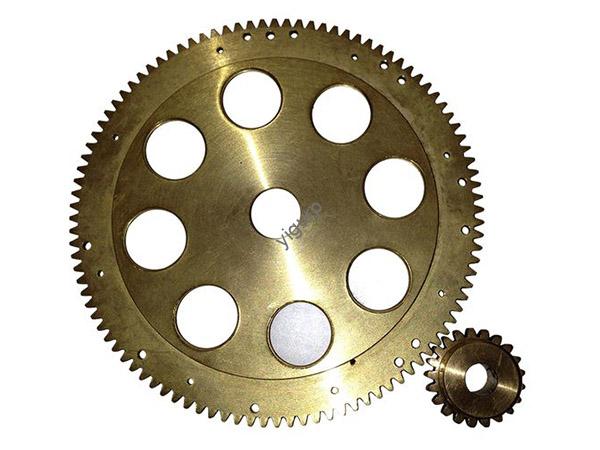
- Matériel: Attaches (vis, noix), engrenages, pinions, et builders’ hardware (doorknobs, charnières).
- Serrures & Sécurité: Lock bodies and cylinders (resists tampering and corrosion in outdoor settings).
- Électronique: Connecteurs électriques (excellent conductivity and heat dissipation).
- Ammunition: Casings (ductile enough to form and strong enough to withstand firing pressure).
- Decorative: Trim for furniture or lighting (polishes to a bright, gold-like finish).
One notable application: A major appliance brand uses 360 brass for dishwasher valves—its machinability allows for complex internal channels, while its corrosion resistance stands up to soapy water.
6. Product Forms & Normes: What’s Available?
360 brass is sold in a wide range of forms to fit different manufacturing needs, all meeting industrynormes:
| Product Form | Common Sizes | Key Standards |
|---|---|---|
| Round Rod | 3mm–150mm diameter | ASTM B16, SAE J463 |
| Hex Bar | 6mm–50mm across flats | ASME SB-16 |
| Square Bar | 5mm–100mm sides | MSA 4610 |
| Tube/Pipe | 6mm–100mm OD (various wall thicknesses) | ASTM B16 |
| Sheet/Plate | 0.5mm–10mm thickness | SAE J463 |
Suppliers typically providecertificats d'usine to verify chemical composition and properties. Par exemple, a CNC shop ordering 360 brass round rod for gears would request a mill cert to ensure the material meets the 3.1% lead content requirement for optimal machining.
7. Comparison with Other Alloys: 360 Brass vs. Concurrents
Comment 360 brass stack up against other popular metals? Comparons les facteurs clés:
| Alliage | Usinabilité (contre. 360=100%) | Cost per Volume | Résistance à la corrosion | Idéal pour |
|---|---|---|---|---|
| 360 Laiton (C36000) | 100% | Modéré ($2–$3/lb) | Bien (intérieur; avoid saltwater) | Pièces usinées, plomberie |
| 260 Laiton (C26000) | 65% | Similar to 360 | Mieux que 360 | Pièces décoratives, tôle |
| 353 Laiton (C35300) | 90% | Higher than 360 | Bien | High-precision fittings |
| 464 Naval Brass | 40% | Higher than 360 | Excellent (eau salée) | Pièces marines |
| Acier inoxydable 303 | 30% | 2x supérieur à 360 | Excellent | Food/medical equipment |
| Aluminium 6061 | 50% | Lower than 360 | Bien (with anodizing) | Pièces légères |
Par exemple, if you’re making a valve for a boat, 464 naval brass is better for corrosion resistance—but if you’re making a indoor lock, 360 brass is cheaper and easier to machine.
Yigu Technology’s Perspective on 360 Laiton
Chez Yigu Technologie, we’ve relied on360 laiton (C36000) for over a decade to produce high-precision electrical connectors and plumbing components. C'est 100% machinability rating cuts our production time by 30% par rapport à 260 laiton, while its balanced strength ensures our parts meet strict quality standards. For clients needing RoHS-compliant options, we recommend low-lead alternatives but always highlight 360 brass as the top choice for cost-effective, high-volume machining. We also help clients select the right product form—whether round rod for connectors or sheet for decorative trim—to optimize their manufacturing processes.
FAQ: Your 360 Brass Questions Answered
1. Is 360 brass suitable for outdoor applications?
360 brass has good corrosion resistance for indoor use but may tarnish or corrode in saltwater or high-humidity outdoor environments. Pour les pièces extérieures (par ex., matériel marin), choisir 464 naval brass instead.
2. Peut 360 brass be welded?
No—360 brass’s lead content makes welding difficult (lead vaporizes at high temperatures, causing weak joints). For welded parts, use lead-free brass like C37700 or stainless steel 303.
3. What’s the difference between 360 brass and C36000?
There’s no difference—360 laiton is the common name, alors queC36000 is its official UNS (Unified Numbering System) designation. Both refer to the same free-cutting, leaded brass alloy.