
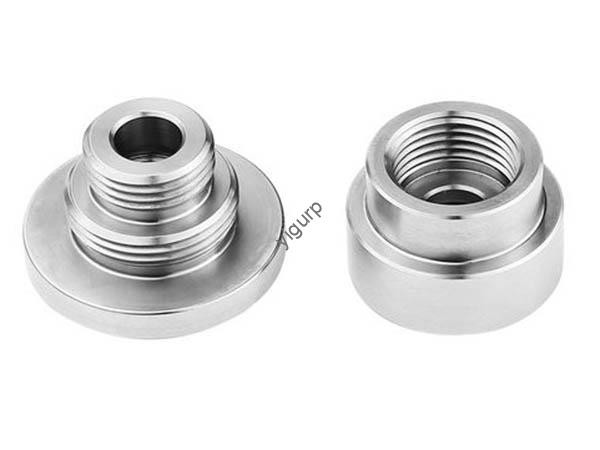
Si vous êtes un fabricant ou un ingénieur ayant besoin d'un acier inoxydable facile à usiner sans sacrifier la résistance de base à la corrosion., 303 acier inoxydable est ta solution. Conçue pour les pièces de précision en grand volume, des fixations aux engrenages, la formule enrichie en soufre du 303 résout le plus gros problème des aciers inoxydables standard.: mauvaise usinabilité. Ce guide décompose sa chimie, propriétés, et utilisation dans le monde réel, helping you cut costs and improve production efficiency.
1. 303 Acier inoxydable: Composition chimique & Alloying Elements
303 stainless steel is an austenitic grade modified with sulfur to boost machinability. Its precise chemistry balances easy cutting with basic corrosion resistance.
Key Chemical Composition (per ASTM/EN Standards)
| Élément | Gamme de contenu | Role in 303 Acier inoxydable |
|---|---|---|
| Chrome (Cr) | 17.0–19.0% | Forms apassivation layer for rust resistance |
| Nickel (Dans) | 8.0–10.0% | Stabilizes the austenitic microstructure (non magnétique) |
| Soufre (S) | 0.15–0.35% | Creates lubricating inclusions that reduce tool wear (the “machinability booster”) |
| Carbone (C) | ≤0.15% | Controls strength; kept low to avoid carbide formation |
| Manganèse (Mn) | ≤2.0% | Improves ductility and hot working ability |
| Silicium (Et) | ≤1.0% | Aids deoxidation during production |
| Phosphore (P.) | ≤0.20% | Limited to prevent brittleness |
| Molybdène (Mo) | Facultatif (traces) | Rarely added; no major impact on 303’s core traits |
Grade Comparisons: Contrairement à 304 (no sulfur, better corrosion resistance) ou 17-4 PH (martensitic, heat-treatable), 303 prioritizes machinability. Par exemple, a fastener manufacturer switched from 304 à 303: tool life increased by 40%, and production time per bolt dropped by 25%.
Traceability Tip: Always request aladle analysis certificate etheat number traceability to confirm the steel meets specs (par ex., UNS S30300, DANS 10088-1 grade 1.4305, JIS SUS303).
2. 303 Acier inoxydable: Mécanique & Propriétés physiques
303’s properties make it ideal for parts that need both precision machining and moderate strength. Here’s how it performs:
Core Mechanical & Propriétés physiques (Annealed Condition)
| Propriété | Valeur typique | Practical Impact |
|---|---|---|
| Résistance à la traction (UTS) | 620 MPa (90,000 psi) | Strong enough for gears, boulons, and small brackets |
| 0.2% Limite d'élasticité | 240 MPa (35,000 psi) | Resists bending in high-use parts (par ex., tiges de valve) |
| Élongation | 35% (dans 2 pouces) | Ductile enough for minor forming (par ex., bending tabs) |
| Dureté | 230 BHN / 85–95 HRB | Soft enough for machining, tough enough for wear |
| Densité | 8.03 g/cm³ | Lightweight for small components (par ex., pièces électroniques) |
| Conductivité thermique | 16.2 W/m·K (at 100°C) | Low heat transfer—good for parts near heat sources (par ex., boutons d'appareils) |
| Electrical Resistivity | 0.73 µΩ·m | Suitable for non-conductive applications |
| Magnetic Permeability | 1.02 μr (recuit) | Near non-magnetic—safe for electronics |
| Fatigue Endurance Limit | 240 MPa (at 10^6 cycles) | Lasts in repetitive-motion parts (par ex., arbres de pompe) |
High-Temperature Note: 303 works well up to 870°C (1,600°F) but loses strength above that. A furnace part manufacturer tested 303 at 900°C: tensile strength dropped by 30%, so they switched to 310S for higher heat resistance.
3. 303 Acier inoxydable: Usinabilité & Forming Characteristics
303’s biggest advantage is itsfree-machining ability—thanks to sulfur inclusions that act as internal lubricants. Here’s how to optimize machining:
Machinability Key Facts & Parameters
- Indice d'usinabilité: 78% (contre. 100% for B1112 free-machining steel). This means 303 coupes 78% as easily as B1112—far better than 304 (30% notation).
- Outillage: Utiliser carbide inserts (TiAlN or AlTiN coated) for faster speeds; acier rapide (HSS) works for low-volume jobs.
- Recommended Cutting Parameters:
- Vitesse: 35–45 m/min (115–148 ft/min)
- Alimentation: 0.1–0.3 mm/rev (0.004–0.012 in/rev)
- Depth of cut: 1–3 mm (0.04–0.12 in)
- Coolant: Utiliser soluble oil ou minimum quantity lubrication (MQL) to reduce heat and tool wear. Avoid dry cutting—303 can gall (stick to tools) without coolant.
Forming Tips
- Pliage: Use a bending radius of 1–2x the material thickness (par ex., 2mm d'épaisseur 303 needs a 2–4mm radius) to avoid cracking.
- Cold Heading: Limited—sulfur makes 303 prone to splitting. Stick to machining for complex shapes.
- Finition de surface: Achievable Ra 0.4–1.6 µm with proper tooling (par ex., sharp inserts, slow feed for fine finishes).
Real Example: A CNC shop machined 303 into medical device brackets. Using carbide tools and MQL, they hit Ra 0.8 µm finish and reduced tool changes from 5x to 2x per shift.
4. 303 Acier inoxydable: Résistance à la corrosion & Environmental Performance
303’s corrosion resistance is “good enough” for most non-severe environments—but it’s not as durable as 304 ou 316.
Corrosion Performance Breakdown
| Environnement | Performance | Notes |
|---|---|---|
| Indoor/dry (par ex., bureaux) | Excellent | No rust; passivation layer stays intact |
| Mild moisture (par ex., kitchens) | Bien | Clean regularly to prevent water spots |
| Marine/coastal (saltwater) | Pauvre | Sulfur inclusions attract corrosion—use 316 instead |
| Acids (par ex., vinegar, citrus) | Équitable | Resists mild acids but avoid prolonged exposure |
| Salt spray (ASTM B117) | 48–96 hours (no red rust) | Shorter than 304 (1000+ heures) |
Corrosion Protection Tips
- Passivation: Utiliser ASTM A967 passivation (citric acid is safer than nitric acid) to strengthen the passivation layer.
- Électropolissage: Improves surface smoothness, reducing crevice corrosion risk (good for food-contact parts).
- Conditionnement: Store 303 dans VCI (volatile corrosion inhibitor) packaging to prevent rust during shipping.
Étude de cas: A furniture maker used 303 for indoor chair legs. Après 2 années, no rust appeared—but when they tested 303 outdoors, it rusted within 6 mois. They switched to 316 for outdoor furniture.
5. 303 Acier inoxydable: Weldability & Joining Challenges
303 estnot weld-friendly—sulfur causes hot cracking and weak welds. Here’s how to handle joining:
Weldability Limitations & Workarounds
- Key Issue: Sulfur forms low-melting-point compounds that crack during welding (solidification cracking).
- Not Recommended: Autogenous TIG (no filler) or MIG welding—welds will likely fail under stress.
- Best Option: Utiliser 308L or 312 filler metal (AWS A5.9 ER308LSi) to dilute sulfur. Preheat to ≤100°C and keep interpass temperature ≤150°C.
- Post-Weld: Anneal at 1010°C (1850°F) pour réduire le stress, then passivate to restore corrosion resistance.
Alternative Joining Methods
- Mechanical Fasteners: Use A2 (304) or A4 (316) bolts—avoid welding when possible.
- Brazing: Use Ag-Cu-Zn filler (600–700°C) for strong, corrosion-resistant joints.
- Collage adhésif: Use epoxy adhesives for non-structural parts (par ex., garniture décorative).
Warning: A manufacturer tried TIG welding 303 gears without filler metal—50% of the gears cracked during testing. Switching to 308L filler fixed the issue.
6. 303 Acier inoxydable: Traitement thermique & Surface Hardening Options
303 is not heat-treatable for hardening, but heat treatment can improve machinability or reduce stress.
Common Heat Treatment Processes
| Processus | Temperature Range | But |
|---|---|---|
| Solution Annealing | 1010–1120°C (1850–2050°F) | Softens 303 pour usinage; restores ductility |
| Stress-Relief Annealing | 200–300°C (390–570°F) | Reduces stress from machining (empêche la déformation) |
| Bright Annealing | 1010–1120°C (H2/N2 atmosphere) | Creates a shiny surface (no scaling) |
Surface Hardening Limitations
- Nitriding/Nitrocarburizing: Not recommended—sulfur blocks nitrogen absorption.
- Laser Surface Hardening: Trials show minimal hardness gain (only 5–10% increase).
- Grenaillage: Use intensity 0.008–0.012 A to improve fatigue resistance (adds 15–20% to endurance limit).
Tip: Cold working (par ex., rolling) can raise 303’s hardness by 30–40% (par ex., 230 BHN → 320 BHN) but reduces ductility. Use this for parts needing extra wear resistance (par ex., courses de roulements).
Yigu Technology’s Perspective
Chez Yigu Technologie, nous recommandons 303 stainless steel for high-volume precision-machined parts like fasteners, engrenages, and electronics components—where machinability drives efficiency. We supply 303 in bars, feuilles, and coils (UNS S30300/EN 1.4305) with full traceability and ladle certificates. Pour les clients, we share optimized machining parameters (par ex., carbide tool speeds, coolant types) to cut tool costs. We also warn against 303 for marine or high-corrosion uses—guiding clients to 316 instead. Notre 303 undergoes salt spray testing (96 heures, pas de rouille) to ensure basic corrosion performance for indoor/outdoor non-severe applications.
FAQ
- Can 303 stainless steel be used for food-contact parts?
Yes—if passivated (selon les normes FDA) and used in dry/mild moisture environments. Avoid it for acidic food processing (par ex., tomato canning) or wet food prep (par ex., commercial sinks)—304 is better for those. - Why is 303 stainless steel harder to weld than 304?
303 has sulfur added for machinability, but sulfur forms low-melting compounds that crack during welding (solidification cracking). 304 has no sulfur, so its welds are stronger and more crack-resistant. - What’s the difference between 303 and 303Se stainless steel?
303Se uses selenium instead of sulfur to boost machinability. It has slightly better corrosion resistance than 303 (selenium inclusions are less corrosive than sulfur) but costs 10–15% more. Use 303Se for parts needing both machinability and slightly better rust resistance.