
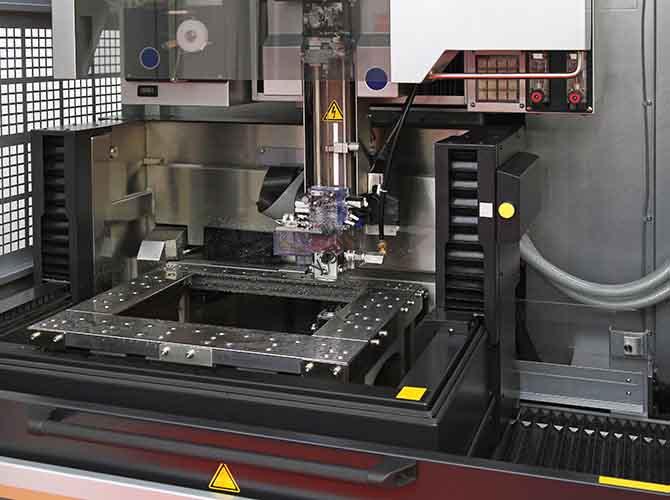
El mecanizado de grabado CNC ha revolucionado la fabricación de precisión al fusionar el control numérico por computadora con el funcionamiento de herramientas de alta velocidad., permitiendo la creación de complejos, piezas de alta precisión en diversos materiales. A diferencia del grabado manual tradicional, ofrece resultados consistentes, maneja estructuras complejas, y se adapta tanto a la producción industrial en masa como a la personalización personalizada. Este artículo analiza su mecánica principal., ventajas clave, escenarios de aplicación, and practical tips—helping you leverage this technology to solve precision machining challenges.
1. Core Basics: Definición & Principio de funcionamiento
To grasp the value of CNC engraving machining, start with its fundamental structure and operational logic. Below is a 总分结构 explaining its definition and core mechanism:
1.1 What Is CNC Engraving Machining?
CNC engraving machining is a precision subtractive manufacturing process that:
- Relies on a control numérico por computadora (CNC) system to interpret design files (p.ej., CAD models converted to G-code).
- Uses a high-speed rotating small tool (diameter often 0.1–10 mm) to cut material layer by layer—combining the principles of drilling and milling.
- Achieves micro-level precision through real-time adjustments of tool position, velocidad, and depth via the CNC system.
- Produces diverse effects (relief, chamfering, mirror finishes) on both flat and 3D surfaces, even for structures too fine for conventional large tools.
This process bridges the gap between “precision” and “flexibility,” making it a go-to for refined machining needs.
1.2 Key Mechanism: How It Ensures Precision & Eficiencia
The success of CNC engraving machining lies in its integrated system, composed of five core components. The table below details each component’s role and technical requirements:
| System Component | Core Function | Technical Specifications |
| CNC Control System | Interprets design files, controls tool movement | Supports 3–5 axis coordination; positioning accuracy ±0.005 mm for high-end models |
| Mechanical Structure | Provides stable platform for tool and workpiece | High-rigidity cast iron frame; backlash ≤0.002 mm for lead screws |
| Drive System | Translates CNC signals to tool motion | Servo motors with 1 ms response time; maximum spindle speed 60,000 RPM |
| Tool System | Executes material cutting | Carbide or diamond-coated tools; tool runout ≤0.001 mm |
| Auxiliary System | Enhances process stability | Dynamic error compensation (laser interferometer); AI visual recognition for workpiece alignment |
2. Unmatched Advantages: Why Choose CNC Engraving Machining?
CNC engraving machining outperforms traditional methods in three critical dimensions. Below is a 对比式 analysis highlighting its edge over manual engraving and conventional milling:
| Ventaja | CNC Engraving Machining | Manual Engraving | Conventional Milling |
| Precisión | Positioning accuracy ±0.01 mm; some high-end equipment reaches μ-level (0.001 milímetros) precisión | Relies on operator skill; accuracy ±0.1–0.5 mm | Bien (±0,02 milímetros) but struggles with fine structures (<1 milímetros) |
| Eficiencia | 5–10x faster than manual; processes 20–50 small parts/hour | Lento (1–2 parts/hour); prone to fatigue-induced errors | Fast for large parts but slow for intricate patterns |
| Flexibilidad | Supports 3D cutting; switches between relief, chamfering, and mirror finishes via program adjustment | Limited to simple 2D patterns; hard to replicate designs | Requires tool changes for different features; poor for complex 3D surfaces |
| Material Adaptability | Handles metals (aluminio, acero inoxidable), no metales (acrílico, madera), y compuestos (fibra de carbono) | Restricted to soft materials (madera, plástico); damages hard metals | Good for metals but less effective for brittle materials (vaso, cerámico) |
Ejemplo: 3C Electronic Part Machining
For a smartphone camera lens bezel (0.5 mm de espesor, with micro-relief patterns):
- Grabado CNC: Completes 30 parts/hour with ±0.005 mm accuracy; no post-processing needed.
- Manual Engraving: Takes 2 hours per part; 50% of parts fail due to uneven patterns.
- Conventional Milling: Cannot process 0.5 mm thin sections without deformation.
3. Key Application Scenarios: Industrias & Use Cases
CNC engraving machining serves diverse sectors, each leveraging its unique capabilities. Below is a 行业 – por – 行业 breakdown with specific examples:
3.1 Manufactura Industrial
- Fabricación de moldes: Engraves precision features (p.ej., 0.1 mm wide grooves) on steel molds, blister molds, and hot stamping molds—ensuring mold cavities match part designs exactly.
- 3C Electronics: Delivers high-gloss chamfering (Real academia de bellas artes <0.8 µm) for smartphone shells and mirror-finish machining for circuit board contacts—critical for electronic part functionality and aesthetics.
- Piezas automotrices: Creates lightweight prototypes (p.ej., engine bracket prototypes) in 1–2 days, accelerating product development cycles by 40%.
3.2 Consumer & Publicidad
- Advertising Logos: Mass-produces 3D signs (p.ej., crystal letters, two-color plate signs) with consistent font and depth—100+ identical signs/hour.
- Personalized Customization: Makes customized jade seals, metal badges, and art reliefs; replicates designs with 100% accuracy across multiple pieces.
3.3 Scientific Research & Médico
- Dispositivos médicos: Machines micron-level features (p.ej., 0.05 mm holes in surgical instruments) using dynamic error compensation—ensuring surface smoothness (Real academia de bellas artes <0.02 µm) to avoid tissue irritation.
- Instrumentos de precisión: Engraves calibration marks (0.1 mm lines) on optical instrument components; maintains ±0.001 mm accuracy for measurement reliability.
4. Practical Tips to Optimize CNC Engraving Results
To maximize efficiency and quality, follow these linear, actionable guidelines:
4.1 Selección de herramientas & Mantenimiento
- Match Tool to Material: Use diamond-coated tools for hard materials (acero inoxidable, vaso); carbide tools for aluminum/wood; PCD tools for high-gloss finishes.
- Control Tool Wear: Replace tools after 50–100 hours of use (varía según el material); use a tool presetter to measure tool length and diameter before each run—reduces error by 80%.
4.2 Parameter Adjustment
- Velocidad del husillo: Set to 15,000–30,000 RPM for aluminum; 30,000–60,000 RPM for acrylic; 5,000–10,000 RPM for stainless steel (prevents tool overheating).
- Tasa de alimentación: Use 50–100 mm/min for fine structures (<0.5 milímetros); 200–500 mm/min for larger features—balances speed and surface quality.
- Cutting Depth: Limit to 0.1–0.3 mm per pass for brittle materials (vaso); 0.5–1 mm per pass for metals—avoids material chipping.
4.3 Control de calidad
- Pre-Process Check: Use AI visual recognition to align workpieces (reduces alignment time by 50%); simulate tool paths via CAM software to detect collisions.
- Monitoreo en proceso: Deploy laser measurement systems to track tool wear in real time; trigger alerts if wear exceeds 0.005 milímetros.
- Post-Process Inspection: Use a coordinate measuring machine (MMC) to verify key dimensions; reject parts with deviations >±0.01 mm for precision applications.
5. Limitaciones & Mitigation Strategies
While powerful, CNC engraving machining has constraints. Use this 因果链 structure to address common challenges:
| Limitation | Root Cause | Mitigation Strategy |
| Not Suitable for Heavy Cutting | Light machine tool structure; small tools can’t handle large cutting volumes | Combine with conventional milling: Use milling for roughing (removes 90% de material), then CNC engraving for finishing |
| High Initial Cost | High-precision equipment (\(50,000–)500,000) and professional operation needed | For small businesses: Opt for entry-level 3-axis machines (\(30,000–)80,000); train operators via CNC system tutorials (reduces training costs by 30%) |
| Brittle Material Damage | Fast tool speed causes thermal shock in glass/ceramic | Use water-cooled spindles; reduce cutting depth to 0.05 mm per pass; preheat brittle materials to 50–100°C |
La perspectiva de la tecnología Yigu
En Yigu Tecnología, we see CNC engraving machining as a cornerstone of precision manufacturing. For 3C clients, we integrate AI visual recognition and dynamic error compensation to produce smartphone parts with ±0.005 mm accuracy—cutting defect rates by 50%. Para clientes médicos, we use diamond-coated tools and water-cooled spindles to machine surgical instruments with Ra <0.02 μm surface finish, meeting biocompatibility standards. We also offer hybrid solutions (molienda + grabado) for automotive prototypes, slashing production time by 40%. Ultimately, CNC engraving isn’t just about machining—it’s about turning complex designs into reliable, high-quality products that drive industry innovation.
Preguntas frecuentes
- What is the minimum feature size CNC engraving machining can produce?
With high-precision tools (p.ej., φ0.1 mm carbide tools) and 5-axis equipment, the minimum feature size can reach 0.05 milímetros—suitable for microelectronic components (p.ej., rastros de la placa de circuito) and medical device micro-holes.
- Can CNC engraving machining handle 3D curved surfaces?
Sí. Advanced 5-axis CNC engraving machines adjust tool angle in real time to match curved surfaces (p.ej., automotive interior panels or guitar bodies). For complex 3D parts, CAM software generates layered tool paths to ensure uniform cutting depth across the surface.
- How to reduce material waste in CNC engraving machining?
- Usar nesting software to arrange multiple small parts on a single material sheet—reduces waste by 20–30%.
- Reuse scrap material for small prototypes (p.ej., aluminum scraps for testing tool parameters).
- Opt for near-net forming: Design parts to minimize excess material, so engraving only removes necessary sections (cuts waste by 15–25%).