
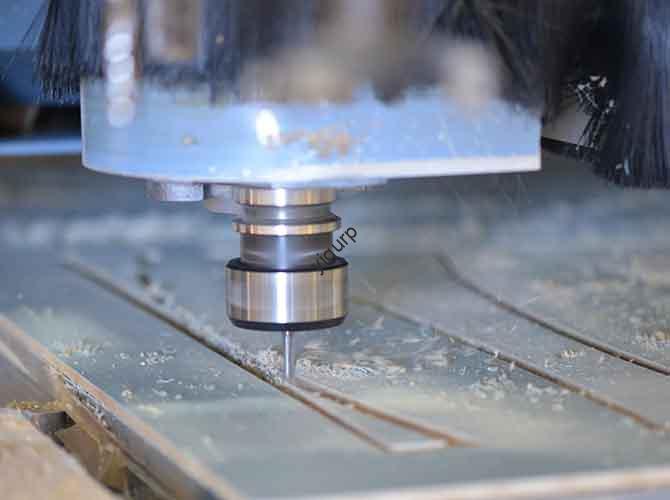
CNC precision milling has become a backbone of modern high-precision manufacturing, leveraging computer numerical control (CNC) technology to achieve micron-level accuracy in shaping diverse materials. Unlike conventional milling, it combines automated tool paths, multi-axis linkage, and real-time parameter adjustment to produce complex, consistent parts—critical for industries like aerospace, dispositivos médicos, y electrónica. This article breaks down its core features, step-by-step workflow, technical advantages, application scenarios, and operational best practices, helping you harness its potential for high-quality part production.
1. Core Features: What Defines CNC Precision Milling?
CNC precision milling’s uniqueness lies in four key traits, each addressing the demand for accuracy, flexibilidad, y eficiencia. Below is a 总分结构 explaining each feature, supported by specific data and use cases:
| Core Feature | Key Technical Details | Industrial Significance |
| Micron-Level Precision Control | Driven by CNC programs (código g) and high-precision servo systems, it achieves positioning accuracy of ±0.001–0.01 mm and repeatability of ±0.0005–0.005 mm. Tolerances are strictly controlled within ISO 286-2 IT5–IT7 standards. | Enables production of critical components like medical implants (p.ej., titanium bone screws) and aerospace engine parts, where even tiny deviations can cause functional failures. |
| Multi-Axis Linkage Capability | Supports 3-axis (X/Y/Z) to 5-axis linkage, allowing machining of non-orthogonal features (p.ej., off-axis holes), complex curved surfaces (p.ej., palas de turbina), and undercut structures. 5-axis machines add rotational axes (A/C or B/C) for full-dimensional coverage. | Eliminates the need for multiple setups (common in 3-axis milling), reducing cumulative errors by 30–50%—e.g., a 5-axis mill can machine a 3D-printed mold cavity in one cycle vs. 3 cycles with 3-axis equipment. |
| Automatizado & Efficient Processing | Pre-written CNC programs automate tool changes, feed rate adjustments, and cutting path execution, reducing manual intervention by 80–90%. High-speed spindles (10,000–40,000 RPM) enable fast material removal without compromising accuracy. | Boosts production efficiency by 50–100% vs. manual milling; p.ej., a smartphone heat sink production line processes 200+ parts/hour with consistent quality. |
| Broad Material Compatibility | Processes metals (aleaciones de aluminio, acero inoxidable, titanio, aleaciones de magnesio) and non-metals (plástica, compuestos, cerámica). For hard materials (p.ej., CDH 50+ acero), it uses carbide or diamond-coated tools to maintain precision. | Adapts to diverse industry needs—from lightweight aluminum aerospace parts to high-strength stainless steel medical instruments. |
2. Flujo de trabajo paso a paso: From Design to Inspection
CNC precision milling follows a linear, rigorous workflow to ensure part accuracy and consistency. The table below details each stage, key operations, and quality control requirements:
| Workflow Stage | Key Operations | Quality Control Measures |
| 1. Diseño & Programación | – Use CAD software (p.ej., SolidWorks, AutoCAD) to create a 3D model of the part.- Convert the model to G-code via CAM software (p.ej., cámara maestra, UG/NX), optimizing tool paths (p.ej., spiral milling for cavities, contour milling for edges) and setting parameters (tasa de avance, velocidad del husillo). | – Verify G-code via simulation (p.ej., using Vericut) to detect collisions or overcuts.- Ensure tool path optimization reduces empty strokes by 20–30% (saves machining time). |
| 2. Configuración de la máquina | – Secure the workpiece to the machine table using precision fixtures (p.ej., vacuum chucks, vises) with clamping accuracy ±0.005 mm.- Install the appropriate tool (p.ej., carbide end mill for steel, PCD tool for aluminum) and calibrate tool length/diameter via a tool presetter (precisión ±0,001 mm).- Set the workpiece coordinate system (G54–G59) using a touch probe. | – Check fixture rigidity (no vibration during test runs).- Verify tool runout (≤0.002 mm) to avoid surface defects. |
| 3. Machining Stages | – Rough Machining: Use large-diameter tools (p.ej., φ20 mm end mill) to remove 80–90% of excess material at high feed rates (1000–3000 mm/min), leaving 0.1–0.3 mm allowance for finishing.- Semi-Finishing: Adjust to smaller tools (p.ej., φ10 mm end mill) and lower feed rates (500–1500 mm/min) to refine shape, reducing allowance to 0.02–0.05 mm.- Refinamiento: Use fine tools (p.ej., φ3 mm ball end mill) and ultra-low feed rates (100–500 mm/min) to achieve target dimensions and surface finish (Ra 0.1–1.6 μm). | – Monitor cutting temperature (≤300°C for aluminum, ≤500°C for steel) to prevent tool wear.- Check dimensional accuracy mid-process using a coordinate measuring machine (MMC) para características críticas. |
| 4. Postprocesamiento & Inspección | – Post-Treatment: Apply surface treatments (passivation for stainless steel, anodizing for aluminum, electroplating for aesthetics) to enhance corrosion resistance or functionality.- Inspección de calidad: Conduct First Article Inspection (FAI) to verify all dimensions against design drawings. Use optical comparators for surface finish and X-ray for internal defects (para piezas críticas). | – Ensure post-treatment does not alter dimensions (tolerance deviation ≤0.005 mm).- FAI pass rate ≥99% to avoid batch defects. |
3. Technical Advantages: Why Choose CNC Precision Milling?
CNC precision milling outperforms conventional manufacturing methods in four critical areas. Below is a 对比式 analysis against manual milling and traditional CNC milling:
| Advantage | CNC Precision Milling | Manual Milling | Traditional CNC Milling (Non-Precision) |
| Exactitud | ±0.001–0.01 mm positioning accuracy; IT5–IT7 tolerances | ±0.1–0.5 mm accuracy; dependent on operator skill | ±0.01–0.05 mm accuracy; IT7–IT9 tolerances |
| Consistencia | Procedural control ensures 99%+ part consistency in batches of 1000+ | High variability (5–10% defect rate) due to human error | Moderate consistency (2–5% defect rate) but less precise than precision CNC |
| Complexity Handling | Machines 3D curved surfaces, socavados, and multi-hole arrays in one setup | Limited to 2D or simple 3D features; requires multiple setups | Handles basic 3D features but struggles with tight undercuts or non-orthogonal holes |
| Eficiencia | High-speed spindles + automated tool changes = 50–100% faster than manual | Lento (1–2 parts/hour for complex parts) | Faster than manual but 20–30% slower than precision CNC (due to lower spindle speeds) |
Ejemplo: For a medical device bracket (tolerancia ±0,005 mm, Real academia de bellas artes 0.8 µm):
- CNC Precision Milling: 10 partes/hora, 0.5% tasa de defectos.
- Manual Milling: 0.5 partes/hora, 8% tasa de defectos.
- Traditional CNC Milling: 8 partes/hora, 3% defect rate but fails to meet Ra 0.8 μm surface finish.
4. Key Application Scenarios: Industry-by-Industry Breakdown
CNC precision milling serves diverse sectors, each leveraging its accuracy and flexibility. The table below highlights critical applications and their rationales:
| Industria | Key Applications | Rationale for Choosing CNC Precision Milling |
| Aeroespacial | Palas de turbina, aircraft structural brackets, avionic system housings | Requires high strength-to-weight ratio (p.ej., titanium parts) and micron-level accuracy to withstand extreme flight conditions. 5-axis milling handles complex blade curves. |
| Dispositivos médicos | Titanium bone implants, surgical instrument jaws, diagnostic equipment components | Materiales biocompatibles (titanio, medical-grade stainless steel) need precise shaping to avoid tissue irritation. Accuracy ensures implant fit (p.ej., hip joint components with ±0.01 mm tolerance). |
| Electrónica | Smartphone/tablet middle frames, 5G base station filters, semiconductor packaging molds | Miniaturized parts (p.ej., 0.5 mm thin phone frames) require tight tolerances and smooth surfaces. High-speed milling meets high-volume production demands. |
| Automotor (High-End) | EV motor cores, transmission gears, carcasas de sensores | Electric vehicles demand lightweight (aluminum/magnesium) and precise parts to improve energy efficiency. CNC precision milling ensures gear tooth accuracy (±0,005 mm) for smooth operation. |
| Moho & Die | Cavidades del molde de inyección, stamping die inserts, electrode manufacturing | Mold components need ultra-smooth surfaces (Ra 0.1–0.4 μm) to replicate part details. Precision milling reduces mold polishing time by 60–70%. |
5. Operational Precautions: Avoid Common Pitfalls
To maximize precision and efficiency, follow these actionable guidelines, organized as a list for clarity:
- Selección de herramientas: Match tool material to workpiece hardness:
- herramientas de carburo (p.ej., WC-Co) for steel, acero inoxidable, and titanium (resist high temperatures).
- Polycrystalline diamond (PCD) tools for aluminum and non-metals (achieve Ra <0.2 μm surface finish).
- High-speed steel (HSS) tools for low-hardness plastics (cost-effective for small batches).
- Enfriamiento & Lubrication:
- Use water-soluble coolant for aluminum (prevents oxidation) and oil-based coolant for steel (reduces friction).
- Ensure coolant flow rate (5–10 L/min) fully covers the cutting zone—prevents tool wear by 30–40% and improves surface finish.
- Avoid Overcutting:
- Program tool radius compensation (G41/G42) to account for tool diameter (critical for contour milling).
- Use “climb milling” (tool rotates in the same direction as workpiece feed) for steel to reduce tool deflection and overcut risk.
- Machine Maintenance:
- Calibrate spindle accuracy monthly (use a laser interferometer) to ensure runout ≤0.002 mm.
- Lubricate guide rails every 8 hours of operation (use lithium-based grease) to maintain positioning precision.
- Replace worn servo motors every 5000+ operating hours to avoid accuracy drift.
La perspectiva de la tecnología Yigu
En Yigu Tecnología, we see CNC precision milling as a cornerstone of high-reliability manufacturing. For aerospace clients, we use 5-axis precision mills with laser calibration (±0.0005 mm accuracy) to produce turbine blades with Ra 0.4 μm surface finish—meeting strict aerospace standards. For medical clients, our PCD tooling and vacuum chucks ensure titanium implants have ±0.005 mm tolerance and biocompatible surfaces. We also optimize tool paths via AI-driven CAM software, cutting machining time by 25% while maintaining precision. Ultimately, CNC precision milling isn’t just about accuracy—it’s about delivering parts that drive trust in critical applications, from life-saving medical devices to high-performance aircraft.
Preguntas frecuentes
- What is the minimum feature size achievable with CNC precision milling?
With high-precision tools (p.ej., φ0.1 mm micro-end mills) y máquinas de 5 ejes, the minimum feature size can reach 0.05 milímetros (p.ej., micro-holes in semiconductor components). Key requirements: ultra-low feed rates (50–100 mm/min), high spindle speeds (40,000 RPM), and vibration-dampened machine bases.
- Can CNC precision milling process composite materials (p.ej., carbon fiber-reinforced polymer)?
Yes—by using specialized tools (p.ej., diamond-coated end mills) and low cutting temperatures (≤200°C) to prevent fiber fraying. We recommend climb milling with a 0.02–0.05 mm depth of cut and air cooling (avoids coolant absorption by composites). Most composites can be milled to Ra 0.8–1.6 μm surface finish.
- How often should CNC precision milling machines be calibrated to maintain accuracy?
Para producción de gran volumen (1000+ parts/week), calibrate monthly using a laser interferometer and ball bar test to correct positioning errors. For low-volume, high-precision jobs (p.ej., implantes medicos), calibrate every 2 semanas or after 500 operating hours. Regular calibration ensures accuracy remains within ±0.001–0.005 mm.