
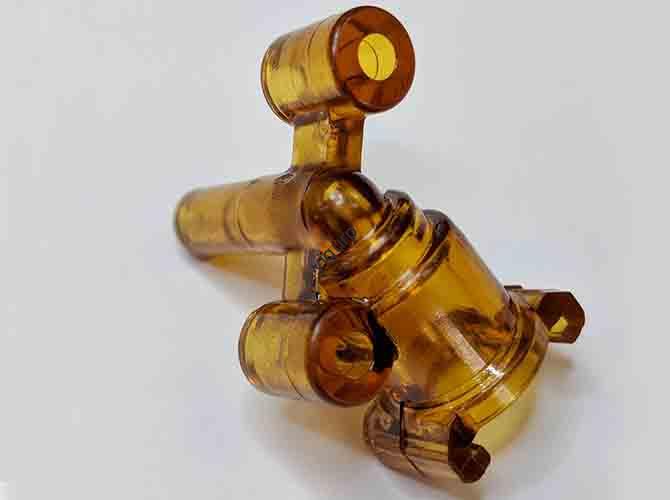
El CNC machining electric iron prototype process is a systematic workflow that transforms design concepts into physical prototypes, validar la autenticidad de la apariencia, estabilidad estructural, eficiencia de conducción de calor, y lógica funcional central (p.ej., sellado del tanque de agua, emisión de vapor). Este artículo desglosa el proceso paso a paso, desde el diseño preliminar hasta la depuración final, utilizando tablas basadas en datos., directrices prácticas, and troubleshooting tips to help you navigate key challenges and ensure prototype success.
1. Preparación preliminar: Lay the Foundation for Machining
Preliminary preparation defines the direction of the entire prototype development. It focuses on two core tasks: 3modelado D & structural design y selección de materiales, both tailored to the unique needs of electric irons (p.ej., resistencia al calor, estanqueidad al vapor, ergonomic operation).
1.1 3Modelado D & Structural Design
Use professional 3D modeling software to create a detailed prototype model, ensuring structural rationality and processability for CNC machining.
- Software Selection: Prioritize tools like SolidWorks, UG NX, o Pro/E—they support parametric design, allowing easy adjustment of key dimensions (p.ej., base plate size, handle length) and compatibility with CAM software for machining.
- Core Design Focus:
- Appearance Simulation: Replicate the real electric iron’s shape, including the base plate (curved for fabric fitting), water tank (integrated or detachable), handle (ergonomic curve), steam nozzle (multiple small holes), control buttons, y heating element cavity (reserved for functional testing).
- Functional Part Simplification: Optimize internal structures for CNC machining—for example, simplify the steam channel (avoid complex undercuts), water inlet (reserve thread for caps), y button grooves (ensure press feedback simulation).
- Detachable Design: Design component connections for hassle-free assembly:
- Base plate: Use bolted joints with the main body (reserve M2–M3 screw holes); ensure parallelism for uniform ironing.
- Water tank: Adopt snap-fit or threaded connections (add sealing grooves for silicone rings to prevent leakage).
- Key Dimension Control: Ensure critical parameters meet practical use standards:
- Base plate size: 150×200mm (tolerance ±0.1mm, for covering fabric areas).
- Water tank capacity: 100–150mL (tolerance ±5mL, for continuous steam supply).
- Handle grip diameter: 28–32mm (tolerance ±0.1mm, for comfortable holding).
Why is this important? A missing detail—like unreserved sealing grooves for the water tank—can force rework, increasing costs by 20–25% and delaying timelines by 2–3 days.
1.2 Selección de materiales: Match Properties to Components
Different parts of the electric iron require materials with specific characteristics (p.ej., heat conductivity for base plates, transparency for water tanks). The table below compares the most suitable options, along with their uses and processing requirements:
| Componente | Material | Propiedades clave | Processing Requirements | Rango de costos (por kilogramo) |
| Base Plate | Aleación de aluminio (6061) | Alta conductividad térmica, ligero | Sandblasted to simulate Teflon texture; flatness error ≤0.02mm | \(6–)10 |
| Water Tank | Transparent Acrylic | Alta transmisión de luz (≥90%), resistencia al calor (hasta 120°C) | Edge chamfer (R1–R2mm); polish to transparency; apply anti-scratch film | \(8–)12 |
| Main Body & Handle | ABS/PC Blend | Resistencia al impacto, heat insulation (up to 80°C) | Spray matte PU paint (simulates real iron texture); Ra1.6–Ra3.2 after sanding | \(3–)6 |
| Control Buttons | PA66 Nylon | Resistencia al desgaste, flexible | Laser engraving for temperature marks; no sharp edges | \(4–)7 |
| Sealing Rings | Caucho de silicona | Resistencia a altas temperaturas (hasta 200°C), waterproof | Molded (no CNC machining); fit into water tank grooves | \(9–)13 |
Ejemplo: El base plate uses aluminum alloy for its excellent thermal conductivity (167 W/m·K)—simulating real iron heating performance—while the water tank chooses acrylic for transparency, allowing users to monitor water levels.
2. Proceso de mecanizado CNC: From Setup to Component Production
The CNC machining phase is the core of prototype creation. It follows a linear workflow: máquina & tool preparation → programming & simulation → clamping & machining → inspection & correction.
2.1 Machine & Preparación de herramientas
Proper setup ensures machining accuracy and efficiency, especially for mixed plastic and metal processing.
- Machine Requirements:
- Use a high-precision three-axis or multi-axis CNC machine (positioning accuracy ±0.01mm) to handle both small parts (p.ej., botones) y componentes grandes (p.ej., placas base).
- Equip with a dual-coolant system: emulsion for metal parts (prevents tool sticking) and compressed air for plastics (avoids material melting).
- Selección de herramientas:
| Machining Task | Tipo de herramienta | Presupuesto | Solicitud |
| Roughing | Carbide Milling Cutter | Φ6–Φ10mm, 2–3 teeth | Remove 80–90% of blank allowance (p.ej., base plate outer contour) |
| Refinamiento | High-Speed Steel (HSS) Milling Cutter | Φ2–Φ4mm, 4–6 teeth | Improve surface quality (p.ej., handle curved surface) |
| Drilling/Tapping | Cobalt Steel Drill Bit/Tap | Drill: Φ2–Φ6mm; Tap: M2–M3 | Process mounting holes (p.ej., base plate screw holes) |
| Curved Surface Machining | Ball Nose Cutter | Φ2–Φ6mm | Shape structures like base plate curves, handle grips |
| Groove Cutting | Groove Cutter | Φ3–Φ5mm | Cut sealing grooves (p.ej., water tank silicone ring slots) |
2.2 Programación & Simulación
Precise programming avoids machining errors and ensures components match design specs.
- Model Import: Import the 3D model into CAM software (p.ej., cámara maestra, PowerMill) and split it into independent parts (base plate, water tank, handle, botones) for separate programming—this reduces toolpath complexity.
- Toolpath Planning:
- Base Plate: Usar “contour milling” for the outer contour, “surface milling” for the curved ironing surface (ensure flatness ≤0.02mm), y “perforación” for heat dissipation holes (Φ1–2mm).
- Water Tank: Adopt “fresado de bolsillo” for the internal cavity (reserve 0.1–0.2mm assembly clearance) y “groove milling” for the sealing ring slot.
- Botones: Usar “profile milling” for the outer shape and “grabado” for temperature marks (depth 0.1–0.2mm).
- Simulation Verification: Simulate toolpaths in software to check for:
- Interference: Ensure tools don’t collide with the machine table or workpiece (p.ej., avoid water tank cavity tool collision).
- Overcutting: Prevent excessive material removal (p.ej., keep water tank wall thickness within 1.2–1.5mm ±0.05mm).
2.3 Clamping & Mecanizado
Proper clamping and parameter setting prevent deformation and ensure precision—critical for electric iron parts that need heat conduction and steam tightness.
- Clamping Methods:
| Tipo de componente | Clamping Method | Key Precautions |
| Piezas pequeñas (Botones, Nozzles) | Precision Flat Pliers/Vacuum Suction Cup | Align with machine coordinate system; use soft rubber pads to avoid surface scratches |
| Piezas grandes (Base Plate, Water Tank) | Bolt Platen/Special Clamp | Distribute clamping force evenly (≤40N) to prevent thin-wall deformation (p.ej., water tank side panels) |
- Parámetros de mecanizado:
| Material | Machining Stage | Velocidad (rpm) | Tasa de alimentación (mm/diente) | Cutting Depth (milímetros) | Coolant |
| Aleación de aluminio (Base Plate) | Roughing | 15000–20000 | 0.15–0,3 | 2–5 | Emulsion |
| Aleación de aluminio (Base Plate) | Refinamiento | 20000–25000 | 0.08–0.15 | 0.1–0,3 | Emulsion |
| Acrílico (Water Tank) | Roughing | 800–1200 | 0.2–0.5 | 3–6 | Compressed Air |
| Acrílico (Water Tank) | Refinamiento | 1500–2000 | 0.1–0.2 | 0.1–0.2 | Compressed Air |
| ABS/PC (Handle) | Refinamiento | 1800–2200 | 0.12–0.18 | 0.1–0.2 | Compressed Air |
Critical Tip: For acrylic water tanks, keep cutting speed ≤2000rpm—high speeds generate excessive heat, causing cracks or clouding (ruining water level visibility and pressure resistance).
2.4 Inspección & Correction
Strict inspection ensures components meet design standards—essential for electric iron functionality (p.ej., heat conduction, estanqueidad al vapor).
- Inspección dimensional:
- Use calipers/micrometers to measure key dimensions: base plate flatness (≤0.02mm), water tank wall thickness (1.2–1.5mm ±0.05mm).
- Use a Coordinate Measuring Machine (MMC) to check complex surfaces: handle curve roundness (error ≤0.02mm), water tank sealing groove position (±0,03 mm).
- Surface Inspection:
- Visually check for scratches, rebabas, or uneven transparency (for acrylic parts).
- Polish defective areas: Use 800–2000 mesh sandpaper for ABS burrs; use acrylic polish for clouded water tanks.
- Correction Measures:
- Dimensional deviation: Adjust tool compensation values (p.ej., reduce feed rate by 0.05mm/tooth if the base plate is too thin).
- Poor surface roughness: Add a polishing step (p.ej., usar 2000 mesh sandpaper for acrylic water tanks).
3. Postprocesamiento & Asamblea: Enhance Functionality & Estética
Post-processing removes flaws and prepares components for assembly, while careful assembly ensures the prototype works as intended (p.ej., no steam leakage, smooth button operation).
3.1 Postprocesamiento
- Desbarbado & Cleaning:
- Metal Parts (Base Plate): Use files and grinders to remove edge burrs; clean emulsion residue with alcohol (prevents corrosion); sandblast to simulate Teflon texture.
- Plastic Parts (Water Tank, Handle): Lightly grind burrs with a blade or 1200 mesh sandpaper; use an anti-static brush to remove chips (avoids dust adsorption on transparent surfaces).
- Tratamiento superficial:
- Main Body & Handle: Spray matte PU paint (cure at 60°C for 2 horas) to simulate the texture of a real electric iron; silk-screen high-temperature ink for brand logos.
- Botones: Laser engrave temperature marks (p.ej., “Bajo,” “Medio,” “Alto”) using high-contrast ink for visibility.
- Acrylic Water Tank: Polish with acrylic-specific polish to restore transparency; apply anti-scratch film (reduces surface damage by 40%).
- Special Process:
- Steam nozzle holes: Drill small holes (Φ0.5–1mm) with a precision drill or use laser cutting (ensures uniform steam distribution).
- Threaded holes: Tap M2–M3 threads for component assembly (pre-drill bottom holes to avoid thread stripping).
3.2 Asamblea & Debugging
Follow a sequential assembly order to avoid rework—start with core functional parts (base plate, water tank), then add outer components.
- Core Component Installation:
- Mount the base plate to the main body (fasten with M2–M3 screws; esfuerzo de torsión: 0.8–1.0 N·m to avoid deformation); ensure parallelism (deviation ≤0.02mm).
- Install the water tank (place silicone sealing rings in the groove first; test for tightness—no gaps >0.05mm).
- Functional Part Installation:
- Attach the handle to the main body (snap or bolt on; test grip comfort—no sharp edges).
- Install control buttons into their grooves (test press feedback; no sticking or looseness).
- Functional Debugging:
| Test Item | Tools/Methods | Pass Criteria |
|———–|—————|—————|
| Steam Tightness | Water injection + pressure test | No steam leakage from joints (pressure drop ≤0.01MPa in 10 minutos) |
| Button Operation | Manual pressing | Smooth feedback; clear temperature mark recognition; no sticking |
| Base Plate Flatness | Straightedge + feeler gauge | Flatness error ≤0.02mm; no uneven areas affecting ironing |
| Steam Distribution | Inspección visual (dye steam) | Uniform steam flow from nozzle holes; no blockages |
4. Key Precautions: Avoid Common Issues
Proactive measures prevent defects and rework—saving time and costs in the prototype process.
- Material Deformation Control:
- Acrylic Water Tanks: Reduce continuous cutting time to 10–15 minutes per part; use segmented processing to avoid heat accumulation (which causes warping and pressure leakage).
- Aluminum Alloy Base Plates: Después del mecanizado, age the part (natural cooling for 24 horas) to eliminate internal stress—prevents post-assembly deformation.
- Monitoreo de desgaste de herramientas:
- Replace roughing tools every 10 hours and finishing tools every 50 hours—dull tools increase dimensional error by 0.05mm or more (ruining base plate flatness).
- Use a tool preset to check edge length and radius deviations before machining (p.ej., ensure ball nose cutter radius is 3mm ±0.01mm for base plate curves).
- Accuracy Compensation:
- Para piezas de pared delgada (p.ej., water tank side panels, 1.2mm de espesor): Reserve 0.1–0.2mm machining allowance to offset clamping force deformation.
- Correct material size deviations via trial cutting: If the acrylic water tank blank is 0.1mm thicker than designed, adjust cutting depth to 0.2mm (instead of 0.1mm) para terminar.
La perspectiva de la tecnología Yigu
En Yigu Tecnología, we see the CNC machining electric iron prototype process as a “performance validator”—it turns design ideas into tangible products while identifying heat conduction and steam leakage flaws early. Our team prioritizes two pillars: precision and functionality. For critical parts like base plates, we use aluminum alloy with CNC finishing (flatness ≤0.02mm) to ensure uniform heat distribution. For water tanks, we optimize sealing groove accuracy (±0,03 mm) and use high-transparency acrylic to prevent leakage and ensure visibility. We also integrate 3D scanning post-machining to verify dimensional accuracy, cutting rework rates by 25%. By focusing on these details, we help clients reduce time-to-market by 1–2 weeks. Whether you need an appearance or functional prototype, we tailor solutions to meet your brand’s performance goals.
Preguntas frecuentes
- q: How long does the entire CNC machining electric iron prototype process take?
A: Typically 9–13 working days. This includes 1–2 days for preparation (modelado, selección de materiales), 3–4 days for CNC machining, 1–2 days for post-processing (cuadro, pulido), 2–3 days for assembly, y 1 day for debugging/inspection.
- q: Can I replace aluminum alloy with ABS plastic for the base plate?
A: No. ABS plastic has poor thermal conductivity (0.2 W/m·K)—far lower than aluminum alloy’s 167 W/m·K—making it unable to simulate real iron heating performance. Además, ABS deforms at 80°C, which is below the electric iron’s working temperature (100–200°C). Aluminum alloy is the only suitable material for the base plate.
- q: What causes uneven steam distribution from the nozzle, and how to fix it?
A: Common causes are uneven nozzle hole size (>0.1mm deviation) or blocked holes. Correcciones: Re-drill nozzle holes with a precision drill (Φ0.5–1mm ±0.03mm) or use laser cutting for uniform size; clean holes with compressed air to remove debris. This resolves 90% of steam distribution issues in 1–2 hours.