
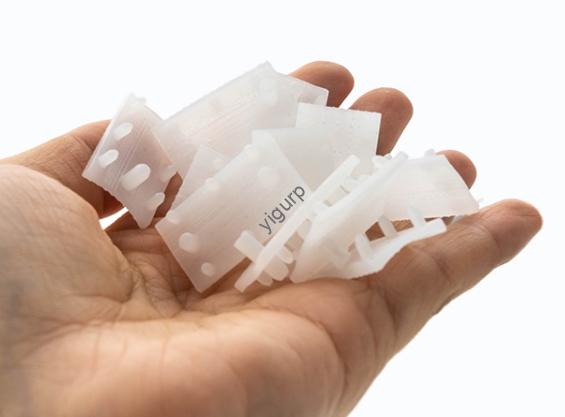
¿Es usted un diseñador que desea crear modelos con detalles intrincados?? O un comprador confundido acerca de qué impresora 3D se adapta a sus proyectos de alta precisión, como la fabricación de joyas o la creación de modelos dentales.? Photosensitive resin 3D printers might be your ideal solution. Estas impresoras utilizan luz – Tecnología de curado para convertir resina líquida en objetos 3D detallados., standing out in fields that demand smooth surfaces and fine details. This guide will walk you through how they work, their key features, real – world applications, and tips for choosing the right one—all to help you make informed decisions and avoid costly mistakes.
1. How Does a Photosensitive Resin 3D Printer Work?
Understanding the working principle of a photosensitive resin 3D printer is key to using it effectively. It’s a straightforward yet precise process that revolves around light – driven resin curing.
Primero, the printer is loaded with liquid photosensitive resin. This resin is a special material that hardens when exposed to specific wavelengths of light, usually UV light. Entonces, the printer’s light source (most commonly a UV laser or a digital light projector) kicks into action. It emits light that follows the design of each layer of the 3D model. As the light hits the liquid resin, the resin in the exposed area cures and solidifies, forming one layer of the object.
After one layer is completed, the build platform moves up or down by a tiny distance (equal to the thickness of one layer). Fresh liquid resin flows into the gap, and the light source starts working on the next layer. This layer – por – layer process repeats until the entire 3D object is fully formed. Finalmente, the printed object is removed from the resin tank, and post – processing steps like cleaning excess resin and further curing (si es necesario) are done to get the final product.
Por ejemplo, el Formlabs Form 4, a popular photosensitive resin 3D printer, uses a UV laser and follows this exact process. It can create highly detailed models with layer thicknesses as low as 0.025mm, showing just how precise this working method can be.
2. Key Features of Photosensitive Resin 3D Printers
Photosensitive resin 3D printers have unique features that make them a top choice for specific 3D printing tasks. Let’s break down these features and see how they benefit different users.
High Definition for Exquisite Details
The biggest advantage of these printers is their high definition. Thanks to the precision of light – curing technology, they can print models with incredibly fine details and smooth surfaces. The dimensional tolerance of top – tier photosensitive resin 3D printers can reach ±0.05mm, and layer thicknesses can be as thin as 0.025mm. This is a huge plus for projects where every small detail matters. Por ejemplo, when making jewelry molds, the printer can capture even the tiniest patterns on the mold, ensuring that the final jewelry piece is a perfect replica of the design.
Diverse Material Options for Various Needs
Another great feature is the diverse range of photosensitive resin materials available. Beyond the standard photosensitive resin, there are translucent and fully transparent options. Each type of resin has its own unique properties, making them suitable for different applications:
| Resin Type | Propiedades clave | Suitable Applications |
| Standard Photosensitive Resin | Good strength and durability, fácil de imprimir | General – purpose models, prototypes for small gadgets |
| Translucent Photosensitive Resin | Semi – transparent appearance, similar to frosted glass | Luz – related products, such as lamp shades, vitrinas |
| Fully Transparent Photosensitive Resin | High transparency, clear like glass | Componentes de dispositivos médicos (where visibility is important), decorative items like crystal – like figurines |
Easy Post – Processing for Customization
Models printed with photosensitive resin are easy to post – proceso. Unlike some other 3D printing methods that require complex sanding or cutting, these resin models can be quickly cleaned with isopropyl alcohol to remove excess resin. After cleaning, you can easily sand them to get an even smoother surface or paint them to match your desired color scheme. This post – processing flexibility allows you to customize the final look of the model to a great extent. Por ejemplo, a toy designer can print a basic figurine with a photosensitive resin 3D printer and then paint it with vibrant colors to make it more attractive to kids.
Important Consideration: Light Sensitivity of Printed Items
It’s important to note that items printed with photosensitive resin have a luz – sensitive drawback. When exposed to light for a long time, they may gradually become brittle and yellow. This means you need to store them properly. Por ejemplo, if you print a decorative model for your home, you should keep it away from direct sunlight or strong indoor lighting. You can also apply a protective coating to the model to slow down the yellowing and brittling process.
3. Real – World Applications and Case Studies
Photosensitive resin 3D printers are widely used in various industries due to their high precision and detail – capturing ability. Let’s look at some real – world cases to see how they’re making a difference.
Jewelry Making Industry
In jewelry making, precision and intricate designs are everything. A small jewelry workshop in New York started using a Anycubic Photon Mono X photosensitive resin 3D printer. Before using this printer, they spent hours carving wax molds by hand, which was time – consuming and often led to inconsistent results. With the 3D printer, they can now print wax – like resin molds in a matter of hours. These molds have perfect details, from tiny gemstone settings to delicate engravings. The workshop owner reported that their production efficiency increased by 60%, and the number of customer complaints about inconsistent mold quality dropped to almost zero.
Dental Industry
The dental industry relies heavily on precise models for procedures like crowns and bridges. A dental clinic in London adopted the 3D Systems NextDent 5100 photosensitive resin 3D printer. This printer can print dental models with extremely high accuracy, matching the patient’s teeth structure perfectly. Before using the 3D printer, the clinic had to send impressions to an external lab, que tomó 3 – 5 days to produce the models. Ahora, they can print the models in – house in just a few hours. This not only reduced the waiting time for patients but also allowed dentists to make adjustments to the models immediately, improving the overall quality of dental procedures.
Figurine and Toy Design
Figurine and toy designers need to create models with unique shapes and fine details to attract consumers. A toy design company in Tokyo used a Elegoo Mars 4 Ultra photosensitive resin 3D printer to develop a new line of collectible figurines. The printer was able to capture every small detail of the figurines, from the texture of the clothing to the expressions on the faces. The company conducted a market test and found that the figurines printed with the 3D printer were 30% more popular among consumers compared to their previous hand – made prototypes. This led to a significant increase in pre – orders for the new figurine line.
4. How to Choose the Right Photosensitive Resin 3D Printer
Con tantas opciones disponibles, choosing the right photosensitive resin 3D printer can be a challenge. Here are some key factors to consider, from a product 研发设计 engineer and 采购员’s perspective.
Print Precision and Resolution
Primero, focus on print precision and resolution. Look at the dimensional tolerance and layer thickness of the printer. If you’re working on projects that require extremely fine details, like jewelry molds or dental models, choose a printer with a dimensional tolerance of ±0.05mm or better and a minimum layer thickness of 0.025mm. For general – purpose projects, a printer with a dimensional tolerance of ±0.1mm and a minimum layer thickness of 0.05mm may be sufficient.
Build Volume
El build volume of the printer is another important factor. It determines the maximum size of the models you can print. If you mainly print small items like jewelry or dental models, a printer with a build volume of around 150x150x200mm may be enough. But if you need to print larger models, such as small prototypes for household appliances, you should opt for a printer with a larger build volume, like 200x200x250mm or more.
Compatibilidad de materiales
Check the compatibilidad de materiales of the printer. Make sure it can work with the type of photosensitive resin you need for your projects. Some printers are only compatible with specific brands or types of resin, which can limit your options. Choose a printer that supports a wide range of resin types, including standard, translúcido, and transparent resins, to give yourself more flexibility.
Price and After – Sales Support
As a 采购员,price and after – sales support are crucial. Photosensitive resin 3D printers range in price from around \(300 a más \)10,000. Set a budget based on your needs. For small workshops or startups, mid – range printers (\(1,000 – \)3,000) like the Anycubic Photon Mono X or Elegoo Mars 4 Ultra offer a good balance of performance and price. Also, look for a brand that provides good after – sales support, such as a warranty period of at least 1 año, easy access to replacement parts, and responsive customer service. This can save you a lot of trouble if the printer has issues.
5. Yigu Technology’s View on Photosensitive Resin 3D Printers
En Yigu Tecnología, we think photosensitive resin 3D printers are a game – changer for industries that need high – precision 3D printing. Their ability to create detailed models with smooth surfaces meets the strict requirements of fields like jewelry making and dentistry. We suggest users prioritize their specific needs when choosing one—like precision for dental work or build volume for larger prototypes. As technology advances, we expect these printers to become more affordable and versatile. We’re ready to help clients pick the right models and integrate them into their workflows to boost efficiency and innovation.
Preguntas frecuentes
1. How long does it take to print a model with a photosensitive resin 3D printer?
The printing time depends on several factors, including the size of the model, the layer thickness, and the printer’s speed. A small model (like a 50x50x50mm jewelry mold) with a layer thickness of 0.05mm can take 2 – 4 hours to print. A larger model (like a 150x150x150mm prototype) with the same layer thickness may take 8 – 12 horas. Thinner layer thicknesses will increase the printing time, while thicker layers will reduce it.
2. Is the photosensitive resin used in these printers safe?
Most photosensitive resins are safe to use if you follow the manufacturer’s instructions. They may emit a slight odor, so it’s recommended to use the printer in a well – ventilated area. You should also wear gloves when handling liquid resin to avoid skin contact. Después de imprimir, clean the models thoroughly with isopropyl alcohol to remove any remaining resin, as uncured resin can be irritating to the skin and eyes.
3. Can photosensitive resin 3D printers be used for mass production?
While photosensitive resin 3D printers are excellent for prototyping and small – producción por lotes, they’re not the best choice for large – producción en masa a escala. The printing process is relatively slow compared to injection molding, and the cost of resin can be higher for large quantities. Sin embargo, they’re perfect for producing small batches of customized items, like personalized jewelry or custom dental models, where precision and uniqueness are more important than production speed.