
1. Mecanizado previo al CNC: Design Preparation for Scale Prototypes
antes de empezar Mecanizado CNC for the scale prototype, Una etapa de diseño exhaustiva es esencial para satisfacer las necesidades funcionales y del usuario.. Esta etapa sigue un proceso lineal con puntos clave claros., como se muestra en la siguiente tabla.
| Design Step | Requisitos clave | Recommended Materials |
| Product Demand Analysis | Achieve a weighing range (p.ej., 0-150kilos) with high-precision sensors (strain gauges or load sensors); the display (LED or LCD) should clearly show weight data, with reserved buttons or touch areas; include a battery compartment (p.ej., CR2032 coin cell battery) or a charging port (p.ej., Type-C). | – |
| Structural Design | Adopt an ultra-thin shell design (thickness 8-15mm) with rounded corners and non-slip foot pads; design internal structures including sensor mounting positions, circuit board fixing slots, and battery compartments to ensure stable component installation. | – |
| Selección de materiales | Choose materials that meet mass production standards, considering factors like lightweight, durabilidad, y maquinabilidad. | Housing: Plástico ABS (ligero, fácil de teñir), ordenador personal (clear or matte texture), aleación de aluminio (for high-end models); Sensor Protective Cover: Stainless steel or acrylic (with clear window); Internal structure: ABS o PC (to support circuit board and sensor). |
| 3Modelado D & Dibujo | Use software such as SolidWorks and UG to design 3D models, and annotate key dimensions (p.ej., sensor position, display cutout size); export STL files for 3D printing prototyping or generate 2D drawings (p.ej., DXF format) for CNC machining. | – |
2. Core CNC Machining Process for Scale Prototypes
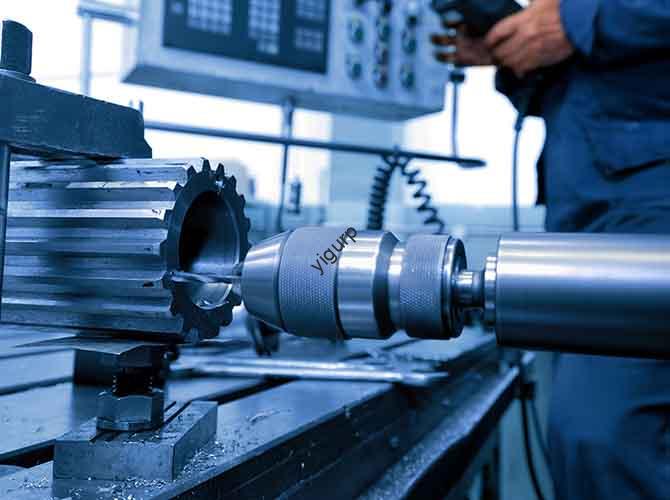
El CNC machining process is crucial for turning design drawings into physical scale prototype parts. It requires strict material preparation, step-by-step operation, and precision control to ensure the scale’s performance.
2.1 Preparación de materiales: Selecting Suitable Base Materials
The choice of materials directly affects the scale’s quality, peso, and machining efficiency. The following table compares common materials:
| Tipo de material | Opciones | Rango de espesor | Application Scenarios |
| Plastic Parts | ABS sheet, PC sheet | ABS sheet: 3-5milímetros; PC sheet: 2-3milímetros | Scale housing (rentable, buena maquinabilidad) |
| Metal Parts | Aluminum alloy sheet | Depends on design requirements | Sensor protective cover or decorative parts (alta durabilidad, good texture) |
2.2 Step-by-Step CNC Machining Execution
Follow this linear workflow to ensure machining precision:
- Programación & Path Planning: Use CAM software like Mastercam and PowerMill to generate tool paths. For ultra-thin housings, set up layer-by-layer milling to avoid deformation. Use large-diameter tools for roughing to remove excess material quickly and small-diameter tools for finishing to ensure surface smoothness.
- Clamping & Posicionamiento: Fix plastic sheets with a vacuum cup to ensure stability during machining. Calibrate the center position to guarantee the symmetry of the scale prototype. For curved surface structures, use four-axis linkage processing to achieve accurate shaping.
- Ejecución de mecanizado:
- Housing Processing: Mill the shell into the desired shape, retaining features such as display cutouts, keyholes, and sensor windows. Chamfer the edges (p.ej., R2mm) to improve the grip and prevent scratches.
- Internal Structure Processing: Mill sensor mounting grooves with a depth tolerance of ±0.05mm to ensure the sensor is installed horizontally. Reserve fixing holes (p.ej., M2 threads) in the circuit board slot for secure component installation.
- Metal Parts Processing: For sensor protective covers, perform finishing with a tolerance of ±0.02mm to ensure the flatness of the transparent window, which does not affect the sensor’s working performance.
- Preliminary Surface Check: Después del mecanizado, remove burrs from the parts and verify the positions of holes and the depth of grooves to ensure they meet design requirements before post-processing.
2.3 Critical Process Control
To avoid functional defects of the scale prototype, focus on the following two key controls:
- Control de tolerancia: Strictly control the housing size tolerance within ±0.1mm to ensure the assembly of various components. The sensor mounting slot tolerance is controlled at ±0.05mm to ensure the sensor’s accurate installation and weighing precision.
- Surface Treatment Control: According to design requirements, perform frosting treatment on the shell to achieve a non-slip effect or high-gloss polishing to enhance the product’s texture, improving both usability and aesthetics.
3. Post-mecanizado: Tratamiento superficial & Asamblea
Después del mecanizado CNC, reasonable surface treatment and correct assembly are essential to turn parts into a functional scale prototype.
3.1 Tratamiento superficial: Material-Specific Processes
Different materials require targeted surface treatment to improve performance and appearance:
| Part Type | Método de tratamiento | Objetivo & Effect |
| Plastic Housing | Pulverización, Silk Screen | Pulverización: Apply matte paint (non-slip) or piano paint (alto brillo), with optional colors like white, negro, or customized colors; Silk Screen: Print brand logos, unit logos (p.ej., “kilos”), and operation instruction icons on the surface for user convenience. |
| Metal Sensor Protective Cover | Pulido (for acrylic transparent windows), Electroplating or Sandblasting (for stainless steel parts) | Pulido: Ensure the transparency of acrylic windows, not affecting the sensor’s detection; galvanoplastia: Improve the corrosion resistance and aesthetics of stainless steel parts; Arenado: Create a unique surface texture for stainless steel parts. |
3.2 Component Testing & Assembly Checklist
Ensure the scale prototype functions properly through the following testing and assembly steps:
- Functional Verification:
- Install load cells and test the weighing accuracy, requiring an error ≤±0.2kg to meet the scale’s measurement requirements.
- Debug the display and buttons, checking the uniformity of the LED backlight to ensure clear weight display and sensitive button operation.
- Assembly Process:
- Attach the sensor, circuit board, and battery to the internal bracket, and connect the wires correctly to ensure stable electrical connections.
- Assemble the housing and case cover using screws or snaps to ensure a tight seal, preventing dust from entering and affecting the internal components’ actuación.
- Equip the scale with non-slip foot pads (silicone material) to improve stability during use and avoid sliding on smooth surfaces.
4. Prototype Optimization & Iteración
Based on user testing feedback and actual use conditions, optimize the scale prototype to improve its performance and user experience.
| Problem Feedback | Improvement Direction |
| Weighing accuracy does not meet standards. | Adjust the sensor mounting position to ensure it is installed horizontally, or calibrate the circuit to improve measurement precision. |
| The shell is prone to deformation. | Optimize the structural stiffeners inside the shell to enhance its rigidity, or replace with thicker materials (p.ej., increase ABS sheet thickness from 3mm to 4mm) to improve anti-deformation ability. |
| The display is easily scratched. | Add a transparent protective cover (p.ej., PC or acrylic material) on the display surface to prevent scratches during use. |
| Battery life is short or charging is inconvenient. | Optimize the battery compartment design to support larger-capacity batteries or add a fast-charging function via the Type-C port. |
| Poor adaptability to different floor environments. | Improve the non-slip foot pad design (p.ej., adopt a split-type structure) to enhance friction on different floor surfaces (wooden, tile, etc.). |
5. Common Technical Difficulties & Soluciones
During the CNC machining and prototype production of the scale, the following technical difficulties may be encountered, and corresponding solutions are provided:
| Technical Difficulty | Solución |
| Insufficient accuracy of the sensor mounting position. | Use high-precision CNC machine tools to process the sensor groove, and calibrate the installation position with a laser level to ensure the sensor is installed accurately. |
| Poor assembly due to shell deformation. | Add stiffeners to the inside of the shell to enhance its structural strength, or switch to fiber-added ABS material, which can improve rigidity by about 30% compared to ordinary ABS. |
| Unstable display fixation. | Design a special card slot for the display to fix it in place, or use double-sided tape with strong adhesion to ensure the display is flush with the housing and does not shake. |
| Non-slip foot pads are easy to fall off. | Add double-sided tape on the back of the foot pad to enhance the bonding strength, or design a snap structure on the foot pad and the shell to fix the foot pad firmly. |
6. Entrega & Subsequent Applications
A well-made scale prototype has multiple uses and provides a reliable basis for subsequent mass production:
- Display Purpose: The prototype can be used for marketing activities (p.ej., product exhibitions), customer proposals to demonstrate the product’s appearance and functions, and appearance verification to ensure the design meets market aesthetics.
- Data Inheritance: Collect and sort out CNC machining parameters (p.ej., tool path settings, velocidad de corte) and problem records (p.ej., solutions to shell deformation) during the prototype production process, and feed them back to the mass production team. This helps optimize the injection mold or metal die-casting process, reducing production risks and improving production efficiency.
Yigu Technology’s Viewpoint
En Yigu Tecnología, we believe CNC machining is the core link in creating high-quality scale prototypes. It ensures that the prototype accurately restores the design intention, meets both functional and aesthetic needs. When producing scale prototypes, we focus on two key points: material selection that matches mass production standards (p.ej., choosing ABS plastic for cost-effective housings and aluminum alloy for high-end parts) and strict control of machining precision (especially the sensor mounting slot tolerance to ensure weighing accuracy). By combining precise CNC machining with continuous prototype optimization, we help customers shorten the product development cycle and lay a solid foundation for mass production. In the future, we will further integrate intelligent technologies into the CNC machining process to improve production efficiency while maintaining high precision.
Preguntas frecuentes
- What factors affect the weighing accuracy of a CNC machined scale prototype, and how to ensure it?
The main factors include the accuracy of the sensor mounting position, the performance of the sensor itself, and the calibration of the circuit. Para garantizar la precisión, use high-precision CNC machine tools to process the sensor groove and calibrate with a laser level; select high-quality load sensors; and debug the circuit to ensure the error is ≤±0.2kg.
- Can the CNC machined scale prototype be directly used for mass production?
No. The prototype is mainly used for design verification, pruebas funcionales, and market feedback collection. Para producción en masa, it is necessary to optimize the production process (p.ej., use injection molding for plastic housings instead of CNC machining) based on the prototype data to improve production efficiency and reduce costs.
- How long does it take to produce a CNC machined scale prototype?
The production cycle depends on the design complexity. For a standard scale prototype (with a simple structure and common materials), it usually takes 7-10 días, including design finalization, Mecanizado CNC, tratamiento superficial, y montaje. For prototypes with complex structures (p.ej., superficies curvas, multiple sensors), the cycle may be extended to 12-15 días.