
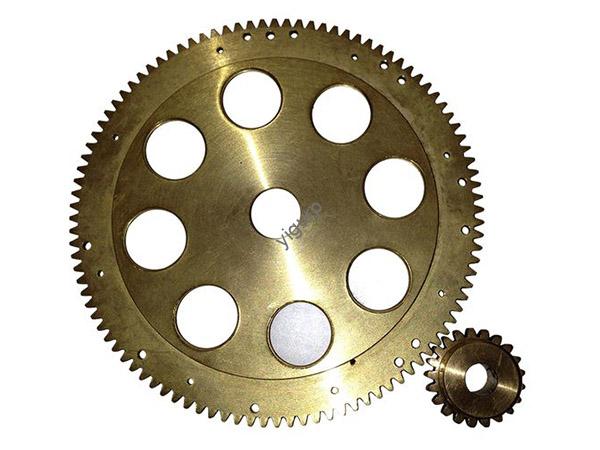
Si necesitas un acero que equilibre un duro, Superficie resistente al desgaste con un núcleo resistente, perfecto para engranajes., ejes, or camshafts—EN 16MnCr5 case hardening steel es tu solución. Como aleación estándar europea, it excels incase hardening (carburación), haciéndolo ideal para situaciones de alto estrés, partes móviles. Esta guía desglosa todo lo que necesitas saber., from its chemistry to real-world success stories, to help you use it effectively.
1. Material Properties of EN 16MnCr5 Case Hardening Steel
EN 16MnCr5’s performance is defined by its suitability for case hardening, all compliant withEN 10084 (European standard for case hardening steels). Let’s explore its key properties in detail.
1.1 Composición química
The alloy’s elements work together to enable deep case hardening while keeping the core tough. Below is the standard composition range:
| Element | Symbol | Composition Range (%) | Key Role in the Alloy |
|---|---|---|---|
| Carbón (do) | do | 0.14 – 0.19 | Low carbon content allows deepcase hardening (forms a hard outer layer without making the core brittle) |
| Manganeso (Minnesota) | Minnesota | 1.00 – 1.30 | Impulsatemplabilidad ymaquinabilidad; strengthens the core during heat treatment |
| Cromo (cr) | cr | 0.80 – 1.10 | Enhancesresistencia al desgaste of the case; improves corrosion resistance and carburizing uniformity |
| Silicio (Y) | Y | 0.15 – 0.35 | Acts as a deoxidizer during steelmaking; prevents oxidation during heat treatment |
| Sulfur (S) | S | ≤ 0.035 | Kept low to avoid cracking in case-hardened parts and high-stress applications |
| Phosphorus (PAG) | PAG | ≤ 0.035 | Limited to prevent cold brittleness (fracture in low-temperature environments) |
| Níquel (En) | En | ≤ 0.30 | Trace amounts slightly improvedureza al impacto without increasing cost |
| Molibdeno (Mes) | Mes | ≤ 0.10 | Minimal content; small amounts enhance high-temperature stability |
| Vanadio (V) | V | ≤ 0.05 | Tiny amounts refine grain structure for uniformcase hardness and core strength |
1.2 Propiedades físicas
These traits determine how EN 16MnCr5 behaves in manufacturing and real-world use:
- Densidad: 7.85 gramos/cm³ (consistent with most ferrous alloys, easy to integrate into existing designs)
- Punto de fusión: 1420 – 1450°C (high enough for forja and high-temperature applications like engine camshafts)
- Conductividad térmica: 44 con/(m·K) a 20ºC (retains heat evenly during case hardening, ensuring uniform case depth)
- Capacidad calorífica específica: 465 j/(kg·K) a 20ºC (absorbs heat steadily, avoiding warping during heat treatment)
- Coeficiente de expansión térmica: 12.3 μm/(m·K) (low expansion, critical for precision parts like gear teeth)
- Propiedades magnéticas: Ferromagnético (attracts magnets, useful for magnetic clamping during machining)
1.3 Propiedades mecánicas
EN 16MnCr5’s full potential is unlocked aftercarburación + temple + templado (standard case hardening process). Below are typical values (tested to EN standards):
| Propiedad | Valor típico (After Case Hardening) | Test Standard (EN) |
|---|---|---|
| Resistencia a la tracción | ≥ 900 MPa | EN ISO 6892-1 |
| Fuerza de producción | ≥ 650 MPa | EN ISO 6892-1 |
| Alargamiento | ≥ 12% | EN ISO 6892-1 |
| Reduction of area | ≥ 45% | EN ISO 6892-1 |
| Case hardness | 58 – 62 CDH (Rockwell C) | EN ISO 6508-1 |
| Core hardness | 28 – 32 CDH (Rockwell C) | EN ISO 6508-1 |
| Dureza (Brinell) | 270 – 310 media pensión (centro) | EN ISO 6506-1 |
| Dureza al impacto | ≥ 60 J (-20°C, centro) | EN ISO 148-1 |
| Fuerza de fatiga | ~500 MPa | EN ISO 13003 |
| Case hardening depth | 0.8 – 1.2 milímetros (typical) | EN ISO 3754 |
1.4 Otras propiedades
- Resistencia a la corrosión: Moderado (resists mild moisture and industrial oils; use zinc plating or paint for outdoor/humid environments)
- Resistencia al desgaste: Excelente (gracias a case hardness 58–62 HRC; ideal for moving parts like gears or pinions)
- maquinabilidad: Bien (soft in annealed state—180–220 HB—so cutting tools last longer; use HSS or carbide tools with cutting fluid)
- Soldabilidad: Acceptable (preheat to 250 – 300°C and post-weld anneal to avoid cracking; use low-hydrogen electrodes)
- Templabilidad: Very good (carburizing penetrates deeply, ensuring a uniform hard case even on thick parts like heavy-duty shafts)
2. Applications of EN 16MnCr5 Case Hardening Steel
EN 16MnCr5’s hard surface and tough core make it perfect forhigh-stress, wear-prone parts en todas las industrias. Here are its most common uses, con ejemplos del mundo real:
2.1 Industria automotriz
Cars, trucks, and commercial vehicles rely on its durability for transmission and engine parts:
- Engranajes: A European automaker uses it for manual transmission gears—its resistencia al desgaste (58–62 HRC case) extends gear life by 40% vs. non-case-hardened steel.
- Camshafts: Diesel engines use EN 16MnCr5 camshafts; the hard case resists wear from valve lifters, while the tough core handles constant mechanical stress.
- Ejes: Electric vehicle (vehículo eléctrico) drive shafts use it—its resistencia a la fatiga (~500 MPa) withstands continuous torque without breaking.
- Pinions: Differential pinions in trucks use it; el case hardening depth (0.8–1.2 mm) ensures long-term durability under heavy loads.
2.2 Ingeniería Mecánica
Industrial machines benefit from its balance of strength and wear resistance:
- Aspectos: Conveyor systems in factories use it for bearing races—its hard surface reduces friction, reducir el tiempo de inactividad por mantenimiento 25%.
- Rollers: Printing presses use EN 16MnCr5 rollers; the uniform case hardness ensures consistent pressure on paper, improving print quality.
- Bolts and fasteners: High-speed machine tools use it for critical bolts—its resistencia a la tracción (≥900 MPa) resists vibration loosening.
2.3 Maquinaria Pesada
Large-scale equipment in construction and mining relies on its toughness:
- Ballestas: Excavator bucket springs use it; the tempered core retains elasticity, while the hard case resists scratch wear from debris.
- Componentes estructurales: Crane hooks use EN 16MnCr5—its tough core (28–32 HRC) handles 30-ton loads, and the hard case resists corrosion from outdoor exposure.
3. Manufacturing Techniques for EN 16MnCr5 Case Hardening Steel
To maximize EN 16MnCr5’s performance, follow these industry-proven steps—with a focus oncase hardening (its key advantage):
3.1 Steelmaking Processes
EN 16MnCr5 is typically produced using two methods, both optimized for alloy uniformity:
- Horno de arco eléctrico (EAF): Most common for medium batches. Scrap steel is melted with electrodes, entonces manganeso (Minnesota) y cromo (cr) are added to reach the target composition. EAF is flexible, ideal for custom parts like large camshafts.
- Horno de oxígeno básico (BOF): Used for mass production. Molten iron is mixed with oxygen to remove impurities, then alloy elements are added. BOF is faster and cost-effective for standard parts like gears or bolts.
3.2 Tratamiento térmico (Critical for Case Hardening)
Case hardening is the core process for EN 16MnCr5. The standard sequence is:
- Recocido: Calentar para 820 – 850°C, cool slowly. Softens the steel to 180–220 HB, making it easy to machine (cuts tool wear by 35%).
- Carburación: Calentar para 900 – 950°C in a carbon-rich atmosphere (p.ej., natural gas or propane) for 4–6 hours. Carbon diffuses into the surface, creating a high-carbon layer (0.8–1.0% C) para case hardness.
- Temple: Cool rapidly in oil (de 830 – 850°C). Hardens the carburized surface to 58–62 HRC while keeping the core tough.
- Templado: Calentar para 180 – 220°C, cool in air. Reduces brittleness in the case without losing hardness—critical for parts like gears that face impact.
- Nitriding (optional): For extra wear resistance, heat to 500 – 550°C in a nitrogen-rich atmosphere. Adds a thin (0.1–0,2 milímetros) super-hard layer (65–70 HRC), ideal for bearings.
3.3 Forming Processes
EN 16MnCr5 is shaped into parts before heat treatment (when it’s soft):
- Forja: Hammered or pressed at 1100 – 1200°C. Aligns the metal’s grain structure, increasing resistencia a la tracción por 15% vs. cast parts. Used for camshafts, ejes, y engranajes.
- Laminación: Passed through rollers to make bars, hojas, or rods. Used for basic shapes like bolt blanks or spring stock.
- Extrusión: Pushed through a die to make complex shapes (p.ej., hollow shafts). Ideal for precision parts like EV drive shafts.
3.4 Machining Processes
Machining is done after annealing (when the steel is soft) to avoid damaging tools:
- Torneado: Uses a lathe to make cylindrical parts (p.ej., ejes). Use cutting fluid (mineral oil) para evitar el sobrecalentamiento.
- Molienda: Uses a rotating cutter to shape gear teeth or camshaft lobes. Carbide tools work best for precision (p.ej., gear tooth tolerance ±0.02 mm).
- Perforación: Creates holes for bolts. High-speed drills (1000–1500 RPM) avoid cracking the soft steel.
- Molienda: Done after case hardening to smooth the hard surface. Ensures tight tolerances (±0,01mm) for parts like bearing races.
4. Estudio de caso: EN 16MnCr5 in Automotive Transmission Gears
A European automotive parts manufacturer faced a problem: their non-case-hardened steel gears failed after 150,000 km, leading to costly recalls. They switched to EN 16MnCr5—and solved the issue.
4.1 Desafío
The manufacturer supplied gears for compact cars used in urban areas (frequent start-stop cycles). Non-case-hardened steel had lowresistencia al desgaste (30 CDH), leading to tooth wear and transmission slippage. The failure rate was 7% por año, hurting brand reputation.
4.2 Solución
They switched to EN 16MnCr5 gears, usando:
- Forja (1150°C) to align grain structure and boost core strength.
- Recocido (830°C) to soften the steel for machining.
- Carburación (920°C para 5 horas) to create a 1.0 mm hard case.
- Temple + templado (200°C) to reach 59 HRC case hardness and 30 HRC core hardness.
- Precision grinding to smooth gear teeth, reducing friction.
4.3 Resultados
- Service life: Gears now last 300,000 km—double the previous lifespan.
- Ahorro de costos: Cut recall costs by €250,000 per year.
- Actuación: Transmission efficiency improved by 6%, reducing fuel consumption for car owners.
5. Comparative Analysis: EN 16MnCr5 vs. Other Materials
How does EN 16MnCr5 stack up against common alternatives—including other case hardening steels? Below is a side-by-side comparison:
| Material | Case Hardness | Core Hardness | Case Depth | Resistencia a la tracción | Costo (vs. EN 16MnCr5) | Mejor para |
|---|---|---|---|---|---|---|
| EN 16MnCr5 | 58–62 HRC | 28–32 HRC | 0.8–1.2 mm | ≥900 MPa | 100% (base) | General case-hardened parts (engranajes, ejes) |
| EN 20MnCr5 | 58–62 HRC | 30–34 HRC | 0.6–1.0 mm | ≥950 MPa | 110% | Higher-stress parts (ejes de servicio pesado) |
| EN 18CrNiMo7-6 | 60–64 HRC | 32–36 HRC | 1.0–1.4 mm | ≥1000 MPa | 180% | Piezas de alto rendimiento (aerospace gears) |
| JIS SCM420 | 58–62 HRC | 25–30 HRC | 0.7–1.1 mm | ≥980 MPa | 105% | Asian-market parts (EV drive shafts) |
| SAE 8620 | 58–62 HRC | 28–32 HRC | 0.8–1.2 mm | ≥900 MPa | 115% | North American-market parts (árboles de levas) |
| Acero carbono (S45C) | N / A (no case) | 20–25 HRC | N / A | 600 MPa | 50% | Piezas de baja tensión (paréntesis) |
Conclusión clave: EN 16MnCr5 offers the best balance ofcase hardness, core toughness, and cost for most case-hardened applications. It’s cheaper than EN 18CrNiMo7-6 and SAE 8620, while providing better wear resistance than non-case-hardened carbon steel.
Yigu Technology’s Perspective on EN 16MnCr5 Case Hardening Steel
En Yigu Tecnología, EN 16MnCr5 is our top choice for clients needing reliable case-hardened parts—especially in automotive and machinery sectors. We’ve supplied it for 12+ años, and its consistentcase hardening depth and core toughness meet strict European standards. We optimize carburizing time (4–6 horas) to avoid over-hardening, and recommend zinc plating for outdoor parts. For manufacturers seeking a cost-effective, high-performance case hardening steel, EN 16MnCr5 is unmatched.
FAQ About EN 16MnCr5 Case Hardening Steel
1. Can EN 16MnCr5 be used in low-temperature environments?
Yes—itsdureza al impacto (≥60 J at -20°C) lets it perform reliably down to -25°C. For colder climates (-30°C or below), adjust tempering to 200–220°C to boost toughness to ≥70 J.
2. How to adjust the case hardening depth of EN 16MnCr5?
To increase depth (p.ej., for thick shafts), extend carburizing time to 7–8 hours. To decrease depth (p.ej., for thin gears), shorten time to 3–4 hours. Always test hardness after adjustment to ensure consistency.
3. Is EN 16MnCr5 compatible with welding?
Sí, but use proper pre- and post-weld steps: preheat to 250–300°C, use low-hydrogen electrodes (E7018), and post-weld anneal at 820–850°C. This prevents cracking and maintains the steel’s toughness.