
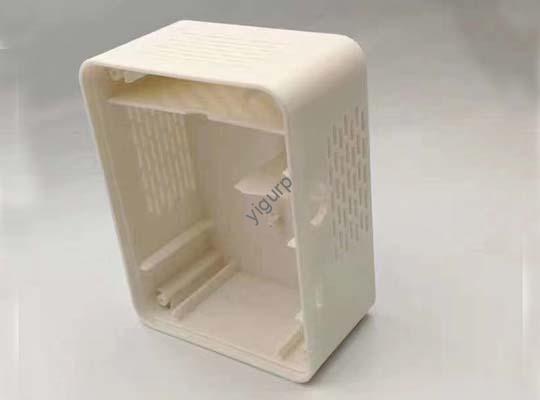
Si está trabajando en el desarrollo de productos, ya sea para electrónica de consumo, dispositivos médicos, o herramientas industriales: probablemente se haya enfrentado al desafío de convertir un diseño 2D en un modelo físico.. Ahí es donde CNC plastic prototype processing entra. En términos simples, es una técnica de fabricación que utiliza Control Numérico por Computadora (CNC) machines to carve plastic materials into precise prototypes. These prototypes let you test design fit, comprobar la funcionalidad, and spot flaws early—saving you from costly mistakes in full-scale production. Let’s dive into everything you need to know to use this process effectively.
1. Common Plastic Materials for CNC Prototype Processing
Not all plastics are the same for CNC prototypes. The material you pick depends on your product’s end use, like impact resistance or transparency. Below is a detailed table of the most popular options, sus rasgos clave, and ideal applications:
| Plastic Material | Propiedades clave | Precisión de tolerancia | Typical Application |
| ABS (Acrilonitrilo Butadieno Estireno) | Alta resistencia al impacto (15 kj /), fácil de mecanizar, bajo costo (\(1–)3 por kilogramo) | ±0,02 milímetros | Piezas de juguete, carcasas de electrónica de consumo (p.ej., controles remotos) |
| ordenador personal (policarbonato) | Transparente (85% transmisión de luz), alta resistencia al calor (melting point 220°C) | ±0,03 milímetros | Cubiertas de luz, carcasas para dispositivos médicos, safety goggles |
| PMMA (Acrílico) | Excelente transparencia (92% transmisión de luz), resistente a los arañazos | ±0.015 mm | Display panels, componentes ópticos (p.ej., lentes), señalización |
| Pensilvania (Nylon) | Alta resistencia al desgaste, buena flexibilidad, oil-resistant | ±0,025 mm | Engranajes, aspectos, piezas interiores de automóviles (p.ej., manijas de las puertas) |
| POM (Acetal) | Bajo coeficiente de fricción (0.2), alta rigidez | ±0,02 milímetros | Piezas de precisión (p.ej., cremalleras, componentes mecanicos), valvulas |
| PÁGINAS (polipropileno) | Resistente a productos químicos, ligero (0.9 gramos/cm³), bajo costo (\(0.8–)2 por kilogramo) | ±0,03 milímetros | Contenedores de comida, equipo de laboratorio, parachoques automotrices (small prototypes) |
2. Step-by-Step Workflow of CNC Plastic Prototype Processing
Creating a CNC plastic prototype follows a clear, repeatable process to ensure accuracy. Aquí están los 6 key steps, with details to help you avoid common pitfalls:
- Revisión de dibujo: Primero, your team checks the client’s 2D/3D design drawings. This step is to catch issues like unmachinable shapes or unclear dimensions—for example, a slot that’s too narrow for CNC tools to reach. Fixing these early saves time later.
- Drawing Breakdown : Split the assembly drawing into individual parts. Por ejemplo, if your prototype is a plastic toy car, you’ll separate the body, ruedas, and axle into single components. This makes machining easier and lets you produce parts in parallel.
- Programación CNC: Use CAM (Fabricación asistida por computadora) software (p.ej., cámara maestra, Fusión 360) to write the machining code. The code tells the CNC machine how fast to cut, which tools to use, and where to remove material. For plastic, slower cutting speeds (500–1500 rpm) are often used to prevent melting.
- Preparación de materiales: Cut the plastic into a “blank” (a solid block) that’s slightly larger than the final prototype. Por ejemplo, if your part is 10cm × 5cm × 3cm, use a blank of 11cm × 6cm × 4cm to leave room for cutting.
- Mecanizado CNC: Load the blank into the CNC machine (usually a CNC mill for plastics) and run the program. The machine uses rotating tools (fresas finales, ejercicios) para eliminar el exceso de plástico, creating the prototype shape. Most CNC plastic prototypes reach a precision of ±0.01–0.03 mm—accurate enough for most product tests.
- Manual Finishing: Después del mecanizado, the prototype may have small burrs (plastic shavings) o bordes ásperos. Usa papel de lija (400–1000 grit) to smooth surfaces, and acetone (for ABS/PMMA) to polish if needed. This step improves appearance and ensures the prototype feels like the final product.
3. Why CNC Plastic Prototype Processing Beats 3D Printing for Many Projects
Quizás te preguntes: Why choose CNC over 3D printing for plastic prototypes? Aquí están 4 key advantages that solve common product development problems:
- Better Material Performance: 3D-printed plastics are often brittle or have layered structures. CNC prototypes use solid plastic blocks, so they have the same strength, flexibilidad, and chemical resistance as the final product. Por ejemplo, a CNC-machined Nylon gear will wear like a production gear—something a 3D-printed one can’t match.
- Higher Precision: As shown in the material table, CNC plastic prototypes hit tolerances of ±0.015 mm (para PMMA), while 3D printing usually only reaches ±0.1 mm. This is critical for parts that need to fit together, like a plastic hinge or a medical device component.
- Faster for Medium-to-Large Parts: For parts larger than 10cm × 10cm, CNC machining is faster. A 3D-printed plastic panel might take 8–12 hours, but a CNC machine can make the same part in 2–4 hours—great for tight deadlines.
- Lower Cost for Small Batches: If you need 5–50 prototypes, CNC is cheaper. 3D printing requires time to set up and often wastes material, while CNC uses almost all the plastic blank. Por ejemplo, 10 ABS prototypes cost 20–30% less with CNC than 3D printing.
4. When to Use CNC Plastic Prototype Processing (Key Scenarios)
CNC plastic prototyping isn’t just for “any” project—it’s best for specific needs. Aquí están los mejores 3 scenarios where it’s the ideal choice:
- Design Validation: When you need to check if parts fit together (p.ej., a plastic phone case and its battery cover). CNC’s precision ensures the fit is accurate, so you don’t find out about issues during production.
- Function Testing: If your product needs to work under stress—like a plastic handle that must hold 5kg—CNC prototypes use real plastic, so test results are reliable. 3D-printed prototypes might break early and give false results.
- Visual Presentations: For showing clients or investors a “final-looking” product. CNC’s smooth surfaces and accurate shapes make the prototype look like it came from a production line, which builds confidence.
Yigu Technology’s View on CNC Plastic Prototype Processing
En Yigu Tecnología, we see CNC plastic prototype processing as a must-have for product teams. It solves a big pain point: turning ideas into testable, real-world models quickly. We’ve helped clients cut design iteration time by 35%—for example, a consumer electronics firm used our CNC prototypes to fix a phone case fit issue in 2 días, instead of the 5 days 3D printing would take. Our team uses high-speed CNC mills for plastics, ensuring ±0.01 mm precision, and offers custom finishing to match your final product’s look. For businesses that value speed, exactitud, and reliable testing, CNC plastic prototyping is the way to go.
FAQ About CNC Plastic Prototype Processing
- How long does it take to make a CNC plastic prototype?
It depends on size and complexity. Pequeño, piezas simples (p.ej., a 5cm × 5cm plastic bracket) take 1–2 days. Larger or complex parts (p.ej., a 20cm × 15cm PC display cover) tomar de 3 a 5 días, including manual finishing.
- Can CNC plastic prototypes be colored to match the final product?
Sí! Después del mecanizado, you can add color via painting, dyeing (for ABS/PA), o (film lamination). Por ejemplo, we often dye ABS prototypes to match a client’s brand color—with a 95% color match accuracy.
- Is CNC plastic prototyping suitable for flexible plastics (p.ej., soft PA)?
Absolutamente. We adjust machining parameters (slower speed, sharper tools) to avoid deforming flexible plastics. For soft PA prototypes, we’ve achieved the same flexibility as production parts—perfect for testing items like plastic gaskets.