
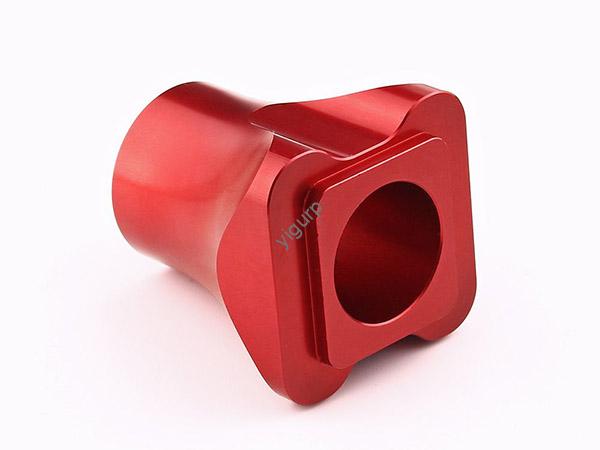
If you’re designing mechanical components that need to handle high stress, wear, or impact—like industrial shafts, engranajes automotrices, or aerospace parts—you need a material that balances strength, tenacidad, and machinability.AISI 4140 acero aleado is the industry’s workhorse: as a chromium-molybdenum (Cr-Mo) aleación, it delivers exceptionalresistencia a la tracción, hardness, and fatigue resistance after heat treatment, outperforming plain carbon steels and even lower-alloy grades like AISI 4130. This guide breaks down its properties, real-world applications, manufacturing process, and material comparisons to help you solve component design challenges across industries.
1. Material Properties of AISI 4140 Acero aleado
AISI 4140’s performance stems from its optimized Cr-Mo composition and heat-treatable design—chromium boosts corrosion resistance and hardenability, while molybdenum enhances high-temperature strength andfatigue limit. Let’s explore its key properties in detail.
1.1 Composición química
AISI 4140 adheres to ASTM A29/A29M standards, with strict control over alloy elements to ensure consistent performance. Below is its typical composition:
| Element | Symbol | Content Range (%) | Key Role |
|---|---|---|---|
| Carbon (do) | do | 0.38 – 0.43 | Enables heat treatment; boostshardness yresistencia a la tracción |
| Chromium (Cr) | Cr | 0.80 – 1.10 | Enhancesresistencia a la corrosión and hardenability; improves wear resistance |
| Molybdenum (Mo) | Mo | 0.15 – 0.25 | Increases high-temperature strength; raisesfatigue limit for cyclic loading |
| Manganese (Mn) | Mn | 0.75 – 1.00 | Refines grain structure; enhancesductilidad without reducing strength |
| Silicon (Y) | Y | 0.15 – 0.35 | Aids deoxidation; supports structural stability at high temperatures |
| Phosphorus (P) | P | ≤ 0.035 | Minimized to prevent brittle fracture in cold or high-stress conditions |
| Sulfur (S) | S | ≤ 0.040 | Controlled to improvemaquinabilidad (free-machining grades may have higher S) |
| Níquel (Ni) | Ni | ≤ 0.25 | Trace element; slightly enhancesimpact toughness |
| Vanadium (V) | V | ≤ 0.03 | Trace element; refines grains for uniform strength |
| Cobre (Cu) | Cu | ≤ 0.30 | Trace element; adds mild atmospheric corrosion resistance |
1.2 Physical Properties
These traits make AISI 4140 suitable for diverse industrial environments—from automotive engines to aerospace components:
- Densidad: 7.85 gramos/cm³ (same as most carbon steels)—simplifies weight calculations for components like shafts or gears
- Punto de fusión: 1,425 – 1,450 °C (2,597 – 2,642 °F)—compatible with forging and welding processes
- Conductividad térmica: 42.0 W/(m·K) en 20 °C; 38.0 W/(m·K) en 300 °C—ensures even heat distribution during heat treatment
- Coefficient of Thermal Expansion: 11.5 × 10⁻⁶/°C (20 – 100 °C)—minimizes distortion during quenching and tempering
- Magnetic Properties: Ferromagnetic—enables non-destructive testing (NDT) like magnetic particle inspection to detect hidden defects.
1.3 Propiedades mecánicas
AISI 4140’s mechanical performance varies with heat treatment, but it consistently outperforms plain carbon steels. Below are typical values for common heat-treated conditions:
| Propiedad | Measurement Method | Annealed (Soft Condition) | Quenched & Tempered (300 °C) | Quenched & Tempered (600 °C) |
|---|---|---|---|---|
| Dureza (Rockwell) | CDH | 19 – 22 CDH | 50 – 53 CDH | 28 – 32 CDH |
| Dureza (Vickers) | HV | 180 – 210 HV | 480 – 510 HV | 270 – 300 HV |
| Resistencia a la tracción | MPa (ksi) | 650 MPa (94 ksi) | 1,700 MPa (247 ksi) | 950 MPa (138 ksi) |
| Yield Strength | MPa (ksi) | 400 MPa (58 ksi) | 1,500 MPa (218 ksi) | 800 MPa (116 ksi) |
| Elongation | % (en 50 milímetros) | 25 – 30% | 8 – 10% | 18 – 20% |
| Impact Toughness | J (en 20 °C) | ≥ 80 J | ≥ 35 J | ≥ 60 J |
| Fatigue Limit | MPa (rotating beam) | 320 MPa | 750 MPa | 450 MPa |
1.4 Other Properties
AISI 4140’s traits solve key component design challenges:
- Soldabilidad: Good—requires preheating to 200–300 °C and post-weld heat treatment (to avoid cracking) but produces strong joints for load-bearing parts.
- Machinability: Excellent—especially in the annealed condition (19–22 HRC); free-machining grades (with higher sulfur) further reduce tool wear.
- Formability: Moderate—can be forged, bent, or rolled into complex shapes (p.ej., gear blanks) when annealed, then heat-treated for strength.
- Resistencia a la corrosión: Moderate—resists mild chemicals and atmospheric rust; for harsh environments, add plating (p.ej., zinc or chrome) or coatings.
- Toughness: Balanced—quenched & tempered conditions offer both high strength and enough ductilidad to absorb impact (critical for automotive and construction parts).
2. Applications of AISI 4140 Acero aleado
AISI 4140’s versatility makes it a top choice across industries where strength and durability matter. Here are its key uses:
- Mechanical Components: Ejes (p.ej., motor shafts, pump shafts), pernos, and nuts—handles high torque and cyclic loading without fatigue failure.
- Engranajes & Aspectos: Automotive transmission gears, industrial gearboxes, and bearing races—its hardness (50–53 HRC when quenched) resists wear from metal-to-metal contact.
- Automotive Parts: Crankshafts, árboles de levas, and suspension components—tolerates engine heat and road vibrations, outperforming plain carbon steels.
- Maquinaria Industrial: Hydraulic cylinders, press rams, and machine tool spindles—supports heavy loads and repeated use in manufacturing plants.
- Construction Equipment: Excavator buckets, bulldozer axles, and crane hooks—withstands impact and abrasion on job sites.
- Componentes aeroespaciales: Landing gear parts and engine brackets (in non-critical systems)—balances strength and weight for aircraft applications.
3. Manufacturing Techniques for AISI 4140 Acero aleado
Producing AISI 4140 requires precise control over alloy content and heat treatment to unlock its full potential. Here’s the step-by-step process:
- Steelmaking:
- AISI 4140 is made using an Electric Arc Furnace (EAF) (recycles scrap steel) o Basic Oxygen Furnace (BOF). Chromium and molybdenum are added during melting to reach the 0.80–1.10% and 0.15–0.25% ranges, respectively.
- Rolling & Forja:
- The steel is Hot Rolled (1,100 – 1,200 °C) into bars, platos, or tubes—hot rolling refines grains and improves formability. Para piezas complejas (p.ej., engranajes), es Hot Forged into blanks to shape the component before machining.
- Tratamiento térmico (Critical for Performance):
- Recocido: Heated to 815–845 °C, held for 2–4 hours, then slow-cooled to 650 °C. Softens the steel (19–22 HRC) for easy machining.
- Quenching: Heated to 845–870 °C (austenitizing), held for 1–2 hours, then rapidly cooled in oil or water. Hardens the steel to 55–60 HRC but increases brittleness.
- Tempering: Reheated to 200–650 °C (based on desired hardness), held for 1–3 hours, then air-cooled. Reduces brittleness and balances strength/toughness (p.ej., 300 °C for high strength, 600 °C for better ductility).
- Mecanizado:
- In the annealed condition, AISI 4140 is machined using turning, molienda, or grinding—tools like high-speed steel (HSS) or carbide cutters work well. For tight tolerances (p.ej., bearing races), finish grinding ensures precision.
- Tratamiento superficial:
- Enchapado: Zinc plating (for rust resistance) or chrome plating (for wear resistance)—common for automotive and industrial parts.
- Revestimiento: Epoxy or powder coating (for chemical resistance)—used in hydraulic cylinders or outdoor components.
- Heat Treatment Add-Ons: Carburizing (hardens surface for gears) or nitriding (improves wear resistance without distortion)—ideal for high-wear parts.
- Control de calidad:
- Chemical Analysis: Spectrometry verifies alloy content (per ASTM A29/A29M).
- Mechanical Testing: De tensión, impacto, and hardness tests confirm strength and toughness.
- NDT: Ultrasonic testing checks for internal defects; magnetic particle inspection finds surface cracks.
- Dimensional Inspection: Calibrador, micrómetros, or CMM (máquinas de medición de coordenadas) ensure parts meet design tolerances.
4. Estudios de caso: AISI 4140 in Action
Real-world projects demonstrate AISI 4140’s reliability in demanding applications.
Estudio de caso 1: Industrial Shaft Failure Prevention (U.S.)
A manufacturing plant in Ohio was replacing pump shafts (made from plain carbon steel) every 6 months due to fatigue failure. They switched to AISI 4140 ejes, heat-treated to 300 °C (50 CDH) for highfatigue limit (750 MPa). The new shafts lasted 3 years—reducing maintenance costs by $40,000 anualmente. The molybdenum in AISI 4140 prevented crack growth from constant pump vibration.
Estudio de caso 2: Automotive Gearbox Durability (Germany)
A car manufacturer needed transmission gears that could handle high torque (350 N·m) without wear. They chose AISI 4140 gear blanks, carburized to harden the surface (60 CDH) and tempered to 300 °C for core toughness. Después 100,000 km of testing, the gears showed only 0.1 mm of wear—half the wear rate of gears made from AISI 1045 carbon steel. This improved the gearbox’s lifespan by 50%.
5. AISI 4140 vs. Other Materials
How does AISI 4140 compare to other popular materials for mechanical components?
| Material | Similarities to AISI 4140 | Diferencias clave | Mejor para |
|---|---|---|---|
| AISI 4130 | Cr-Mo alloy steel | Lower carbon (0.28–0.33%); lower strength; better weldability; 15% cheaper | Welded parts (p.ej., aircraft frames) |
| AISI 1045 | Carbon steel | No alloying; lower strength (600 MPa tensile); 30% cheaper | Low-load parts (p.ej., non-critical bolts) |
| 304 Acero inoxidable | Resistente a la corrosión | Excellent rust resistance; lower strength (515 MPa tensile); 2× more expensive | Food processing or marine components |
| Titanium Alloy (Ti-6Al-4V) | High strength-to-weight | Lighter (4.5 gramos/cm³); higher strength; 8× more expensive | Aerospace or medical implants |
| Compuesto (Fibra de carbono) | High strength-to-weight | Lighter; no corrosion; lower impact toughness; 5× more expensive | High-performance automotive (p.ej., race car parts) |
Yigu Technology’s Perspective on AISI 4140 Acero aleado
En Yigu Tecnología, AISI 4140 is our top recommendation for high-stress mechanical components. Its Cr-Mo composition balances strength, tenacidad, and machinability—solving the “strength vs. workability” pain point for clients in automotive, industrial, and construction sectors. We supply AISI 4140 in annealed, quenched & tempered, or custom heat-treated conditions, with options for plating or coating. For clients upgrading from plain carbon steels, AISI 4140 delivers a cost-effective performance boost—extending component lifespan by 2–5x without the premium of titanium or composites.
FAQ About AISI 4140 Acero aleado
- Can AISI 4140 be used for high-temperature applications (above 300 °C)?
Yes—its molybdenum content maintains strength up to 450 °C. For temperatures above 450 °C (p.ej., engine exhaust parts), choose AISI 4340 (higher molybdenum) or alloy steels with more heat resistance. - Is AISI 4140 suitable for welding load-bearing components?
Yes—with proper preheating (200–300 °C) and post-weld tempering (600 °C). This reduces residual stress and prevents cracking. Use low-hydrogen electrodes (p.ej., E8018-B2) for best results. - ¿Cuál es la diferencia entre AISI? 4140 and AISI 4140H?
AISI 4140H is a “hardenable” grade with stricter carbon control (0.38–0.43% vs. 0.38–0.43% for standard 4140) and higher hardenability. It’s ideal for large parts (p.ej., thick shafts) where uniform heat treatment is critical—standard 4140 may not harden evenly in sections over 50 mm de espesor.