
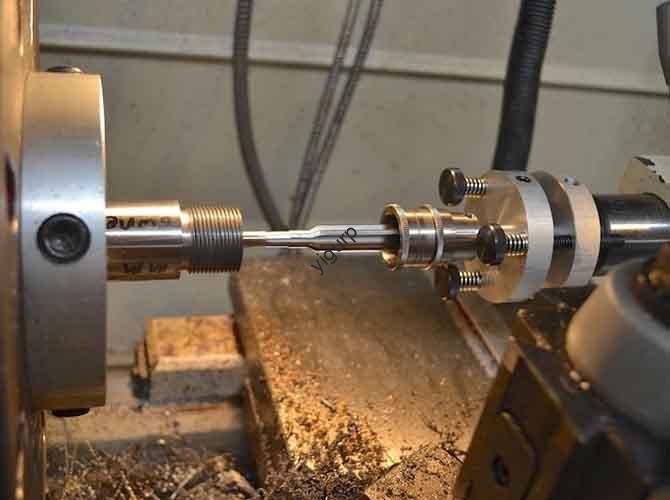
In high-end manufacturing fields—from aerospace engine blades to medical artificial joints—precision and high-speed CNC machining stands as a game-changing technology. It combines ultra-high spindle speeds (bis zu 50,000 rpm), micron-level positioning accuracy (≤0.5μm), and efficient material removal to produce complex, high-performance components that traditional machining can’t match. This article breaks down its core technical system, typical processes, key application areas, solutions to common challenges, und zukünftige Trends, helping you fully grasp how to leverage this technology for high-quality production.
1. What Are the Core Technical Systems of Precision and High-Speed CNC Machining?
The excellence of this technology relies on three interconnected systems: machine tool hardware, tool innovation, and CNC system optimization. Each system addresses a critical aspect of “speed, Präzision, and stability.”
1.1 Machine Tool Hardware: The Foundation of High Performance
Hardware configuration directly determines the upper limit of machining accuracy and speed. Key components and their technical parameters are detailed below:
| Hardware Component | Technical Characteristics | Critical Parameters | Role in Machining |
| Bed Material | Marble or mineral casting (high damping coefficient) | Damping ratio: 0.05-0.1 (5-10x higher than steel beds) | Reduces vibration during high-speed cutting; Improves surface roughness (Ra) von 30-50% |
| Spindle System | – Hybrid ceramic bearings + oil-gas lubrication- Optional air bearing spindles (for ultra-high speed) | – Max speed: 20,000-50,000 rpm- Automatic dynamic balance correction (Genauigkeit: G0.4) | Enables high-speed cutting of hard materials (z.B., titanium alloy at 120-200 m/mein); Minimizes spindle runout (<2μm) |
| Drive Unit | Linear motor direct drive (no transmission gaps) | – Reverse clearance: <0.5μm- Acceleration: 1-3 G | Ensures rapid, precise axis movement; Reduces positioning time by 40-60% vs. ball screw drives |
| Temperature Control System | – Cooling medium accuracy: ±0.1°C- Integrated liquid cooling for key components- Constant temperature workshop (20±1°C) | Temperature fluctuation of spindle: <±1°C during operation | Prevents thermal deformation (a major cause of accuracy loss); Maintains dimensional stability (Toleranz: ±0,005 mm) |
1.2 Tool Technology Innovation: The Key to Efficient Cutting
Advanced tools match high-speed, high-precision machining needs by improving hardness, Verschleißfestigkeit, and stability.
| Tool Type | Technical Improvements | Application Scenarios | Performance Advantages |
| Ultra-Fine Grain Carbide Tools | Added TaN coating; Härte: HRC70 | Titanium alloy roughing (z.B., Teile für Luft- und Raumfahrtmotoren) | Tool life extended by 50-80% vs. standard carbide tools; Cutting speed up to 200 m/mein |
| Single Crystal Diamond PCD Tools | Cutting edge radius: <1μm; Ultra-sharp edge | Aluminum alloy mirror turning (z.B., optical mold substrates) | Achieves nanoscale surface roughness (Ra <0.05μm); No need for post-polishing |
| Thermal Expansion Compensation Tool Holder | Interference fit accuracy: <2μm | High-precision milling (z.B., Komponenten medizinischer Geräte) | Eliminates tool looseness and static deviation; Ensures repeat positioning accuracy (<0.003mm) |
| Micro Lubrication System | Minimum atomization amount: 0.05ml/h | Hochgeschwindigkeitsbohren (z.B., printed circuit board holes) | Reduces cutting heat-induced expansion; Lowers lubricant consumption by 95% vs. flood cooling |
1.3 CNC System Optimization: The Brain of Precision Control
Intelligent algorithms and real-time compensation ensure smooth, accurate machining even at high speeds.
| Optimization Feature | Technical Principles | Practical Effects |
| Forward-Looking Algorithm | Predicts corner velocity changes; Controls acceleration fluctuation within 5% | High-speed contour machining (z.B., optical lens molds) |
| Five-Axis Linkage Interpolation | Uses spline fitting instead of traditional G-code | Complex surface machining (z.B., aerospace engine blades) |
| Real-Time Compensation Technology | Laser interferometer monitors spindle deflection online; Auto-corrects 2000 times/min | Ultra-precision milling (z.B., lithography machine components) |
2. What Are the Typical Processes of Precision and High-Speed CNC Machining?
The process follows a “preparation → phased machining → quality inspection” workflow, with each step optimized for efficiency and accuracy.
2.1 Pre-Machining Preparation
Thorough preparation prevents errors and ensures smooth production:
- CAD/CAM Integration: Use PowerMill or ESPRIT software for intelligent air avoidance analysis; Auto-generate anti-collision tool paths (reduces collision risk to <0.1%).
- Virtual Simulation Verification: Via Vericut software, simulate the entire machining process (including tool changes and spindle movement); Accurately predict tool wear areas (optimize tool life by 15-25%).
- Blank Pretreatment:
- Quenched steel parts: Ultrasonic flaw detection (identifies internal defects >0.1mm to avoid machining failure).
- Aluminum alloy blanks: Aging treatment (releases internal stress; Reduces post-machining deformation by 70%).
2.2 Phased Machining Strategy
Different stages balance speed and precision to achieve optimal results:
| Machining Stage | Key Parameters | Objectives | Application Notes |
| Schruppen (Waste Removal) | – Cutting speed: 120-200 m/mein- Feed per tooth: 0.2mm- High-torque spindle full power output | Quickly remove 70-80% of margin; Shorten machining time | Use large-diameter cutters (φ20-50mm) for high efficiency; Avoid overloading the spindle |
| Semi-Finishing | – Cutting speed: 600-1200 m/mein- Feed per tooth: 0.05mm- Ball head cutter ring layering strategy | Uniformly reserve 0.1-0.2mm finishing allowance; Smooth surface for finishing | Suitable for parts with complex curved surfaces (z.B., optical aspherical lenses) |
| Abschluss | – Cutting speed: 2000-5000 m/mein- Feed per tooth: 0.01mm- Mainly along milling | Achieve nanoscale surface roughness (Ra <0.2μm); Meet tight tolerances (±0,005 mm) | Use high-precision tools (z.B., PCD tools); Minimize cutting force to avoid deformation |
| Polieren (Optional) | – Magnetorheological polishing- Ion beam bombardment | Further improve surface microscopic topography; Reduce subsurface damage | For ultra-high-precision parts (z.B., lithography machine silicon wafer fixtures) |
3. What Are the Key Application Areas of Precision and High-Speed CNC Machining?
This technology is irreplaceable in high-end fields requiring extreme precision and performance. Below are typical applications with specific requirements:
| Industrie | Anwendungsbeispiele | Machining Requirements | How the Technology Meets Needs |
| Luft- und Raumfahrt | – Nickel-based monocrystalline turbine disc grooving- Carbon fiber composite laying mold (red copper electrode) | – Groove width tolerance: ±0,02 mm; Profile Ra <0.2μm- Micro-nano texture engraving (affects composite layer bonding) | High-speed spindle (50,000 rpm) ensures precise groove cutting; PCD tools achieve smooth electrode surfaces |
| Precision Optics | – Optical aspherical lens mold- Lithography machine silicon wafer fixture | – Radius of curvature error: <0.5μm- Ebenheit: λ/8@He-Ne laser (λ=632.8nm) | Five-axis linkage interpolation ensures complex surface accuracy; Temperature control prevents thermal deformation |
| Medizinische Geräte | – Titanium alloy artificial joint implants (porous structure)- Minimally invasive surgical instruments (thin-walled pipes) | – Porosity error: <2% (promotes bone growth)- Pipe outer diameter ≤1mm; Wall thickness uniformity: ±0,005 mm | Ultra-fine grain carbide tools mill porous structures; Micro lubrication system ensures thin-wall machining stability |
4. How to Solve Common Challenges in Precision and High-Speed CNC Machining?
Even with advanced technology, challenges like vibration and thermal deformation can occur. Below are targeted solutions:
| Herausforderung | Grundursache | Practical Solutions | Expected Results |
| Micro Vibration | Spindle critical speed resonance | – Adjust SFM parameters to avoid formants- Install vibration damping mass ring (damping ratio: 0.1-0.2) | Vibration amplitude reduced by 60-80%; Surface Ra improved from 0.2μm to 0.08μm |
| Abnormal Tool Edge Wear | Impact load from material hard points | – Change CBN tool sintering method to gradient sintering- Reduce single cutting depth (from 0.5mm to 0.2mm) | Tool life extended by 40-60%; Avoids edge chipping (a major cause of defective parts) |
| Thermal Deformation Deviation | Insufficient cutting fluid supply; Uneven heat distribution | – Use low-temperature nitrogen cooling (-70°C)- Optimize nozzle layout (3-4 nozzles per tool) | Thermal deformation reduced by 70-90%; Dimensional tolerance maintained at ±0.005mm |
| Servo Lag Error | Improper feedforward gain setting | – Enable feedforward function- Adjust Kv factor to optimal value (1000-1500 rpm/V) | Positioning error reduced by 50-70%; Eliminates contour deviation at high speeds |
| Subsurface Damage Layer | Residual stress from plastic deformation | – Adopt ultrasonic vibration-assisted machining (20-40 kHz)- Reduce cutting force (feed per tooth: 0.005-0.01mm) | Subsurface damage depth reduced from 5μm to <1μm; Improves part fatigue life |
5. What Are the Future Trends of Precision and High-Speed CNC Machining?
The technology is evolving toward intelligence, micro-nano processing, green manufacturing, and cross-scale integration:
| Trend Direction | Technical Innovations | Expected Impact by 2030 |
| Intelligent Upgrade | – AI adaptive control (acoustic emission sensors monitor tool wear in real time)- Auto-adjust cutting parameters (Geschwindigkeit, Vorschubgeschwindigkeit) | Defect rate reduced to <0.5%; Unmanned operation for 24/7 Produktion |
| Micro-Nano Processing Breakthroughs | Atomic layer deposition (ALD) combined with CNC; Feature sizes down to sub-micron level | Enables machining of micro-electro-mechanical systems (MEMS) and quantum device components |
| Green Manufacturing Solutions | Dry cutting + electrostatic dust removal system; Cutting fluid use reduced by 90% | Lowers environmental impact; Cuts lubricant costs by 80% |
| Cross-Scale Integration | Same equipment handles macro structural parts (tonnage-level) and microstructure arrays (micron-level) | Reduces equipment investment; Improves production flexibility for multi-variety, Kleinserienbestellungen |
6. Yigu Technology’s Perspective on Precision and High-Speed CNC Machining
Bei Yigu Technology, we view precision and high-speed CNC machining as the “core engine of high-end manufacturing competitiveness.” Our practice shows that 80% of high-performance parts (z.B., aerospace turbine discs) rely on this technology to meet strict standards.
We recommend a “systematic matching” approach: For aerospace clients, we pair 50,000-rpm air bearing spindles with single crystal diamond tools to achieve Ra <0.05μm surfaces; For medical device makers, we use ultrasonic vibration-assisted machining to reduce subsurface damage in titanium alloy implants. We also integrate AI monitoring to predict tool wear (reducing unexpected downtime by 30%). Looking ahead, combining this technology with digital twins will further push machining accuracy to the nanoscale, opening new possibilities in emerging fields like quantum computing.
7. FAQ: Common Questions About Precision and High-Speed CNC Machining
Q1: What’s the difference between precision CNC machining and high-speed CNC machining?
Precision CNC machining focuses on accuracy (Toleranz: ±0.001-0.01mm) und Oberflächenqualität (Ra <0.1μm), often using low-to-medium speeds. High-speed CNC machining prioritizes speed (spindle >15,000 rpm) to boost efficiency, Aber precision and high-speed CNC machining combines both—achieving high speed (bis zu 50,000 rpm) while maintaining micron-level accuracy, Damit ist es ideal für komplexe, Hochleistungsteile.
Q2: Can this technology machine all materials, including super-hard alloys?
It excels at hard, difficult-to-cut materials (Titanlegierung, nickel-based superalloys) using advanced tools (z.B., TaN-coated carbide, CBN). Jedoch, it’s less suitable for ultra-hard materials like diamond or cubic boron nitride (CBN) itself—those require specialized processes like laser cutting. For most industrial materials (Aluminium, Stahl, Titan), it’s the top choice.
Q3: How much does a precision and high-speed CNC machine cost, and is it suitable for small-batch production?
Entry-level machines cost \(500,000-\)1M, while high-end models (für die Luft- und Raumfahrt) exceed $5M. Für die Produktion von Kleinserien (10-100 Teile), it’s economical if parts require high precision (z.B., medizinische Implantate)—the reduced post-processing and rework costs offset equipment investment. For simple, low-precision parts, traditional CNC machining is more cost-effective.