
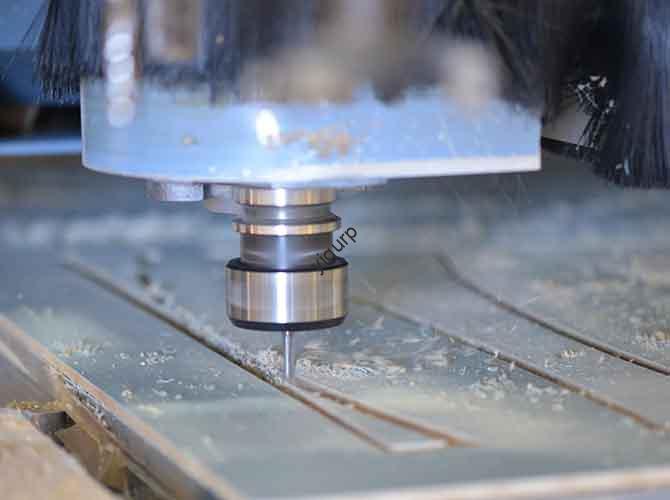
CNC precision milling has become a backbone of modern high-precision manufacturing, Nutzung computergestützter numerischer Steuerung (CNC) Technologie zur Erzielung einer Genauigkeit im Mikrometerbereich bei der Formung verschiedener Materialien. Im Gegensatz zum herkömmlichen Fräsen, Es kombiniert automatisierte Werkzeugwege, Mehrachsgestänge, und Echtzeit-Parameteranpassung zur Herstellung komplexer, konsistente Teile – entscheidend für Branchen wie die Luft- und Raumfahrt, medizinische Geräte, und Elektronik. In diesem Artikel werden die Kernfunktionen erläutert, Schritt-für-Schritt-Workflow, technical advantages, Anwendungsszenarien, and operational best practices, helping you harness its potential for high-quality part production.
1. Core Features: What Defines CNC Precision Milling?
CNC precision milling’s uniqueness lies in four key traits, each addressing the demand for accuracy, Flexibilität, und Effizienz. Below is a 总分结构 explaining each feature, supported by specific data and use cases:
| Core Feature | Key Technical Details | Industrial Significance |
| Micron-Level Precision Control | Driven by CNC programs (G-Code) and high-precision servo systems, it achieves positioning accuracy of ±0.001–0.01 mm and repeatability of ±0.0005–0.005 mm. Tolerances are strictly controlled within ISO 286-2 IT5–IT7 standards. | Enables production of critical components like medical implants (z.B., titanium bone screws) and aerospace engine parts, where even tiny deviations can cause functional failures. |
| Multi-Axis Linkage Capability | Supports 3-axis (X/Y/Z) to 5-axis linkage, allowing machining of non-orthogonal features (z.B., off-axis holes), complex curved surfaces (z.B., Turbinenschaufeln), and undercut structures. 5-axis machines add rotational axes (A/C or B/C) for full-dimensional coverage. | Eliminates the need for multiple setups (common in 3-axis milling), reducing cumulative errors by 30–50%—e.g., a 5-axis mill can machine a 3D-printed mold cavity in one cycle vs. 3 cycles with 3-axis equipment. |
| Automatisiert & Efficient Processing | Pre-written CNC programs automate tool changes, feed rate adjustments, and cutting path execution, reducing manual intervention by 80–90%. High-speed spindles (10,000–40,000 RPM) enable fast material removal without compromising accuracy. | Boosts production efficiency by 50–100% vs. manual milling; z.B., a smartphone heat sink production line processes 200+ parts/hour with consistent quality. |
| Broad Material Compatibility | Processes metals (Aluminiumlegierungen, Edelstahl, Titan, Magnesiumlegierungen) und Nichtmetalle (Kunststoffe, Verbundwerkstoffe, Keramik). Für harte Materialien (z.B., HRC 50+ Stahl), it uses carbide or diamond-coated tools to maintain precision. | Adapts to diverse industry needs—from lightweight aluminum aerospace parts to high-strength stainless steel medical instruments. |
2. Schritt-für-Schritt-Workflow: From Design to Inspection
CNC precision milling follows a linear, rigorous workflow to ensure part accuracy and consistency. The table below details each stage, key operations, and quality control requirements:
| Workflow Stage | Key Operations | Qualitätskontrollmaßnahmen |
| 1. Design & Programmierung | – Use CAD software (z.B., SolidWorks, AutoCAD) to create a 3D model of the part.- Convert the model to G-code via CAM software (z.B., Mastercam, UG/NX), optimizing tool paths (z.B., spiral milling for cavities, contour milling for edges) and setting parameters (Vorschubgeschwindigkeit, Spindeldrehzahl). | – Verify G-code via simulation (z.B., using Vericut) to detect collisions or overcuts.- Ensure tool path optimization reduces empty strokes by 20–30% (saves machining time). |
| 2. Maschineneinrichtung | – Secure the workpiece to the machine table using precision fixtures (z.B., vacuum chucks, vises) with clamping accuracy ±0.005 mm.- Install the appropriate tool (z.B., carbide end mill for steel, PCD tool for aluminum) and calibrate tool length/diameter via a tool presetter (Genauigkeit ±0,001 mm).- Set the workpiece coordinate system (G54–G59) using a touch probe. | – Check fixture rigidity (no vibration during test runs).- Verify tool runout (≤0.002 mm) um Oberflächenfehler zu vermeiden. |
| 3. Machining Stages | – Grobbearbeitung: Use large-diameter tools (z.B., φ20 mm end mill) to remove 80–90% of excess material at high feed rates (1000–3000 mm/min), leaving 0.1–0.3 mm allowance for finishing.- Semi-Finishing: Adjust to smaller tools (z.B., φ10 mm end mill) and lower feed rates (500–1500 mm/min) to refine shape, reducing allowance to 0.02–0.05 mm.- Abschluss: Use fine tools (z.B., φ3 mm ball end mill) und extrem niedrige Vorschubgeschwindigkeiten (100–500 mm/min) to achieve target dimensions and surface finish (Ra 0.1–1.6 μm). | – Monitor cutting temperature (≤300°C for aluminum, ≤500°C for steel) to prevent tool wear.- Check dimensional accuracy mid-process using a coordinate measuring machine (CMM) für kritische Funktionen. |
| 4. Nachbearbeitung & Inspektion | – Post-Treatment: Apply surface treatments (passivation for stainless steel, Eloxieren für Aluminium, electroplating for aesthetics) to enhance corrosion resistance or functionality.- Qualitätsprüfung: Conduct First Article Inspection (FAI) to verify all dimensions against design drawings. Use optical comparators for surface finish and X-ray for internal defects (für kritische Teile). | – Ensure post-treatment does not alter dimensions (tolerance deviation ≤0.005 mm).- FAI pass rate ≥99% to avoid batch defects. |
3. Technical Advantages: Why Choose CNC Precision Milling?
CNC precision milling outperforms conventional manufacturing methods in four critical areas. Below is a 对比式 analysis against manual milling and traditional CNC milling:
| Vorteil | CNC Precision Milling | Manual Milling | Traditional CNC Milling (Non-Precision) |
| Genauigkeit | ±0.001–0.01 mm positioning accuracy; IT5–IT7 tolerances | ±0.1–0.5 mm accuracy; dependent on operator skill | ±0.01–0.05 mm accuracy; IT7–IT9 tolerances |
| Konsistenz | Procedural control ensures 99%+ part consistency in batches of 1000+ | High variability (5–10% defect rate) due to human error | Moderate consistency (2–5% defect rate) but less precise than precision CNC |
| Umgang mit Komplexität | Machines 3D curved surfaces, Unterschneidungen, and multi-hole arrays in one setup | Limited to 2D or simple 3D features; requires multiple setups | Handles basic 3D features but struggles with tight undercuts or non-orthogonal holes |
| Effizienz | High-speed spindles + automated tool changes = 50–100% faster than manual | Langsam (1–2 parts/hour for complex parts) | Faster than manual but 20–30% slower than precision CNC (due to lower spindle speeds) |
Beispiel: For a medical device bracket (Toleranz ±0,005 mm, Ra 0.8 μm):
- CNC Precision Milling: 10 Teile/Stunde, 0.5% Fehlerrate.
- Manual Milling: 0.5 Teile/Stunde, 8% Fehlerrate.
- Traditional CNC Milling: 8 Teile/Stunde, 3% defect rate but fails to meet Ra 0.8 μm surface finish.
4. Key Application Scenarios: Industry-by-Industry Breakdown
CNC precision milling serves diverse sectors, each leveraging its accuracy and flexibility. The table below highlights critical applications and their rationales:
| Industrie | Schlüsselanwendungen | Rationale for Choosing CNC Precision Milling |
| Luft- und Raumfahrt | Turbinenschaufeln, aircraft structural brackets, avionic system housings | Requires high strength-to-weight ratio (z.B., titanium parts) and micron-level accuracy to withstand extreme flight conditions. 5-axis milling handles complex blade curves. |
| Medizinische Geräte | Titanium bone implants, surgical instrument jaws, Komponenten von Diagnosegeräten | Biokompatible Materialien (Titan, medical-grade stainless steel) need precise shaping to avoid tissue irritation. Accuracy ensures implant fit (z.B., hip joint components with ±0.01 mm tolerance). |
| Elektronik | Smartphone/tablet middle frames, 5G-Basisstationsfilter, semiconductor packaging molds | Miniaturized parts (z.B., 0.5 mm thin phone frames) require tight tolerances and smooth surfaces. High-speed milling meets high-volume production demands. |
| Automobil (High-End) | EV motor cores, Getriebe, Sensorgehäuse | Electric vehicles demand lightweight (aluminum/magnesium) and precise parts to improve energy efficiency. CNC precision milling ensures gear tooth accuracy (±0,005 mm) for smooth operation. |
| Schimmel & Sterben | Hohlräume für Spritzgussformen, stamping die inserts, electrode manufacturing | Mold components need ultra-smooth surfaces (Ra 0.1–0.4 μm) to replicate part details. Precision milling reduces mold polishing time by 60–70%. |
5. Operational Precautions: Avoid Common Pitfalls
To maximize precision and efficiency, follow these actionable guidelines, organized as a list for clarity:
- Werkzeugauswahl: Match tool material to workpiece hardness:
- Hartmetallwerkzeuge (z.B., WC-Co) für Stahl, Edelstahl, und Titan (resist high temperatures).
- Polycrystalline diamond (PCD) tools for aluminum and non-metals (achieve Ra <0.2 μm surface finish).
- Schnellarbeitsstahl (HSS) tools for low-hardness plastics (cost-effective for small batches).
- Kühlung & Lubrication:
- Use water-soluble coolant for aluminum (prevents oxidation) and oil-based coolant for steel (reduziert die Reibung).
- Ensure coolant flow rate (5–10 L/min) fully covers the cutting zone—prevents tool wear by 30–40% and improves surface finish.
- Avoid Overcutting:
- Program tool radius compensation (G41/G42) to account for tool diameter (critical for contour milling).
- Use “climb milling” (tool rotates in the same direction as workpiece feed) for steel to reduce tool deflection and overcut risk.
- Machine Maintenance:
- Calibrate spindle accuracy monthly (use a laser interferometer) to ensure runout ≤0.002 mm.
- Lubricate guide rails every 8 hours of operation (use lithium-based grease) to maintain positioning precision.
- Replace worn servo motors every 5000+ operating hours to avoid accuracy drift.
Die Perspektive von Yigu Technology
Bei Yigu Technology, we see CNC precision milling as a cornerstone of high-reliability manufacturing. For aerospace clients, we use 5-axis precision mills with laser calibration (±0.0005 mm accuracy) to produce turbine blades with Ra 0.4 μm surface finish—meeting strict aerospace standards. Für medizinische Kunden, our PCD tooling and vacuum chucks ensure titanium implants have ±0.005 mm tolerance and biocompatible surfaces. We also optimize tool paths via AI-driven CAM software, cutting machining time by 25% unter Beibehaltung der Präzision. Letztlich, CNC precision milling isn’t just about accuracy—it’s about delivering parts that drive trust in critical applications, from life-saving medical devices to high-performance aircraft.
FAQ
- What is the minimum feature size achievable with CNC precision milling?
With high-precision tools (z.B., φ0.1 mm micro-end mills) und 5-Achs-Maschinen, the minimum feature size can reach 0.05 mm (z.B., micro-holes in semiconductor components). Key requirements: ultra-low feed rates (50–100 mm/min), high spindle speeds (40,000 U/min), and vibration-dampened machine bases.
- Can CNC precision milling process composite materials (z.B., Kohlenstofffaserverstärktes Polymer)?
Yes—by using specialized tools (z.B., diamond-coated end mills) and low cutting temperatures (≤200°C) to prevent fiber fraying. We recommend climb milling with a 0.02–0.05 mm depth of cut and air cooling (avoids coolant absorption by composites). Most composites can be milled to Ra 0.8–1.6 μm surface finish.
- How often should CNC precision milling machines be calibrated to maintain accuracy?
Für die Massenproduktion (1000+ parts/week), calibrate monatlich using a laser interferometer and ball bar test to correct positioning errors. For low-volume, high-precision jobs (z.B., medizinische Implantate), calibrate jeder 2 Wochen or after 500 operating hours. Regular calibration ensures accuracy remains within ±0.001–0.005 mm.