
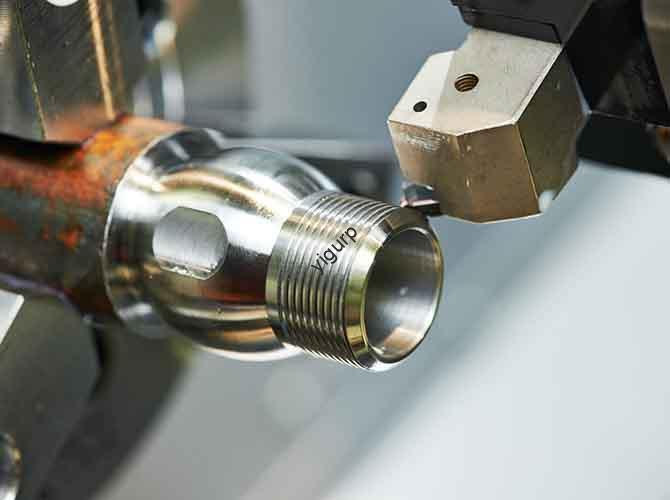
Der CNC machining rounding process—which replaces sharp workpiece edges and corners with precise arc transitions—plays a pivotal role in modern manufacturing. Weit über die kosmetische Verbesserung hinaus, es beseitigt Stresskonzentration, erhöht die Montagesicherheit, optimiert den Flüssigkeitsfluss, und passt sich den Trends des Industriedesigns an. In diesem Artikel werden die wichtigsten Links des Prozesses aufgeschlüsselt, löst häufige Probleme, and shares quality control tips to help you achieve consistent, high-precision rounding results.
1. Why the CNC Machining Rounding Process Matters: Rationale & Importance
Rounding is not an optional step but a critical engineering measure. Below is a 总分结构 explaining its key values, supported by specific scenarios:
- Eliminate Stress Concentration: Sharp corners act as “stress traps”—in high-load parts like automotive engine brackets, they can cause fatigue cracking after 10,000+ Zyklen. A R2–R5 mm rounding reduces stress by 40–60%, extending part lifespan significantly.
- Improve Assembly Safety: Unrounded edges (common in raw machined parts) scratch operators’ hands or damage fitting components (z.B., Dichtungen). Rounding ensures smooth contact, cutting assembly-related injuries by 80%.
- Optimize Functional Performance: For hydraulic lines or fluid valves, rounded inner corners (R1–R3 mm) reduce fluid turbulence—lowering pressure loss by 15–25% compared to sharp corners.
- Enhance Aesthetics & Textur: High-gloss rounding (z.B., R0.8 mm on smartphone middle frames) meets modern consumer demands for sleek, premium products, boosting market competitiveness.
2. Core Links of the CNC Machining Rounding Process
Mastering rounding requires strict control over three key stages: Werkzeugauswahl, Programmierung, and parameter setting. Use the linear 叙述 below to follow the workflow:
2.1 Tool Selection Strategy: Match Tools to Rounding Needs
The right tool directly impacts efficiency and rounding accuracy. The table below compares common tool types and their applications:
| Tool Type | Hauptmerkmale | Ideal Scenarios | Usage Tips |
| Ball End Mills | – Hemispherical cutting edge- Suitable for small radii (R0.1–R5 mm) | General-purpose rounding (z.B., electronic part edges) | Ensure tool diameter ≥ 2× target radius (z.B., R2 mm needs ≥φ4 mm tool) |
| Ring Groove Cutters | – U-shaped cutting edge- High material removal rate | Large-allowance roughing (z.B., R5–R15 mm on industrial machine frames) | Reserve 0.1–0.2 mm finishing allowance for subsequent precision machining |
| Taper Cutters | – Angled cutting edge- Good for deep/narrow grooves | Rounding in confined spaces (z.B., deep cavity corners) | Avoid excessive tool overhang (>3× tool diameter) to prevent vibration |
| Custom Forming Cutters | – Pre-machined to match complex rounding trajectories | Specialized needs (z.B., variable-radius rounding R3→R5 mm) | Kostengünstig für die Massenproduktion (10,000+ Teile) |
2.2 Programming Implementation: Ensure Precise Tool Paths
Programming determines whether the rounding arc is smooth and consistent. Choose the right method based on part complexity:
- Manual G-Code Writing: Suitable for simple rounding (z.B., straight-edge R2 mm). Use G01 (linear interpolation) and G02/G03 (circular interpolation) commands. Example for R2 mm rounding:
G90 G54 G00 X10 Y10 Z5; (Rapid move to start position)G01 Z-2 F300; (Feed to cutting depth)G03 X12 Y12 R2 F200; (Circular interpolation for R2 mm rounding)Limitation: Low efficiency for complex shapes (z.B., 3D gekrümmte Flächen).
- CAM Software Automatic Programming: Ideal for complex parts (z.B., automotive engine blocks). Software like UG/NX or Mastercam:
- Imports 3D part models.
- Automatically identifies sharp corners needing rounding.
- Generates optimal tool paths (avoids interference).
Vorteil: Cuts programming time by 60–70% vs. manual writing.
- Macro Programs for Batch Repeating Features: For parts with multiple identical rounding features (z.B., 20 R1.5 mm holes), use macro programs to simplify code. Beispiel: Define a macro variable #1=1.5 (target radius) to apply rounding to all features—reducing code volume by 80%.
2.3 Core Parameter Settings: Avoid Overcut/Undercut
Incorrect parameters cause rounding defects (z.B., uneven arcs). Follow the recommended ranges below, adjusted by material:
| Parameter | Aluminiumlegierungen (Soft Material) | Steel Parts (Hard Material) | Rationale |
| Vorschubgeschwindigkeit (F) | ≤800 mm/min | ≤300 mm/min | Higher feed for soft materials boosts efficiency; lower feed for hard materials reduces tool wear |
| Spindelgeschwindigkeit (S) | – Schnellarbeitsstahl (HSS): 800–1200 rpm- Hartmetall: 3000–5000 rpm | – HSS: 600–1000 rpm- Hartmetall: 1500–3000 rpm | Carbide tools handle higher speeds; hard materials need slower speeds to prevent overheating |
| Single Cutting Depth (ap) | ≤20% of tool diameter (z.B., φ10 mm tool → ≤2 mm) | ≤15% of tool diameter (z.B., φ10 mm tool → ≤1.5 mm) | Shallow cuts for hard materials ensure cutting stability |
| Retraction Distance | ≥0.5 mm along the normal direction | ≥0.5 mm along the normal direction | Prevents tool marks on the rounded surface during retraction |
3. Common Problems & Solutions in CNC Machining Rounding
Even with careful preparation, issues like overcut or step defects may occur. Use this 因果链 structure to diagnose and fix problems:
| Common Problem | Grundursache | Lösung |
| Overcut/Undercut | – Tool path interference (z.B., groove corners)- Incorrect tool radius compensation | 1. Perform toolpath simulation verification (use CAM software to check for collisions)2. For large radii (R≥5 mm), process in layers (z.B., R2→R3→R5 mm) to gradually reach target size |
| Step Defects at Joints | – Incoherent chamfering on adjacent sides- No path overlap between tool passes | 1. Keep chamfering actions continuous (avoid lifting the knife between adjacent sides)2. Set 5–10% path overlap (z.B., 10 mm tool path → 0.5–1 mm overlap) to eliminate height differences |
| Poor Surface Finish (Vibrosis) | – Tool vibration (z.B., long overhang)- Excessive feed rate | 1. Use high-rigidity tools (z.B., carbide tools with short shanks)2. Reduce feed rate by 20–30%3. Enable smooth acceleration mode in the CNC system |
| Material Adhesion (Stainless Steel/Titanium Alloy) | – High cutting temperature causes material to stick to the tool edge | 1. Use tools with TiAlN/CrAlN coating (reduziert die Reibung)2. Apply coolant (oil-based for steel, water-based for aluminum)3. For superalloys, verwenden liquid nitrogen-assisted cooling to lower temperature |
| Burrs on Rounded Edges | – Incorrect retraction direction (z.B., parallel to the surface) | Adjust retraction to the surface normal direction (avoids scraping the rounded edge during tool withdrawal) |
4. Qualitätskontrolle: Ensure Rounding Precision
Quantitative testing and defect correction are key to consistent quality. Follow these steps:
4.1 Detection Methods
- 3D Coordinate Measuring Machine (CMM): Measures rounding radius, arc smoothness, and dimensional deviation with ±0.001 mm accuracy. Compare results to drawing requirements (z.B., R2±0.05 mm).
- Optical Projector: Für Kleinteile (z.B., elektronische Komponenten), project the rounded edge onto a screen to check for arc irregularities.
- Standard Compliance: Refer to ISO 13715 (CNC machined part dimensional tolerances) to control linear deviations—ensure rounding radius error ≤±0.05 mm for precision parts.
4.2 Defect Correction
- Roundness Exceedance: Check tool wear (replace if edge chipping is found) or shorten tool holder protruding length (reduce vibration).
- Surface Scratches: Verwenden Sie diamantbeschichtete Werkzeuge (for pure aluminum) or adjust coolant flow (ensure full coverage of the cutting zone).
5. Typical Application Examples
Rounding is widely used across industries. Here are three practical cases:
- Automotive Engine Block: The coupling surface requires R2±0.05 mm rounding to ensure gasket fit—prevents oil leaks and improves sealing performance.
- Smartphone Middle Frame: Aviation aluminum (6061) is processed with R0.8 mm high-gloss rounding—balances comfortable feel and signal protection (sharp edges interfere with electromagnetic signals).
- Aerospace Structural Part: Variable-radius rounding (R3→R5 mm) reduces weight by 10–15% while maintaining structural strength—critical for aircraft fuel efficiency.
6. Technology Development Trends
The CNC machining rounding process is evolving with advanced technologies:
- Adaptive Bearbeitung: Sensors monitor cutting force in real time, automatically correcting tool radius compensation (reduces error by 30–40% for material hardness variations).
- High-Pressure Coolant Cutting: Precise coolant injection (30–50 bar) improves heat dissipation—boosts rounding efficiency for difficult-to-machine materials (z.B., Titanlegierung) von 25%.
- Cloud Manufacturing Platforms: Enable remote tool life management and process optimization—engineers can adjust rounding parameters online, reducing downtime by 20%.
Die Perspektive von Yigu Technology
Bei Yigu Technology, we believe mastering the CNC machining rounding process is about balancing precision, Effizienz, und Kosten. Für Automotive-Kunden, we use custom forming cutters for large-radius rounding (R5–R10 mm), Verkürzung der Produktionszeit um 30% while ensuring ISO 13715 Einhaltung. For electronic clients, our CAM software simulation and 5% path overlap eliminate step defects on smartphone frames. We also adopt adaptive machining for stainless steel parts, reducing overcut rates by 40%. Letztlich, rounding isn’t just a process step—it’s a way to enhance part performance and customer satisfaction.
FAQ
- What is the minimum rounding radius achievable with CNC machining?
With high-precision ball end mills (z.B., φ0.2 mm tool), the minimum rounding radius can reach R0.1 mm—suitable for microelectronic parts (z.B., Sensorgehäuse). The key is using a high-rigidity CNC machine (5-Achse) and carbide tools to avoid vibration.
- Can the CNC machining rounding process be used for 3D curved surfaces?
Ja. For 3D curved surfaces (z.B., Karosserieteile für Kraftfahrzeuge), use 5-axis CNC machines and CAM software (z.B., PowerMill) to generate continuous rounding tool paths. Ensure the tool’s contact point with the surface remains consistent—this avoids uneven arcs.
- How to choose between wet and dry cutting for rounding?
- Wet cutting: Ideal for hard materials (Stahl, Titanlegierung) and large radii—coolant reduces tool wear and improves surface finish. Use oil-based coolant for steel, water-based for aluminum.
- Dry cutting: Suitable for soft materials (reines Aluminium, Plastik) and small radii (R≤1 mm)—avoids coolant residue on the rounded surface. Ensure spindle speed is 10–15% higher than wet cutting to compensate for heat buildup.