
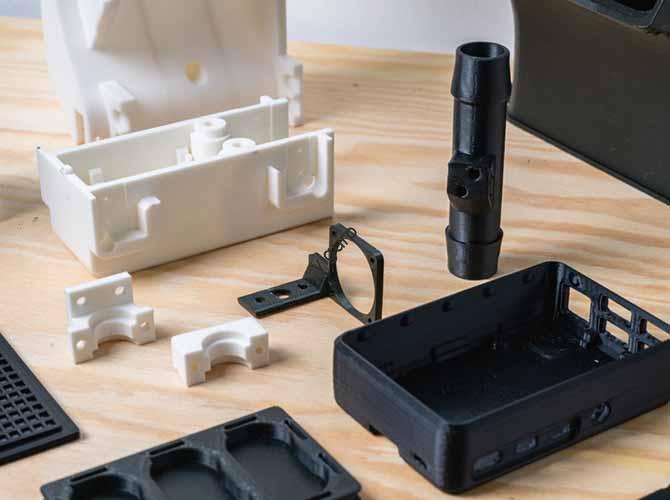
You need a 3D printed part that’s tough enough to survive an impact, won’t warp in a hot car, and can be printed reliably without constant clogs or failures. Pure ABS feels too brittle under heat, and pure Polycarbonate (PC) seems like a frustrating challenge. This is the exact problem that 3D printing ABS+PC was engineered to solve. This hybrid thermoplastic blend isn’t a casual mixture; it’s a strategically engineered alloy designed to combine the best properties of its parent materials while mitigating their weaknesses. This guide provides a deep dive into the material science, processing requirements, and real-world applications of ABS+PC, moving beyond marketing hype to deliver actionable knowledge that helps you decide if it’s right for your project and, if so, how to print it successfully.
What is ABS+PC, and How Does Its Chemistry Work?
ABS+PC (Acrylonitrile Butadiene Styrene + Polycarbonate) is a polymer alloy, meaning its components are blended at the molecular level to create a new material with distinct properties, rather than a simple physical mixture. Think of it as metallurgy for plastics: just as steel is an alloy of iron and carbon with superior properties, ABS+PC combines the toughness and processability of ABS with the heat resistance and impact strength of PC.
The butadiene rubber in ABS provides impact resistance, the styrene offers rigidity and ease of processing, and the polycarbonate backbone contributes high glass transition temperature (Tg) and dimensional stability under thermal load. The resulting synergy creates a material that is more than the sum of its parts, effectively bridging the gap between standard and high-performance engineering plastics for additive manufacturing.
How Does ABS+PC Compare to Pure ABS, Pure PC, and Other Alternatives?
Choosing a material is about balancing property trade-offs. This comparison highlights where ABS+PC truly shines.
| Property | ABS+PC Alloy | Pure ABS | Pure PC | PETG (Common Alternative) |
|---|---|---|---|---|
| Heat Resistance (HDT @ 0.45MPa) | Excellent (~110-120°C) | Moderate (~85-100°C) | Superior (~130-140°C) | Poor (~70-80°C) |
| Impact Strength (Notched Izod) | Very High | Good | Highest, but can be brittle | Moderate |
| Tensile Strength | High (50-60 MPa) | Moderate (40 MPa) | Very High (60-70 MPa) | Moderate (50 MPa) |
| Printability & Warping | Moderate (Requires heated bed & enclosure) | Moderate (Pronounced warping) | Difficult (High temp, high moisture sensitivity) | Easy (Low warping) |
| Layer Adhesion | Strong (with correct temps) | Good | Can be challenging | Excellent |
| Material Cost | Moderate-High ($35-$50/kg) | Low ($20-$30/kg) | High ($40-$60/kg) | Low ($25-$35/kg) |
| Key Advantage | Best balance of heat, impact, and printability. | Low cost, easy to post-process. | Ultimate strength & heat resistance. | Ease of use, chemical resistance. |
The Takeaway: ABS+PC is your material when you need parts that will be exposed to elevated temperatures (e.g., inside an electronic enclosure or a car’s interior) and require good toughness, but you need a more forgiving printing experience than pure PC demands.
What Are the Essential Requirements for Printing ABS+PC Successfully?
ABS+PC is not a “plug-and-play” material like PLA. It demands respect and specific hardware. Failure to meet these prerequisites is the leading cause of print failures.
Is Your Hardware Adequate?
- Enclosed Heated Build Chamber (Non-Negotiable): An enclosure is critical to maintain a stable, draft-free ambient temperature of 45-55°C. This drastically reduces thermal stress and warping, which ABS+PC is still prone to.
- Consistent Heated Bed: A bed that can reliably maintain 90-110°C is required. A PEI spring steel sheet often provides the best adhesion.
- All-Metal Hotend: You must be able to print at 250-270°C consistently. A PTFE-lined hotend will degrade and off-gas at these temperatures, creating clogs and health hazards.
- Dry Filament Storage: ABS+PC is hygroscopic, absorbing moisture from the air which causes severe bubbling, poor layer adhesion, and reduced strength. Store in a heated dry box or with abundant desiccant, and dry new spools for 4-6 hours at 70-80°C before first use.
What is the Optimal Slicer Configuration and Process?
Dialing in your profile is where science meets practice.
- Temperatures:
- Nozzle: 250-270°C. Start at 260°C. A temperature tower is essential to find the sweet spot for your specific brand between strength and ooze.
- Bed: 100-110°C for initial layer, can potentially drop to 90-100°C for subsequent layers.
- Speeds and Cooling:
- Print Speed: 30-50 mm/s. This is not a fast material. Slow down for better layer fusion.
- Part Cooling: Minimal to None. Unlike PLA, you want the layers to remain hot to fuse together. Use 0-15% fan speed maximum, and only for small bridges or overhangs.
- Adhesion and Warping Fight:
- Use a Brim: A 5-10mm brim is cheap insurance against corner lifting.
- Avoid Drafts: The enclosure door must stay closed.
- Bed Adhesive: If PEI alone fails, a thin layer of ABS slurry (ABS scraps dissolved in acetone) or a dedicated adhesive like Dimafix can be used.
What Are the Most Impactful Real-World Applications of ABS+PC?
This material excels in functional, end-use applications where environmental stress is a factor.
- Automotive Interior Components: HVAC ducting, clips, brackets, and covers. These parts must withstand the high ambient temperatures inside a vehicle (which can exceed 80°C) while remaining tough and dimensionally stable. A manufacturer we worked with replaced injection-molded ABS clips with 3D printed ABS+PC for low-volume specialty vehicles, achieving the required heat performance without tooling costs.
- Electrical Enclosures and Housings: For power tools, routers, or industrial controls. ABS+PC provides the necessary UL94 HB flame retardancy (check specific brand certifications), good impact resistance for field use, and can handle heat generated by internal electronics better than ABS or PETG.
- Functional Prototypes for High-Temp Environments: Prototyping parts that will eventually be made from PC or other high-temp plastics. Using ABS+PC allows engineers to test form, fit, and function under realistic thermal conditions much earlier in the development cycle.
- Drone Frames and RC Car Parts: Where the combination of lightweight toughness and resistance to motor/electronic heat is critical. It outperforms ABS in crashes and resists softening on hot days.
How Do You Post-Process and Finish ABS+PC Parts?
Post-processing is straightforward and leverages techniques familiar to ABS users.
- Sanding: Sands well, moving from 180 to 400+ grit. It produces less fuzz than pure ABS.
- Chemical Smoothing (Use with Extreme Caution): Acetone vapor smoothing works but is less predictable than with pure ABS. The PC component reacts differently. Always test on a scrap piece first. Expect a longer exposure time and a potentially different final texture.
- Painting: Primers designed for plastics adhere well. Ensure the part is clean and grease-free.
- Machining: It can be drilled and tapped with standard tools, exhibiting less creep than pure ABS.
The Professional Prototyping Perspective: ABS+PC as a Strategic Tool
In our rapid prototyping lab, ABS+PC is categorized as a “Bridge-to-Production” material. It’s not for every prototype, but it’s invaluable for specific, high-value validation tests.
- A Case Study in Risk Reduction: A client developing an outdoor IoT sensor housing was deciding between injection-molding in ABS or PC. The cost difference for the PC tool was significant. We printed functional housings in ABS+PC and subjected them to an accelerated life test: thermal cycling from -10°C to 70°C and UV exposure. The ABS+PC prototypes showed minimal deformation and no cracking, convincingly demonstrating that the added cost of PC was unnecessary for the application. This data-driven recommendation saved the client over $25,000 in tooling costs.
- The Moisture Management Imperative: We treat every spool of ABS+PC as if it’s wet. Our standard procedure includes mandatory drying upon receipt and continuous storage in dry boxes at the printer. We’ve measured tensile strength reductions of up to 30% in “room dry” ABS+PC versus properly dried material. This isn’t a minor detail; it’s a critical process control point.
- The Verdict: ABS+PC is for the user who has graduated from PLA and PETG, has a properly equipped printer, and now needs functional parts that live in demanding environments. It rewards careful process control with exceptional performance.
Conclusion
3D printing with ABS+PC unlocks a valuable middle ground in the world of engineering thermoplastics, offering a compelling balance of heat resistance, durability, and relative printability. While it demands a capable, enclosed printer and meticulous attention to drying and temperatures, the payoff is the ability to produce robust, functional parts that can perform in environments where most common 3D printing materials would fail. If your projects require parts that must withstand heat, impact, and real-world use, mastering ABS+PC is a worthwhile investment. Start by ensuring your hardware is up to the task, rigorously dry your filament, and prepare for a slower, more deliberate printing process. The resulting parts will justify the effort, bridging the gap between prototype and end-use component.
FAQ: Your Top ABS+PC 3D Printing Questions Answered
Q: My printer has an all-metal hotend and a heated bed, but no enclosure. Can I print ABS+PC?
A: It is not recommended and will likely lead to warping and layer separation. The enclosure is critical to control cooling stress. You can build a temporary enclosure using cardboard, foam board, or an acrylic kit. Without it, even with a brim, large parts have a very high risk of failure.
Q: How does ABS+PC filament storage compare to Nylon?
A: While both are hygroscopic, ABS+PC is generally less sensitive than Nylon but more sensitive than ABS. You cannot leave it on the printer exposed to ambient air for days. For daily use, a sealed bag with desiccant is okay. For long-term storage or in humid climates, a heated dry box (40-50°C) is ideal.
Q: Can I print ABS+PC on a glass bed with glue stick?
A: Yes, this is a common and effective method. A clean glass bed at 100-110°C with a layer of glue stick (PVA) provides excellent adhesion and acts as a convenient release layer once the bed cools. The glue helps prevent the part from sticking too well and cracking the glass.
Q: Is ABS+PC food safe or suitable for medical applications?
A: No 3D printed part is inherently food-safe due to microscopic layer gaps that can harbor bacteria. Furthermore, most ABS+PC filaments contain dyes and additives not rated for food contact. It is not certified for medical implants or devices. Always check the manufacturer’s datasheet for specific biocompatibility or regulatory certifications if needed for your application.
Q: What causes layer delamination in ABS+PC, and how do I fix it?
A: Delamination (splitting between layers) is primarily a temperature issue.
- Nozzle too low: Increase temperature by 5-10°C to improve interlayer fusion.
- Excessive cooling: Turn off your part cooling fan completely.
- Printing too fast: Slow down to allow proper heat transfer between layers.
- Wet filament: This is a major, often overlooked cause. Dry your filament thoroughly.
Discuss Your Projects with Yigu Rapid Prototyping
Are you evaluating materials for a demanding application that must withstand heat, impact, or harsh environments? Our material science and engineering team has deep experience processing advanced thermoplastics like ABS+PC, PC, Nylon, and beyond. We can help you select the optimal material, develop a robust printing process, and validate your parts against real-world performance criteria.
Let us handle the complexities of high-performance 3D printing. Contact Yigu Rapid Prototyping for a consultation. We’ll help you determine if ABS+PC is the right solution and provide a reliable, quality-assured path from your design to a functional, durable prototype or end-use part.